
Crisis Response and Intervention Training (CRIT) Curriculum and Trainers' Toolkit
A CIT Memphis Model Curriculum
For officers, responding to individuals with behavioral health conditions, including mental health conditions, substance use disorders, and intellectual and developmental disabilities (IDD) in a safe, effective manner can often present a challenge. Recognizing these unique challenges, the Crisis Response and Intervention Training (CRIT) Initiative equips police departments with a comprehensive suite of resources, most notably, a 40-hour standardized curriculum.
Learn more about the CRIT Initiative and these free training resources in the expandable sections below!
About the Curriculum and Toolkit
The Crisis Response and Intervention Training (CRIT) curriculum is a 40-hour training designed to prepare police officers in their crisis response to people experiencing crises related to behavioral health conditions and intellectual and developmental disabilities (IDD). CRIT is based on the Crisis Intervention Team (CIT) training Memphis Model. The CRIT curriculum has been certified by the International Association of Directors of Law Enforcement Standards and Training (IADLEST) as part of the National Certification Program™. CRIT is designed to complement the development and delivery of crisis response programs planned by law enforcement agencies, behavioral health service providers, and disability service providers in the community.
CRIT is a no-cost, off-the-shelf curriculum that was designed to be incorporated into any agency or jurisdiction's existing training infrastructure or crisis response programming, including CIT. It can be downloaded and customized to meet the needs of the agency and specific community. CRIT was developed by a group of organizations and subject matter experts dedicated to meeting the needs of the policing profession through evidence-based training products. This effort was funded by the Bureau of Justice Assistance (BJA) of the Office of Justice Programs (OJP) at the U.S. Department of Justice (DOJ).
The full 40-hour training program includes 18 modules of varying lengths and learning styles. These modules focus on topical areas such as behavioral health and IDD, community engagement and resources, systems and legal considerations, and scenario-based skills.
In addition to the full CRIT curriculum, the free-to-access Trainers' Toolkit provides comprehensive resources to support the planning and implementation of the CRIT curriculum. It includes an instructor guide, training materials including PowerPoint slides for the 18 core modules, expanded content on select module topics, and instructional videos that guide training staff in coordinating CRIT delivery.
Explore and download the CRIT curriculum and the Trainers' Toolkit in the sections below.
How is CRIT related to CIT?
Crisis Intervention Team (CIT) programs are community-based initiatives that bring together law enforcement, mental health and addiction professionals, individuals who live with mental health conditions and/or substance use disorders, their families, and other partners to improve community responses to mental health crises. One component of CIT is training for frontline law enforcement officers who perform patrol functions.
In contrast, Crisis Response and Intervention Training (CRIT) is a curriculum and toolkit to help police agencies plan and deliver training for many different types of crisis response programs. CRIT was developed based on the CIT Memphis Model and can be used as the training component of CIT programs or for in-service training for all frontline sworn agency staff. While CRIT is complementary to CIT, there are a few key differences.
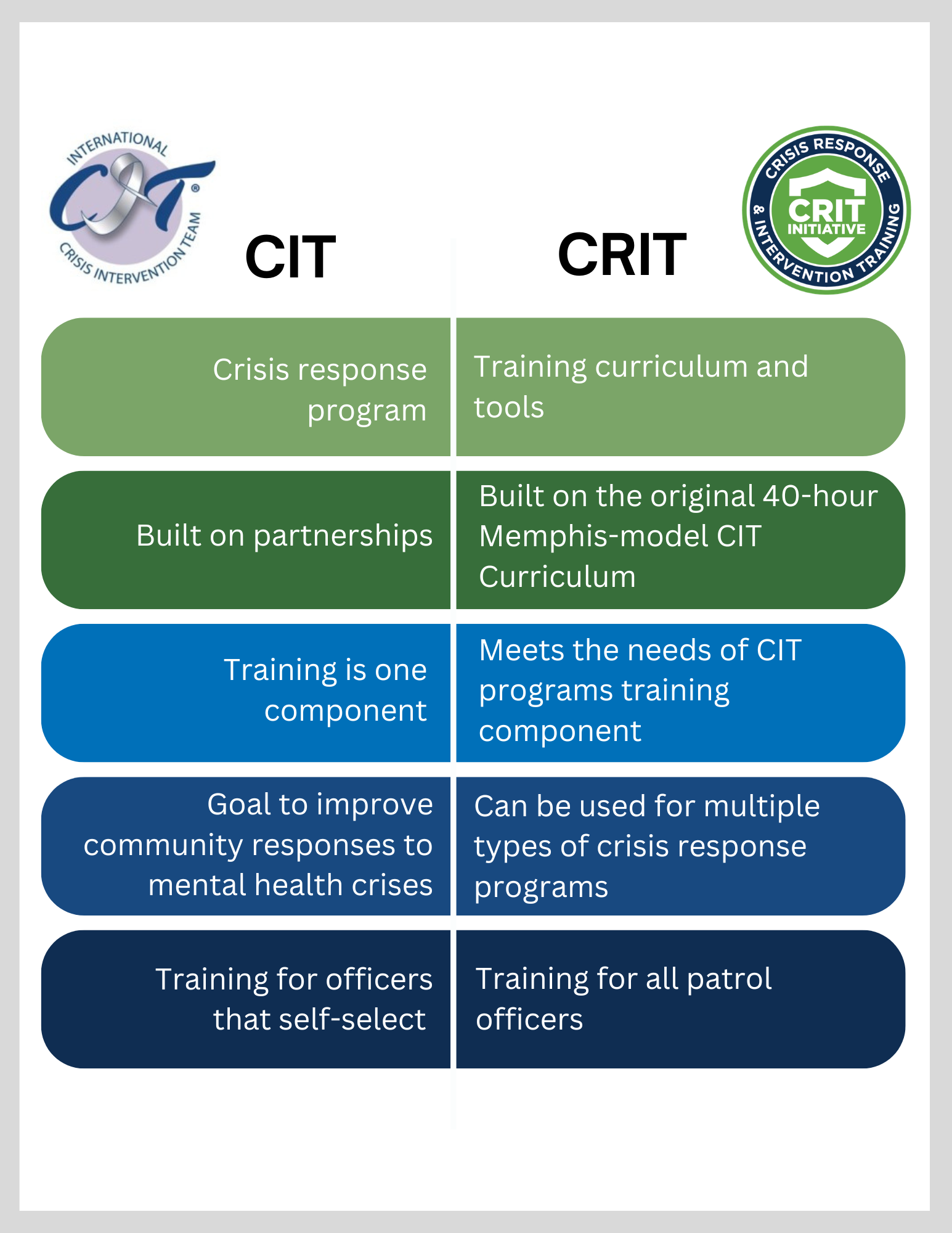
CIT is a crisis response program that has a training component. CRIT is a training curriculum and toolkit that can be used for multiple types of crisis responses, including CIT programs.
To learn more about how CRIT complements CIT programs, you can watch this informational webinar that explores the interaction between CIT and CRIT. Panelists provide valuable tips and resources to enhance your crisis response training, CIT program development, and other related initiatives.
Sample CRIT Scheduling Matrix
A sample scheduling matrix for the full 40-hour Crisis Response and Intervention Training (CRIT) training is displayed below.
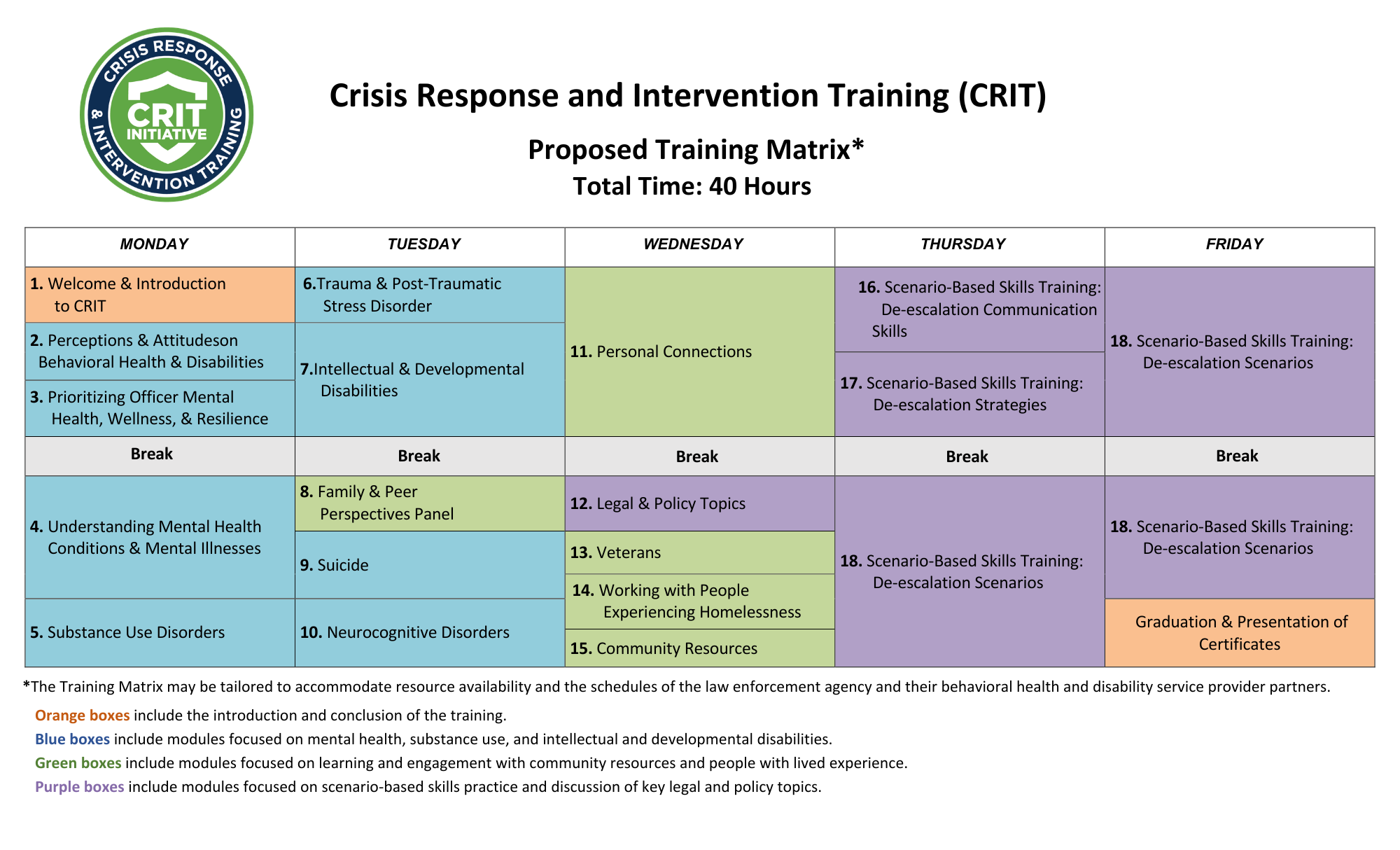
The curriculum is designed for any agency to customize and deliver themselves, integrating easily into existing training without requiring certification or prerequisites. Agencies can flexibly select, organize, and combine individual modules to meet their specific agency and community needs, allowing the curriculum to be delivered in full or adapted in parts to complement existing initiatives, such as CIT programs. Agencies can use individual components of the CRIT curriculum to enhance their existing training programs or implement the curriculum in full as their crisis response training.
History of CRIT
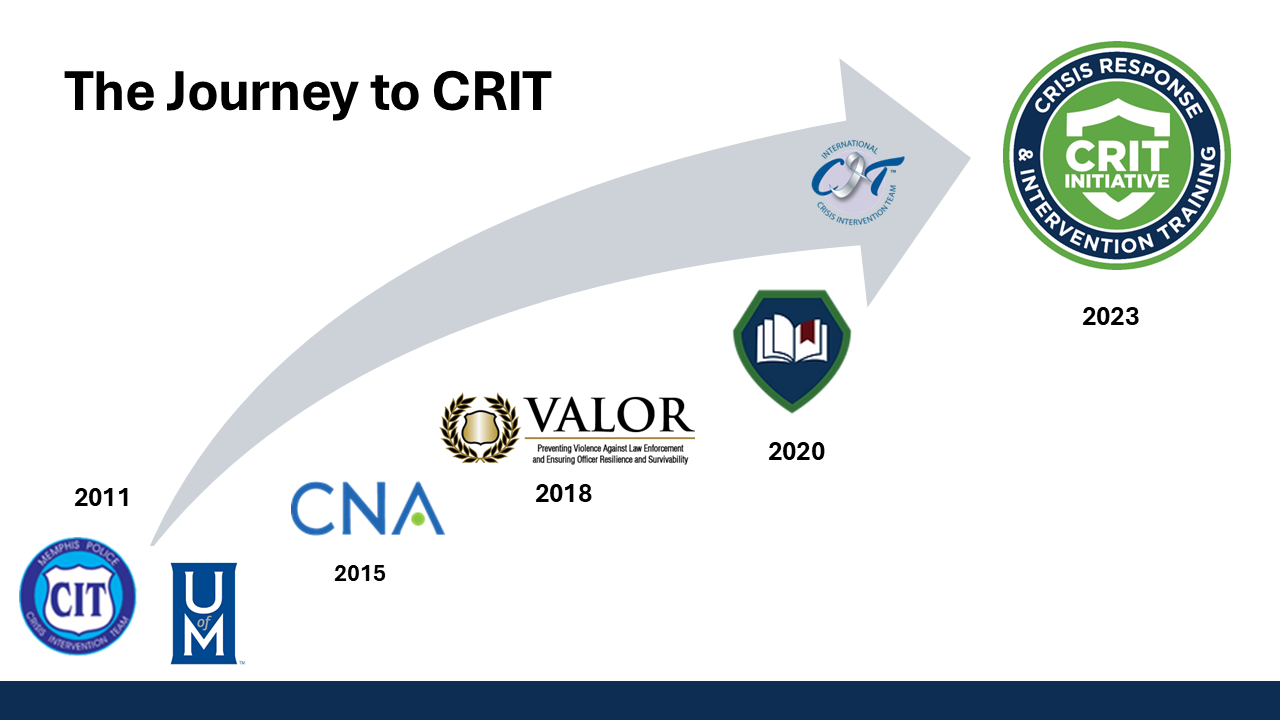
The effort to develop and launch a standardized, national training curriculum for CIT started more than a decade ago, but despite multiple initiatives, it did not come to fruition until the launch of the Crisis Response and Intervention Training (CRIT) curriculum in December 2022. This work began in Memphis with the Memphis Police Department, the University of Memphis, and CIT International. In 2015, another organization funded by the Bureau of Justice Assistance (BJA) revised that initial curriculum. This revision was the foundation of the BJA-funded 2018 initiative to revise and pilot the curriculum under the Preventing Violence Against Law Enforcement and Ensuring Officer Resilience and Survivability (VALOR) Initiative, led by Policy Research Associations (PRA), partnering with CIT International, the IACP, and the National Alliance on Mental Illness (NAMI). This Law Enforcement and Community: Crisis Intervention Training Model program piloted the curriculum through direct training to frontline officers in four jurisdictions around the United States and delivered train-the-trainer events to build the capacity of pilot agencies to sustain the program.
In 2020, Congress authorized a university-led initiative to update the VALOR CIT curriculum to include police responses to individuals with intellectual or developmental disabilities. Led by the University of Cincinnati, in partnership with the IACP, PRA, and The Arc's National Center on Criminal Justice and Disability (NCCJD), this initiative re-developed and piloted the curriculum and new tools in four jurisdictions around the United States before launching the fully downloadable CRIT curriculum and toolkit in December 2022.
CIT International was involved in every stage of the development of what is now the CRIT curriculum.
In 2023, the IACP was funded by BJA to support the nationwide rollout of the CRIT curriculum and toolkit and provide assistance to agencies implementing the training.
For more information on these efforts, check out:
Instructor Guide for Coordinating CRIT Delivery
Law enforcement agencies should designate a local coordinator to lead the planning and implementation of this training. The coordinator will serve as the central point of contact for all planning activities, including instructor recruitment, site visits, guest speaker coordination, scenario planning, and other training logistics.
Instructor Guide - Download Here!
The Instructor Guide provides resources for local coordinators in the planning and delivery of Crisis Response Intervention Training (CRIT). This Guide includes the following sections.
- The Introduction provides information on the purpose of CRIT and course development. It also lists the modules and their learning objectives.
- Using the Instructor Guide provides an overview of the content of the Instructor Guide and guidance on how to prepare for training delivery, including a list of all videos used in the curriculum.
- Getting Ready provides coordinators with detailed guidelines and tools for planning and delivering CRIT. Specifically, it outlines key roles and tasks to complete before the training and includes a Course Preparation Phase Checklist and a Training Set Up and Wrap-Up Checklist.
- Trainer Materials and Resources: In this section, instructors will find copies of the materials necessary to deliver the training, including handouts, activity instructions, and additional resources.
- Participant Materials: In this section, instructors will find standard items used as participant materials, including the CRIT training matrix, agenda, module learning objectives, evaluation materials, and a sample certificate of completion.
- Modules: This section includes the Trainer’s Guides for each of the 18 training modules.
- References and Resources: This section includes the reference list, which contains the sources cited throughout the Instructor Guide, and additional resources listed by module.
CRIT Modules
All 18 modules are listed below. When you click on the module name, you will be taken to a separate page with all materials needed to support the module’s delivery.
Module 1. Welcome and Introduction to CRIT
This module sets the stage for the 40-hour Crisis Response and Intervention Training (CRIT). It introduces the lead instructors and the classroom participants to one another, sets expectations for the week, and presents the basic concept of police-mental health collaboration (PMHC) in crisis response. This module also discusses issues related to the high prevalence of people living with mental health (MH) conditions and those with intellectual and developmental disabilities (IDD) in the criminal justice system.
This module includes:
- Trainer's Guide: Welcome and Introduction to CRIT
- PowerPoint: Welcome and Introduction to CRIT
- CRIT Pre-Training Survey
- CRIT Post-Training Survey
- PMHC Toolkit - Essential Elements Handout
Module 2. Perceptions and Attitudes on Behavioral Health and Disabilities
This module provides the opportunity for participants to consider common perceptions and attitudes related to people with behavioral health conditions (including mental health conditions and substance use disorders) and disabilities and consider how those perceptions and attitudes may impact their interactions with these individuals. It presents information on the development of perceptions and attitudes and how they might be changed. It also introduces the topic of disability and highlights core values for officers to consider in their responses to people who experience a crisis in the community. The purpose of this module is to encourage participants to think about the diverse communities they respond to and interact with and emphasize the need for an open, understanding mind to best support these communities through crisis response.
This module includes:
- Trainer's Guide: Perceptions and Attitudes on Behavioral Health and Disabilities
- PowerPoint: Perceptions and Attitudes on Behavioral Health and Disabilities
Module 3. Prioritizing Officer Mental Health, Wellness, and Resilience
This module discusses topics related to officer mental health and wellness and provides training participants with strategies to support mental wellbeing throughout their career.
This module includes:
- Trainer's Guide: Prioritizing Officer Mental Health, Wellness, and Resilience
- PowerPoint: Prioritizing Officer Mental Health, Wellness, and Resilience
Module 4. Understanding Mental Health Conditions and Mental Illnesses
This module introduces participants to information on mental health conditions and mental illness and increases participants' understanding of mood disorders, psychotic disorders, and anxiety disorders, as well as their signs and symptoms. Mental health disorders specific to children and youth and their associated symptoms and behaviors are also presented. The role of medication in the treatment of people living with mental illnesses is discussed.
This module includes:
- Trainer's Guide: Understanding Mental Health Conditions and Mental Illnesses
- PowerPoint: Understanding Mental Health Conditions and Mental Illnesses
- Hearing Voices Drawing Activity
- Case Scenarios
Module 5. Substance Use Disorders
This module will introduce participants to substance use disorders and their signs and symptoms and discuss effective approaches for intervening with those under the influence of substances.
This module includes:
Module 6. Trauma and Post-Traumatic Stress Disorder
This module provides a greater understanding of trauma, the adverse effects that traumatic stress can have on a person, and how traumatic stress can manifest differently in different people. Specific emphasis will be given to understanding Post-Traumatic Stress Disorder (PTSD), its signs and symptoms, as well as intervention strategies for responding when someone with traumatic stress or PTSD may be experiencing a crisis.
This module includes:
- Trainer's Guide: Trauma and Post-Traumatic Stress Disorder
- PowerPoint: Trauma and Post-Traumatic Stress Disorder
Module 7. Intellectual and Developmental Disabilities
This module introduces participants to intellectual and developmental disabilities (IDD), their characteristics, how to recognize them, and tips for responding more effectively as an officer
This module includes:
- Trainer's Guide: Intellectual and Developmental Disabilities
- PowerPoint: Intellectual and Developmental Disabilities
- IDD Brief Role Plays for Discussion
Module 8. Family and Peer Perspectives Panel
The Family and Peer Perspectives Panel is intended to be an opportunity for participants to hear personal stories from people living with behavioral health conditions and intellectual and developmental disabilities (IDD). Stories often include details about barriers to accessing services, positive and negative interactions with law enforcement, and feelings about the stigma and bias related to behavioral health conditions and disabilities. The goal is to have participants learn directly from those with lived experience. Family members or others who support people with behavioral health conditions and disabilities can be a helpful addition to the panel, but they should not replace the perspectives of those with behavioral health conditions and disabilities.
This module includes:
Module 9. Suicide
This module introduces the risk factors and warning signs for suicide. Additionally, intervention strategies to help prevent suicide are discussed.
This module includes:
Module 10. Neurocognitive Disorders
This module introduces participants to neurocognitive disorders and the symptoms and behaviors associated with these disorders.
This module includes:
- Trainer's Guide: Neurocognitive Disorders
- PowerPoint: Neurocognitive Disorders
- IACP Alzheimer's Initiatives
Module 11. Personal Connections (Site Visits)
The Personal Connections module involves site visits. Site visits should be designed to help training participants build positive relationships with people with behavioral health conditions and intellectual and developmental disabilities (IDD). Site visits can support classroom learning by giving officers an opportunity to engage with people with lived experience and learn about service and advocacy organizations in their community.
This module includes:
Module 12. Legal and Policy Topics
This module will review federal and state laws, as well as agency policies and procedures, that guide the work of law enforcement. Laws and policies specific to disability rights is the focus here, with the Americans with Disabilities Act (ADA) serving as the foundation for discussion.
This module includes:
Module 13. Veterans
The material in this module is a guide. Local trainers from the community/jurisdiction are encouraged to make this module their own by developing new content or refining the content provided.
This module includes:
Module 14. Working with People Experiencing Homelessness
The material presented within this trainer’s guide provides a framework for content on people experiencing homelessness. Trainers are encouraged to add content and/or revise this module to tailor the materials to their local jurisdiction and experiences within their community.
This module includes:
- Trainer's Guide: Working with People Experiencing Homelessness
- PowerPoint: Working with People Experiencing Homelessness
Module 15. Community Resources
This module should be tailored to the community/jurisdiction in which the training is occurring. It is meant to inform participants about resources they can use in their community when responding to people experiencing crises. This module should include information about local disability organizations, hospitals, mental health clinics, local advocacy groups, and other relevant resources such as community mental health centers and substance use providers. Bring in guest speakers from the local emergency room and other emergency mental health and substance use services to describe their facilities and organizations or have representatives from the mental health and IDD service systems that are familiar enough with those services to present an overview.
This module includes:
Module 16. Scenario-Based Skills Training - De-escalation Communication Skills
This module introduces concepts and skills relevant to effective communication and de-escalation. It introduces scenario-based training.
This module includes:
- Trainer's Guide: Scenario-Based Skills Training - De-escalation Communication Skills
- PowerPoint: Scenario-Based Skills Training - De-escalation Communication Skills
- Scenario Practice: Restatement, Reflection, and Summary
- Empathy Scripted Role Play
Module 17. Scenario-Based Skills Training – De-escalation Strategies
This module contains de-escalation strategies for officers.
This module includes:
- Trainer's Guide: Scenario-Based Skills Training – De-escalation Strategies
- PowerPoint: Scenario-Based Skills Training – De-escalation Strategies
Module 18. Scenario-Based Skills Training – De-escalation Scenarios
This module provides the opportunity for participants to practice their verbal de-escalation skills and receive constructive feedback. Additionally, this module includes the CRIT Post-Training Survey to collect feedback from participants at the end of the training.
This module includes:
- Trainer's Guide: Scenario-Based Skills Training – De-escalation Scenarios
- PowerPoint: Scenario-Based Skills Training – De-escalation Scenarios
- De-Escalation Scenarios: Role Player Instructions
- De-Escalation Scenarios: Role Play Feedback
- De-Escalation Scenarios: Role Play Scenarios
- CRIT Post-Training Survey
Trainer Materials
This section provides resources for local trainers to support the delivery of the Crisis Response and Intervention Training (CRIT).
Local Trainer Materials - Download Here!
To prepare local trainers to teach their assigned module(s), it is recommended to provide them with the following resources:
- Instructor Guide (Specifically, local trainers should be provided the sections listed below:)
- Section 1. Introduction
- Section 2. Using the Instructor Guide
- Section 4. Trainer Materials and Resources
- CRIT Sample Training Matrix
- Module PowerPoint Slides
- CRIT Agenda
Additional trainer materials include:
Participant Materials
This section provides materials for the Crisis Response and Intervention Training (CRIT) participants and lists what materials should be included in the Participant Guide.
Participant Guide - Download Here!
The Participant Guide should include the following materials in a folder or binder:
- CRIT Sample Training Matrix
- CRIT Agenda
- Module Learning Objectives
- Module PowerPoint Slides
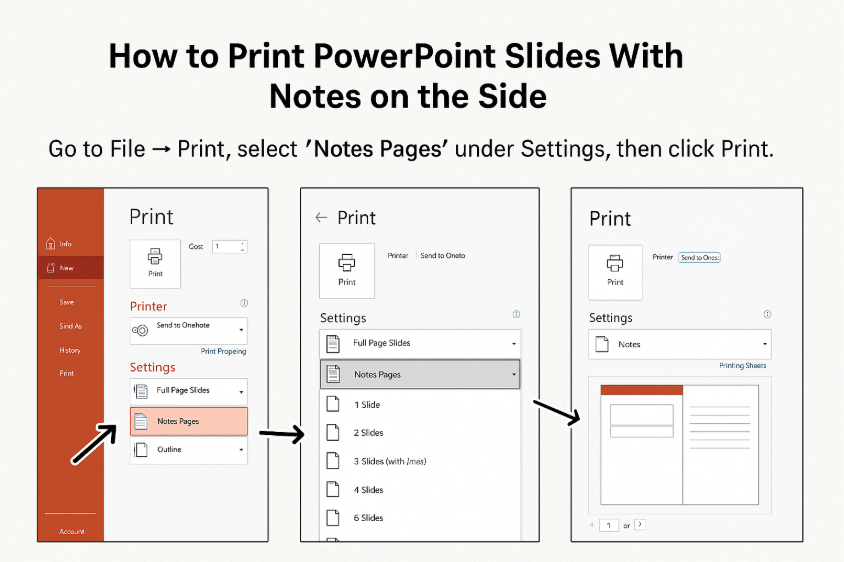
To give participants blank space to write notes next to each slide, go to File → Print, then under Settings select Handouts → 3 Slides (with lines) and print. This layout automatically places lined note space beside each slide.
- Where to Find the Slide Decks: Each module’s PowerPoint file is located directly under the module dropdown above
Additional participant materials include:
CRIT Toolkit Videos
This section provides videos to guide and instruct the implementation of the Crisis Response and Intervention Training (CRIT) curriculum across a variety of jurisdictions.
Crisis Response and Intervention Training (CRIT): Welcome and Introduction to CRIT
This video is a "live delivery" of the first CRIT Module - Welcome and Introduction to CRIT by a U.S. national trainer.
CRIT: An Overview for Law Enforcement Executives
This video provides an overview of the CRIT curriculum, including the goals of the training and a brief history of its development.
CRIT: Selecting Instructors to Ensure Effective Training Delivery
This video provides specific recommendations related to the selection of trainers for each training module.
CRIT: Planning, Delivering, and Debriefing the Family and Peer Perspectives Panel
This video provides guidance on planning for the Family and Peer Perspectives Panel, including how to identify and collaborate with local organizations and advocacy groups, prepare panel speakers, and moderate and debrief the panel.
CRIT: Preparing Role-players for De-escalation Scenarios
This video provides information about how to identify and prepare role-players for de-escalation scenarios.
Supplemental Materials
This section provides additional resources developed as part of the CRIT Toolkit to support agencies in the planning and delivery of the CRIT curriculum.
Expanded CRIT Content
In addition to the content created for the 40-hour CRIT curriculum, supplemental modules were developed to provide extra instruction on key topic areas. Agencies can use these modules to support stand-alone, refresher training courses for their officers or incorporate the additional content into the 40-hour curriculum.
Psychotic Disorders
This module provides additional instruction on psychotic disorders. It builds upon the information presented within CRIT Module 4: Understanding Mental Health Conditions and Mental Illnesses. Participants will be introduced to information on psychosis, the signs and symptoms of psychotic disorders, and considerations for law enforcement when responding to a person who appears to be experiencing psychosis.
Personality Disorders
This module provides additional instruction on personality disorders. Participants will be introduced to information on personality disorders, the signs and symptoms of personality disorders, and considerations for law enforcement when responding to a person living with a personality disorder.
Extended Legal and Policy Topics
This module provides additional instruction on various federal and state laws and agency policies and procedures on disability rights. It builds upon the information presented within CRIT Module 12: Legal and Policy Topics.
Mental Illnesses in Children and Adolescents
This module provides additional instruction on mental illnesses that present in children and adolescents. It builds upon the information presented within CRIT Module 4: Understanding Mental Health Conditions and Mental Illnesses. Participants will be introduced to information relevant to children and adolescents experiencing mental health crises.
CRIT Tips for Trainers
This document integrates adult learning theory to provide trainers with practical tips for training law enforcement and includes specific examples from the CRIT curriculum.
Triggered
This video features leading autism advocate, motivational speaker, and poet Russell Lehmann performing his spoken word piece Triggered. CRIT coordinators and trainers can incorporate this video into the CRIT training program to deepen participants’ awareness of IDD and bring in a lived‑experience perspective at no cost.
Contact Information
For more information, please contact the team via email [email protected] or call 1-800-the-IACP.
This Web site is funded in whole or in part through a grant from the Bureau of Justice Assistance, Office of Justice Programs, U.S. Department of Justice. Neither the U.S. Department of Justice nor any of its components operate, control, are responsible for, or necessarily endorse, this Web site (including, without limitation, its content, technical infrastructure, and policies, and any services or tools provided).


