
Projects
IACP has developed a number of programs on a variety of topics important to law enforcement today. Through these projects and programs, IACP delivers resources including published documents such as guidebooks and fact sheets, online and in-person training, and interactive tools.
Projects
Projects
Professional Services
Executive Search
The IACP offers comprehensive police executive search services.
Our experienced team recognizes the significance of selecting the new executive leadership of a police department and works in partnership with the jurisdiction through all stages of the planning, selection, and transition process.
Key elements of the IACP police executive search process include:
- Comprehensive candidate profiling and job analysis
- Extensive recruitment advertising
- Applicant screening, evaluation, and selection
Hiring agencies may engage the IACP for all or a portion of these executive search elements.
To obtain more information about these services please visit IACP's Executive Search page, email [email protected] or call 703.836.6767.
Testing & Assessment Centers
ASSESSMENT CENTERS
A powerful tool for making promotional decisions, an assessment center uses a series of simulated on-the-job challenges to gauge a candidate’s ability to perform the target job. Individual and group job simulations offer in-depth information and insight on an individual’s strengths, weaknesses, and overall performance potential. The performance of candidates is evaluated by trained assessors, providing information unattainable from written tests, interviews or any other source. Assessment Centers can be utilized for all promotional processes, from first-line supervisor to Chief of Police.
PROMOTIONAL EXAMINATIONS
The IACP recognizes the importance of selecting and advancing the right candidates into leadership positions, understanding that each agency has its own set of challenges and circumstances. For decades the IACP has been a leader in assisting agencies with their promotional needs by offering custom promotional examinations and semi-stock options.
The IACP offers two options for written multiple-choice promotional testing:
- Applying the IACP Promotional Examination System (PES)
- Developing custom-designed examinations.
To obtain more information about these services please visit IACP's Testing and Assessment Center page, email [email protected] or call 703.836.6767.
Management Studies
IACP is available to conduct comprehensive surveys of the management and operations of police agencies. The surveys aim to determine the degree to which a department is properly accountable, is operating cost-effectively, complies with professional police standards, and satisfies the crime control and service requirements of the citizens it serves.
IACP's management studies produce an extensive set of practical, prioritized recommendations to upgrade the effectiveness, productivity and professionalism of municipal police services. The recommendations enable the department to cope successfully in the future with emerging conditions or trends, placing special emphasis on actions to ensure that the department is accountable to elected officials and the public.
To obtain more information about these services please visit IACP's Management Study page, email [email protected] or call 703.836.6767.
Technical Assistance
IACP's Professional Services team can work with your agency to create a customized process to address your specific needs. We have produced the following custom solutions:
- Entry Level and Promotional Interviews
- Assessment Center Training
- Assessor Training
- Chief Assessment Center
- Job Analyisis
- Training Academy Study
- Hiring and Recruitment Study
- Patrol and Investigations Staffing Analysis
- Beat Re-Design and Implementation
To dicuss your specific needs please contact us via email [email protected] or call 703.836.6767.
Promising Practices in Law Enforcement Victim Support
Through this project, case studies of up to 16 law enforcement agencies will document promising practices and lessons learned around effective victim response. A diverse array of agencies will be included – both those with and without agency-based victim services personnel. The case studies will address how victim-centered, trauma-informed practices are implemented and sustained as part of overall operating philosophy and culture.
Case Studies
Law enforcement agencies can contribute to field advancement by helping document successes and challenges for victim-centered, trauma-informed approaches. IACP and RTI will jointly conduct comprehensive case studies through virtual interviews and review of supporting material for agency practices. These case studies will include information about:
- Victims’ rights education and implementation
- Victim-centered, trauma-informed response across all ranks and disciplines
- Challenges to implementing law enforcement-based victim services
- Funding support for victim-centered, trauma-informed approaches
For identified law enforcement agencies with agency-based victim services personnel, the case studies will include additional information about:
- Advocacy parameters
- Documentation practices
- Partnerships
- Agency incorporation of victim services personnel
Participating agencies receive site-specific recommendations developed by subject matter experts aimed at enhancing and sustaining victim-centered, trauma-informed approaches. Three agencies demonstrating effective incorporation of practices across all ranks and disciplines will receive on-site visits for enhanced data collection and targeted technical assistance.
Participating agencies include:
| Chandler Police Department (AZ) | Gainesville Police Department (FL) | Redlands Police Department (CA) |
| Chattanooga Police Department (TN) | Hillsborough County Sheriff's Office (FL) | Saginaw Police Department (MI) |
| DeWitt Police Department (IA) | Miami-Dade Police Department (FL) | University of Utah Department of Public Safety (UT) |
| Doña Ana County Sheriff's Office (NM) | Pennington County Sheriff's Office (SD) | Wheeling Police Department (IL) |
| Fairfax County Police Department (VA) | Raleigh Police Department (NC) | Wisconsin Department of Justice (WI) |
Resources
Identifying and Incorporating Core Principles of Victim-Centered and Trauma-Informed Response
| This resource is designed to provide a streamlined set of emerging practices from the field for first responders, investigators, evidence collection teams, supervisors, and agencies related to victim response efforts. |  |
Agency Self-Assessment Tool for Law Enforcement Victim Support
| This resource is designed to assist law enforcement agencies in the self-guided review of practices related to victim response - specifically the integration of victim-centered, trauma-informed practices into the overall operating philosophy and culture of the agency. |  |
Identifying and Securing Funding for Victim Response Efforts
| This resource is designed to help law enforcement agencies and their partners identify and secure appropriate funding to support multilayered strategies to meet crime victims' individual needs and strengthen victim response. |  |
Related Projects
Enhancing Law Enforcement Response to Victims (ELERV)
The Enhancing Law Enforcement Response to Victims (ELERV) Strategy introduces federal, state, local, campus, and tribal law enforcement leaders to the concepts and benefits of enhancing their response to victims of all crimes. It also illustrates how every person in a law enforcement agency has a role in effective victim response. Due to the customizable nature of the ELERV Strategy, agencies can easily start small and build on their efforts over time.
Law Enforcement-Based Victim Services (LEV)
The IACP is proud to serve as the training and technical assistance provider for the Law Enforcement-Based Victim Services and Technical Assistance Program (LEV Program). Sponsored by the Office for Victims of Crime, this project seeks to establish or enhance victim services programs in criminal justice agencies in order to couple law enforcement-based services with community-based program partnerships to serve the broader needs and rights of all crime victims.
Law Enforcement’s Role in Victim Compensation
Law enforcement officers, often the first and possibly the only professionals to speak to victims following a crime, are a vital component in providing justice, information, and services to crime victims. Law enforcement provides a critical connection between the justice system and victim support services, ensuring that victims know about all available resources. IACP has created resources which include training videos for first responders, investigators, and executive leadership; companion guides to accompany each video and guide discussions; tip cards for law enforcement; and more.
Sexual Assault Kit Initiative (SAKI)
The IACP is proud to serve as a partner to RTI International on the National Sexual Assault Kit Initiative (SAKI). This initiative is funded by the Bureau of Justice Assistance and is aimed at supporting the jurisdictional reform of approaches to sexual assault cases resulting from evidence found in previously unsubmitted sexual assault kits (SAKs). As a project partner, the IACP lends an important voice towards identifying and developing practices, procedures, and training to enhance victim-centered approaches to sexual assault.
Trauma Informed Sexual Assault Investigation Training
The Trauma Informed Sexual Assault Investigation Training provides law enforcement and multi-disciplinary community partners with information on the neurobiology of trauma and investigative strategies to respond to sexual assault crimes in a victim centered, trauma informed manner.
Vicarious Trauma Response Initiative (VTRI)
Individuals responsible for responding to and addressing the needs of crime victims in various professional capacities are impacted by both single incident and chronic trauma exposure. Through interdisciplinary, cross-agency community collaborations, the VTRI initiative seeks to ensure that all such providers and organizations understand the impact of vicarious trauma and benefit from workplaces and communities of practice that promote their health, wellbeing, and their resilience.
Project Partners

For additional information, contact Jesenia Alonso at [email protected].
This project was supported, in whole or in part, by federal award number 2020CKWXK051 awarded to the International Association of Chiefs of Police by the U.S. Department of Justice, Office of Community Oriented Policing Services. The opinions contain herein are those of the author(s) or contributor(s) and do not necessarily represent the official position or policies of the U.S. Department of Justice. References to specific individuals, agencies, companies, products, or services should not be considered an endorsement by the author(s), contributors, or the U.S. Department of Justice. Rather, the references are illustrations to supplement discussion of the issues. The Internet references cited in this publication were valid as of the date of this publication. Given that URLs and websites are in constant flux, neither the author(s) nor the COPS Office can vouch for their current validity.
Protecting Citizens’ Civil Rights (PCCR)
The mutual trust that is engendered by policing practices that are respectful, fair, and unbiased is the critical element in establishing strong police-community partnerships. The mere perception of mistreatment, disrespect, or disengagement of the community on the part of the police can be immensely damaging. Cultivating and sustaining these partnerships can help the police be more effective in the myriad duties and responsibilities carried out by modern law enforcement agencies.

Protecting Civil Rights: A Leadership Guide for State, Local, and Tribal Law Enforcement
Prepared by the International Association of Chiefs of Police; September 2006
The project‘s key deliverable, expected in August of 2005, will be a promising practices guide for law enforcement executives. This guide will integrate information from various sources and provide executives with a basis for assessing and enhancing their own agencies' standing with regard to guaranteeing and promoting civil rights. Information from numerous sources will be integrated into a guide that is intended to serve as a desk reference for police executives.
- Ten years of "pattern or practice" data from agencies that have been under federal monitors for civil rights violations will be assessed from a lessons learned perspective. Knowing where other agencies went astray and how they remedied those situations can provide practical guidance for police executives.
- Relevant literature on issues related to civil rights – such as racial profiling and excessive force – will be summarized.
- Exemplary or model policies that promote civil rights protections and enhancements will be highlighted.
- Promising practices from a variety of law enforcement agencies will be featured.
- The role of police leaders who have developed exemplary vision and agency approaches to civil rights will be emphasized.
The challenges of developing practices that simultaneously assure civil rights protections and public safety are complex and critical. The environment in which police officers must operated is ever changing; expectations have been affected greatly by the events of September 11th 2001 as well as by changes brought about by new technology and related practices. In consideration of this complex and dynamic backdrop, IACP is relying on a diverse group of project partners and subject matter experts as the guide is being developed. The project is undertaken with in partnership with federal agencies – including the COPS office and the Civil Rights Division of the Department of Justice – and representatives from municipal, county, state, and federal law enforcement agencies.
Information related to police agencies that are now being or have been investigated by the Civil Rights Division of the Department of Justice is available on the webpage of their Special Litigation Section.
Contact: 800-843-4227
Public Recording of Police


Photo credit - Mickey Osterreicher
The International Association of Chiefs of Police (IACP), with funding from the Office of Community Oriented Policing Services (COPS), developed a training toolkit addressing the public’s right to record police officers. This training focuses on the public’s First Amendment right to record, limitations of this right, common police responses to recording individuals, strategies for diffusing and deflecting police-civilian confrontations, and how and when video equipment or recordings can be seized.
Available Resources
-
In-Service Training
-
Webinars
For more information, please contact [email protected]
RAPID: Resident and Police Insights and Data
What is RAPID?
Policing needs to generate real-time insights that inform smarter policing strategies, build public trust, and identify urgent trends as they emerge. To support your work, the International Association of Chiefs of Police (IACP) proudly introduces RAPID: Resident and Police Insights and Data The goal is simple but powerful: gather timely, targeted input from both police professionals and community members. Whether you’re a community member, frontline officer, or police executive, your voice will help shape the future of policing.
RAPID: Blue
Help shape the future of policing – in real time.
RAPID: Blue is a text-based micro-survey that invites officers and police staff of all ranks and assignments to weigh in on critical topics in under 30 seconds a week.
Join the survey to be part of telling the international story of policing.
Have a question for the field? Submit a question to be considered for RAPID: Blue!
Learn more about RAPID: Blue
Police professionals from across the globe already contribute to IACP’s understanding of trends, challenges, and successes through vital committee and division work at quarterly meetings and the annual conference. But we live in turbulent times and there is a need for more rapid assessments of dynamic trends and situations. You can be a part of this new venture. RAPID: Blue is a text-based micro-survey that invites officers and police staff of all ranks and assignments to weigh in on critical topics in under 30 seconds a week. Here’s how it works:
- Enter your contact number and some information about the jurisdiction you serve.
- You’ll receive one text message per week.
- Each message includes a single question around a pressing policing topic.
- Reply with a number from 1 to 5. That’s it.
Your confidential responses are gathered with many others to inform understanding of emerging patterns and trends and to guide policing strategy and priorities.
By participating, you contribute to global dialogue and data that shapes training, policy, and advocacy.
RAPID: Community
Help improve policing – in your neighborhood, and around the world.
RAPID: Community, a quick-response survey sent via text message, giving residents a chance to weigh in on safety, trust, and perceptions of police.
Police leaders interested in deploying RAPID: Community should contact [email protected] for more information.
Learn more about RAPID: Community
The IACP conducts rapid surveys several times a year to deliver timely, actionable insights directly from community members to the police leaders in your town. One of these surveys is RAPID: Community, a quick-response survey sent via text message, giving residents a chance to weigh in on safety, trust, and perceptions of police. Here’s how it works:
- Receive 1 to 2 text messages per week.
- Each message contains one multiple choice question about police, safety, or trust.
- Simply reply with a number from 1 to 5. That’s it.
Your confidential responses are gathered with many others and shared with local leaders to identify urgent issues and emerging trends, and to provide insight into global patterns and community needs. By participating, you’re contributing to a real-time, global understanding of policing challenges and priorities.
Want to take part? Ask your local police leader to join the RAPID: Community survey today!
Reducing Risks and Building Trust: Effective Interview and Interrogation of People with Intellectual and Developmental Disabilities
Police officers may experience various challenges when responding to situations involving individuals with intellectual and developmental disabilities (IDD). In partnership with The Arc of the United States’ National Center on Criminal Justice and Disability (The Arc), leading legal experts, and the Office of Community Oriented Policing Services (COPS Office), the IACP is developing innovative resources to enhance strategies for police interviews and interrogations of individuals with IDD who are witnesses to or suspects of crime.
Project Activities
National Consortium on Effective Police Interactions with People with Intellectual and Developmental Disabilities (National IDD Consortium)
The IACP is convening a United States group of police and prosecutorial leaders, nationally recognized experts from criminal justice, academic, and nonprofit organizations, and individuals with lived experience to explore promising practices, current research, case law and the legal landscape, existing training and resources, and specific challenges related to recognition, communication, understanding of Miranda rights, vulnerability to suggestion and influence, and risks of false confession when working with this population. This National Consortium engages a wide span of impacted stakeholders and will translate their input into recommendations for innovative policies and practices around police interview and interrogation of individuals with IDD.
Police Leader Roundtable
The IACP hosted a roundtable at the 2025 IACP Annual Conference in Denver, Colorado, to gather feedback and seek guidance from police leaders representing diverse agencies around the U.S. Participants shared their experience in community policing, training, legal issues, civil rights, trauma-informed policing, criminal investigations, interview and interrogation, and interacting with individuals with IDD. Discussions focused on exploring the state of the field in police interview and interrogation of people with IDD, police training and policy needs, engagement strategies to form effective community partnerships with the disability community, prosecution, and criminal defense agencies in local U.S. jurisdictions, and dissemination strategies for upcoming resources.
State of the Field and Roadmap Report
In 2026, the IACP will develop a report on the current state of practice, promising practices, and recommendations for interviewing or interrogating people with IDD. Content will compile findings from IACP’s National IDD Consortium convenings, police leader roundtable, and insights from multidisciplinary subject matter experts. The report will provide recommended strategies for effectively interviewing and interrogating individuals with IDD, training and policy guidance, and community partner engagement strategies that will enhance police practices at the local level.
Key Takeaways for Police Professionals
The IACP will condense the recommendations and strategies from the State of the Field and Roadmap Report down to key takeaways for police professionals. The IACP will highlight the issue and topline messages and outline the most essential recommended practices for police interviews and interrogations with individuals with IDD. This high-level resource will provide actionable recommendations to help agencies and officers operationalize promising practices from across the U.S.
Promotion to the Field
The IACP, partners, and the National Consortium members will share project resources and recommendations with the field. A robust marketing and dissemination strategy will be deployed through IACP's website, social media, conferences, podcasts, and webinars.
Related Content and Resources
Crisis Response and Intervention Training (CRIT) Curriculum and Toolkit A 40-hour training program designed to prepare police officers in their response to people experiencing crises related to behavioral health conditions and intellectual and developmental disabilities. This curriculum and toolkit are free for agencies to use. | This project assists police agencies with implementing technologies to track missing individuals and with developing or operating programs to prevent wandering, increase safety, and facilitate rescue of those with dementia or developmental disabilities. |
Interactions with Individuals with Intellectual and Developmental Disabilities Policy This policy provides police officers with guidelines for appropriately accommodating, interacting, and communicating with individuals with intellectual and developmental disabilities. | Juvenile Interview and Interrogation The IACP has a series of training, tools, and resources for police on effective juvenile interview and interrogation.
|
Law Enforcement Engagement with People with Behavioral Health Issues and Developmental Disabilities A report from a multi-disciplinary roundtable with subject matter experts in police responses to incidents involving individuals with behavioral health (BH) issues and/or developmental disabilities (DD).
| Law Enforcement Resources on Autism Spectrum Disorder These three resources provide police with guidance on preparing for and responding to incidents involving missing children with autism.
|
This resource provides insights into the developmental disability community, offers suggestions for successful interactions, and outlines options for safe and effective deflection and pre-arrest diversion when people with developmental disabilities encounter police and may be experiencing a crisis or are otherwise in need of services.
| Policing and People with Developmental Disabilities: Emerging Issues in the Field This webinar provides perspectives of police officers and a person with a developmental disability, including emerging issues and practical tips officers can use to respond effectively to people with developmental disabilities.
|
Resources on Developmental Disabilities These two resources discuss the importance of understanding developmental disabilities and highlight the common encounters officers may have with individuals with developmental disabilities in the field. | What Law Enforcement Need to Know About Developmental Disabilities: Tips from an Officer and His Son This webinar offers information on the general signs of a developmental disability; explains tips and strategies for successful interactions with individuals with developmental disabilities; and describes wandering and its impact on families, police, and the community. |
External Resources
This content is designed for reference purposes only. The IACP does not necessarily endorse, certify, recommend, or promote any particular resource(s) within.
Contact Information
For more information, please contact [email protected].
Partners

This webpage was produced by the International Association of Chiefs of Police (IACP) under Grant No. 15JCOPS-24-GK-02520-PPSE awarded by the Office of Community Oriented Policing Services, U.S. Department of Justice. The opinions, findings, conclusions, and recommendations contained herein are those of the author(s) or contributor(s) and do not necessarily represent the official position or policies of the Department of Justice, Office on Community Oriented Policing Services. References to specific individuals, agencies, companies, products, or services should not considered an endorsement by the author(s), contributor(s), or the U.S. Department of Justice. Rather the references are illustrations to supplement discussion of the issues. The internet references cited in this publication were valid as of the date of publication. Given that URLs and websites are in constant flux, neither the author(s) nor the COPS Office can vouch for their current validity.
Safe, Quick Clearance of Traffic Incidents
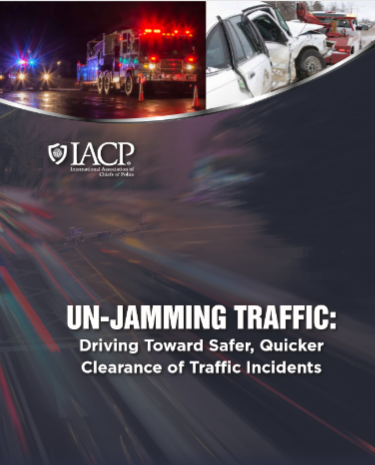 Saving lives, reducing the financial impact of traffic crashes, and contributing to the quality of life in communities ensures safe, efficient, and convenient movement of people and commerce. Traffic Incident Management (TIM) is a cornerstone activity to promote and adopt best practice concepts as a business model and application when responding to crashes and roadway incidents that negatively impact mobility and public safety.
Throughout this webpage, you will find resources developed and collected by the IACP to assist in creating your business case for safe, quick clearance of traffic incidents.
A message from IACP President Steven R. Casstevens, Chief of Police, Buffalo Grove Police Department discussing the importance of safe, quick clearance of traffic incidents and responder safety
A message from Assistant Chief Matt Myers, Peachtree City, GA Police Department promoting the benefits of safe, quick clearance for responder safety and the quality of life in communities
The IACP has launched the Safe, Quick Clearance of Traffic Incidents toolkit. This toolkit provides law enforcement executives with information that demonstrates the importance of adopting practices that facilitate the safe, quick clearance of traffic incidents. Learn more about the toolkit here.
General Safe, Quick Clearance Resources
Numerous agencies have created resources to assist with training, awareness, and education efforts. Below are a few that have provided significant resources pertaining to the importance of adopting and implementing TIM strategies.
- Federal Highway Administration (FHWA) - FHWA provides training on Traffic Incident Management (TIM) to responders including law enforcement, Fire, EMS, and Tow & Recovery. Training information can be found in the below Traffic Incident Management Training section.
- Responder Safety - ResponderSafety.com is a website of the Emergency Responder Safety Institute, an advisory group of public safety leaders and transportation experts who are committed to reducing deaths and injuries among America's emergency responders. This site is a clearinghouse of information related to safe, quick clearance and contains resources to facilitate communication with the public.
- National Highway Traffic Safety Administration (NHTSA) - NHTSA has developed resources in both English and Spanish to encourage the use of "Move Over" laws and to emphasize their importance to responder and public safety. These resources include news releases, a media advisory, social media posts, etc.
- Arizona Department of Transportation (ADOT) - ADOT provides public education resources demonstrating the importance and benefits of safe, quick clearance and illustrating communities' role in ensuring their own safety and the safety of responders.
Traffic Incident Managment (TIM) Training
The National TIM Responder Training program, also known as the Strategic Highway Research Program TIM Training, was developed to improve the coordination of all traffic incident responders from the moment the first emergency call is placed through conclusion of the incident and return of normal traffic flow. This training serves as the foundation of TIM response thanks to its curriculum, which is based on extensive and detailed research conducted with TIM responders across the country and delivered using a train-the-trainer approach.
- In-person TIM training - To learn more about training for your agency, visit https://www.FHWA.dot.gov/innovation/everydaycounts/edc-2/tim.cfm. To schedule this training for law enforcement agencies, reach out to the state point of contact for the National TIM Responder Training Program by visiting ops.fhwa.dot.gov/eto_tim_pse/training/state_poc_list.pdf.
- Online TIM training - The web-based training is available online through the National Highway Institute, the education and training arm of the FHWA. To register for this training, an account will need to be created at https://www.nhi.fhwa.dot.gov/. Search for training course using number FHWA-NHI-133126A.
Examples of Practices from Police Agencies
Utilizing practices that have been created and successfully implemented by other law enforcement agencies can inform your agency's TIM strategy, helping you ensure successful outcomes in the form of safe, quick clearance. Below are some examples of some agencies that have found an effective method to incorporating practices into their agency's routine.
Examples of Policies and Towing & Recovery Incentive Programs (TRIP)
Traffic incidents are a community problem and managing them requires a community approach. Law enforcement agencies' ability to ensure safe, quick clearance of traffic incidents therefore hinges on their ability to build collaborative partnerships with a diverse coalition of stakeholders that includes fire, EMS, state departments of transportation, local transportation officials, tow operators, and the motoring public.
A Joint Operating Policy (JOP) can be developed to determine what TIM policies agencies may have in place to create a common guideline for effective safe, quick clearance of traffic incidents. JOPs act as the standard for all agencies to update their policies and procedures to include TIM strategies.
The Federal Highway Administration (FHWA) describes Open Roads policies as state agencies' partnership goals to remove vehicles, cargo, and debris from roadways in order to restore safe, orderly traffic flow after motor vehicle crashes and other roadway incidents. These goals often include timeframes for incident clearance that start with the arrival of the first responding officer.
Towing & Recovery Incentive Programs (TRIP) facilitate the safe, quick clearance of large commercial vehicle crashes by improving towing procedures through monetary incentives given to qualified towing operators, which builds a mutually beneficial relationship to meet quick clearance goals.
- Georgia's Open Roads Policy
- Georgia's TRIP Program
- Florida's Open Roads Policy
- Florida's Joint Operating Policy
- California Department of Transportation (Caltrans) and California Highway Patrol (CHP) Joint Operating Policy
- Washington State Department of Transportation, The Washington State Patrol, and The Washington Fire Chiefs' Joint Operating Policy
Examples of After-Action Reports
After-action reports are a crucial component to document a traffic incident. A detailed accounting of the incident and response - particularly when a responder is killed or injured on the scene of an incident - provide the opportunity to learn from an event and apply lessons learned in training as well as in future events.
- Maine, Falmouth/Portland line of Interstate 295 - After-Action report on incident involving tank trunk on Maine Turnpike for October 2, 2018 - At Mile 9 southbound off ramp
- Seattle, Washington - After-Action report on Aurora Avenue Bus Collision for September 24, 2015 on the Aurora Bridge
- George, Washington (Grant County) - After-Action report on I90 Charter Bus Crash incident for November 22, 2018
- Highway 31-South Carolina (Horry County) - After-Action report on a Highway 31 fire in South Carolina
- Mosier, Oregon (Wasco County) - After-Action report on the derailment of a Union Pacific Railroad (UPRR) unit train in Mosier, Wasco County, Oregon on June 3, 2016
- Wisconsin (Winnebago County) - After-Action report on an I-41 multi-vehicle crash in Winnebago County, Wisconsin on February 24, 2019
For other inquiries regarding IACP's traffic safety initiatives, please contact the IACP's Traffic Safety Initiatives team at [email protected].
Sex Offender Management
Since November 2005, in partnership with the U.S. Department of Justice, Bureau of Justice Assistance (BJA), the IACP has worked to identify policy and operational challenges facing law enforcement regarding sex offenders and has developed resources to assist law enforcement executives and their agencies with preventing future victimization, educating the community, holding offenders accountable, and increasing community safety.
In 2007 the IACP, in partnership with the Center for Sex Offender Management (CSOM), was selected to administer the Sex Offender Management Training and Technical Assistance program to BJA’s FY 2007 Comprehensive Approaches to Sex Offender Management (CASOM) grantees. The CASOM Discretionary Grant Program provides funding to help jurisdictions effectively manage sex offenders in the community by implementing new or enhancing existing programs.
Through the Sex Offender Management Training and Technical Assistance program, the IACP and CSOM provide training and technical assistance to FY 2007 BJA CASOM grantees (comprised of law enforcement and community supervision agencies.)
The IACP is developing multiple products and resources to enhance the law enforcement response to sex offenders in the community. Current resources available include:
Two free one-day training workshops for law enforcement executives, community corrections administrators, and law enforcement and probation and parole officers.
Contact
To request copies of the above sex offender management related products or for more information on IACP sex offender management efforts, please contact: [email protected]
Sexual Assault Kit Initiative
SAKI Featured Content
SAKI Virtual Academy

Interactive e-learning curricula to help reform sexual assault response.
The Sexual Assault Kit Initiative (SAKI) Virtual Academy is an online learning platform that offers five e-learning curricula. The curricula are broken out into 24 separate e-learning modules to allow learners to complete courses at their own pace. Through each course learners are asked to complete knowledge checks and case study challenges to assess their comprehension of the course content.
SAKI Toolkit

Explore, save, and share the resources you need.
The Sexual Assault Kit Initiative (SAKI) Toolkit offers hands-on resources tailored for the community of practitioners working to respond to cold case sexual assault. Users of the toolkit can explore key categories of sexual assault response, browse topics centered around skill development, and save tools to a customizable Briefcase dashboard.
Explore resources, save them for later, or share tools with others. The SAKI Toolkit is an ideal place to create curriculum for your team or stay up to date with the latest practices in sexual assault response.
Visit sakitta.org for more information.
_0.png)
SAKI in the News
Fayetteville and Portland: Reforming the Response to Sexual Assault
With funding from the Sexual Assault Kit Initiative, the Fayetteville Police Department and Portland Police Bureau are changing how they respond to sexual assault victims, partnering across the community, and bringing offenders to justice. Watch the video to learn more about Fayetteville and Portland’s efforts to end the backlog of unsubmitted rape kits, and find out about other SAKI grantees at www.sakitta.org.
Prosecuting Cold Case SA: The Dallas County Experience
With funding from the National Sexual Assault Kit Initiative (SAKI), Dallas County is prosecuting sexual assault cold cases as a result of testing previously unsubmitted sexual assault kits. By moving these cases forward, the Dallas County District Attorney's Office is helping to bring long-awaited justice to victims. Watch the video to learn more about Dallas County's efforts, and explore our other SAKI grantees at www.sakitta.org.
How do I get Training and Technical Assistance?
The U.S. Department of Justice, Bureau of Justice Assistance (BJA), has released competitive grant announcements under the National Sexual Assault Kit Initiative. State, local, and tribal law enforcement agencies; prosecutors’ offices; and governmental non-law enforcement agencies acting as fiscal agents for these types of agencies were eligible to apply for funding. The BJA website provides information on upcoming funding opportunities. Check https://www.bja.gov/funding.aspx for details.
SAKI grantees have access to customized TTA resources as part of their BJA funding that are not available to the general public. However, the SAKI TTA team also creates materials (e.g., guidelines, trainings, webinars) that will showcase best practices and lessons learned and that will be openly accessible to other jurisdictions and the public.
SAKI Training and Technical Assistance Factsheet
IACP's Role
The overarching aims of SAKI are to create a coordinated community response that ensures just resolution to sexual assault cases through (1) a comprehensive and victim-centered approach; (2) jurisdictional capacity building to prevent unsubmitted SAKs in the future; and (3) supporting the investigation and prosecution of cases for which SAKs were previously unsubmitted.
The IACP is positioned to support SAKI sites in their efforts to:
- assess organizational priorities and develop leadership to sustain a meaningful response to sexual assault;
- identify promising practices and procedures to implement and/or strengthen sexual assault response;
- present cutting-edge information and innovative strategies and techniques to enhance the capacity of law enforcement to provide effective, consistent response to victims of sexual assault;
- develop comprehensive law enforcement and community wide guidance, training sessions, and partnerships to support the elimination of untested SAKs;
- provide information on the realities of sexual assault victim response and perpetrator behavior, the neurobiological impact of trauma, and effective methods for conducting sexual assault investigations and interviews; and
- create effective partnerships with community organizations and other criminal justice system partners.
Please contact Emily Burton [email protected] for more information.
Related Resources
Sexual Assault Response Policy and Training Content Guidelines
Responding to Sexual Violence in LGBTQ+ Communities: Law Enforcement Strategies and Considerations
Response to Sexual Assault Report Review Checklist
Sexual Assault Incident Reports: Pocket Tip Card

Sexual Assault Incident Reports: Investigative Strategies
Partnering Organizations




This Web site is funded in whole or in part through a grant from the Bureau of Justice Assistance, Office of Justice Programs, U.S. Department of Justice. Neither the U.S. Department of Justice nor any of its components operate, control, are responsible for, or necessarily endorse, this Web site (including, without limitation, its content, technical infrastructure, and policies, and any services or tools provided).
Sexual Assault Kit Initiative (SAKI) Convening Virtual Toolkit
Police leaders were invited to attend Unified Front: Integrating Sexual Assault Response into Comprehensive Violence Crime Strategies at the IACP 2025 Annual Conference. This invitation-only event was co-hosted by the IACP and Research Triangle Institute (RTI), as funded by the Bureau of Justice Administration (BJA).
The below resources were compiled to assist attendees to collect information as they bring home promising practices to their own agency.
Investigations
The following resources focus on trauma-informed and victim-centered investigative strategies and are curated to support law enforcement and allied professionals in responding to sexual assault investigations.
- Maximizing Investigative Leads: Recommended Practices for Communicating, Pursuing, and Tracking CODIS Hits
- Re-engaging Cold Case Victims: Factors to Consider
- Criminal Victimization, 2015
- Introduction Trauma Informed Sexual Assault Investigation Training Curriculum
- Successful Trauma-Informed Victim Interviewing
- 12 Key Questions to Guide Victim Notification Protocols
- Core Standards for Sexual Assault Investigations
- Advocacy and Investigation: Identifying the Unique but Complementary Roles in Sexual Assault Response
- Trauma Informed Sexual Assault Investigation Training Curriculum
Serving Victims
The following resources are designed to support agencies in delivering trauma-informed, victim-centered services throughout the duration of a case. They include guidance on best practices for re-engaging victims, maintaining consistent communication, and providing notifications of key case developments in a timely and respectful manner.
- 12 Key Questions to Guide Victim Notification Protocols
- Guide for Offering Sexual Assault Survivors Continual Support
- Compassionate Response to Disclosure: Advice for Supporting a Victim of Sexual Assault
- Victim Advocacy for Cold Case Sexual Assault: Developing a Work Plan
- What Happens Next? Victim Resources for Support, Questions, and Information in Cold Case Sexual Assaults
- Voices of Survivors: How to Respond to Disclosure of Sexual Assault
- Trauma-Informed Communication: What to Expect When Interacting with Victims of Sexual Assault and Trauma
- Law Enforcement-Based Victim Services (LEV) Getting Started
- Law Enforcement-Based Victim Services (LEV): Key Considerations
Agency-Wide Initiatives
Trauma-informed, victim-centered approaches should be the focus for every employee of a police agency. While these approaches tend to be prioritized for patrol response and investigations, they can be integrated into training, policies, and promotions for both sworn and professional staff. The following resources can be used to lift your agency's overall response to victims.
Contact
The IACP and RTI are proud to support police agencies who are committed to improving the response to sexual assault. Stay tuned for more information about SAKI Leadership Academy (summer 2026).
For more information, please visit Sakitta.org or email [email protected] or [email protected]
This Web site is funded in whole or in part through a grant from the Bureau of Justice Assistance, Office of Justice Programs, U.S. Department of Justice. Neither the U.S. Department of Justice nor any of its components operate, control, are responsible for, or necessarily endorse, this Web site (including, without limitation, its content, technical infrastructure, and policies, and any services or tools provided).
Smaller Law Enforcement Agency Program

First-Line Leadership Training (FLL)
Resources and Tools for Smaller Departments
IACP Smaller Law Enforcement Agency Program Guidance for Executives
IACP Internal and Community Surveys
Police Chiefs Desk Reference
Emerging Trends and Issues in Smaller Law Enforcement Agencies Focus Group Report
The landscape of policing in America is changing rapidly. It is impacted by recent high profile events covered by the media, changing expectations from the...
Recorded Webinars
- The Role of Law Enforcement in Domestic Violence Fatality Review
- Bridging the Generation Gap through Leadership and Communication
- Combatting Addiction and Building Great Neighborhoods
- Developing a Successful and Sustainable Victim Services Program to Build Community Trust
- Improving Officer Safety and Wellness through Mindful Resilience
- Grant Writing Fundamentals for Smaller Law Enforcement Agencies
- Officer-Involved Shootings and the Smaller Agency
- Developing and Implementing a Fitness Requirement for Sworn Law Enforcement Officers Webinar
- Bringing Research into Police Agencies Webinar
- Reducing Overtime through Schedule Design Webinar
- Police Response to People with Autism Webinar


