
Resources
IACP's resources are aimed at helping law enforcement executives do their jobs better and cover a variety of topics, including professional development, leadership, management, and supervision, as well as hot topics such as ethics.
Resources
Response to Sexual Assault Report Review Checklist

The crimes of violence against women, including sexual assault, domestic violence, and stalking, are complex and can pose challenges to responding officers. Oftentimes, significant details are missed and necessary elements to document these crimes are left out of reports. In order to support law enforcement first-line supervisors as they review reports for stalking, strangulation, sexual assault, domestic violence, and protection order violations, the IACP created five violence against women Report Review Checklists.
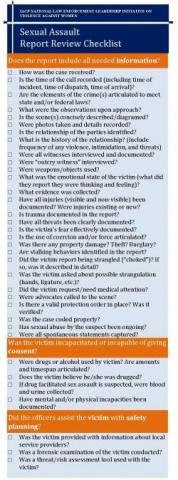
These tools serve to assist supervisors in ensuring that reports capture significant and comprehensive details and the totality of crimes that occurred. The checklists can also be utilized by first-responders as a training tool to highlight the specifics needed in a thorough report, and as a resource for first-responders as they complete reports, interview victims, and reflect on whether pertinent information has been effectively documented.
Explore the full Violence Against Women resource library:
Response to Domestic Violence Report Review Checklist
These tools serve to assist supervisors in ensuring that reports capture significant and comprehensive details and the totality of crimes that occurred. The checklists can also be utilized by first-responders as a training tool to highlight the specifics needed in a thorough report, and as a resource for first-responders as they complete reports, interview victims, and reflect on whether pertinent information has been effectively documented.
The crimes of violence against women, including sexual assault, domestic violence, and stalking, are complex and can pose challenges to responding officers. Oftentimes, significant details are missed and necessary elements to document these crimes are left out of reports. In order to support law enforcement first-line supervisors as they review reports for stalking, strangulation, sexual assault, domestic violence, and protection order violations, the IACP created five violence against women Report Review Checklists.
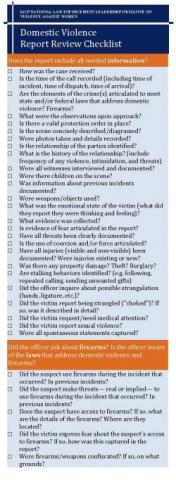
These tools serve to assist supervisors in ensuring that reports capture significant and comprehensive details and the totality of crimes that occurred. The checklists can also be utilized by first-responders as a training tool to highlight the specifics needed in a thorough report, and as a resource for first-responders as they complete reports, interview victims, and reflect on whether pertinent information has been effectively documented.
Explore the full Violence Against Women resource library:
Response to Protection Order Violations Report Review Checklist
The crimes of violence against women, including sexual assault, domestic violence, and stalking, are complex and can pose challenges to responding officers. Oftentimes, significant details are missed and necessary elements to document these crimes are left out of reports. In order to support law enforcement first-line supervisors as they review reports for stalking, strangulation, sexual assault, domestic violence, and protection order violations, the IACP created five violence against women Report Review Checklists.
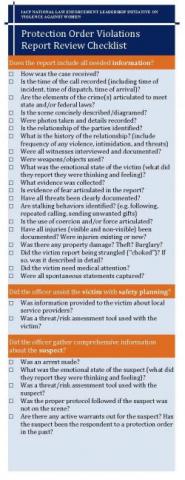
These tools serve to assist supervisors in ensuring that reports capture significant and comprehensive details and the totality of crimes that occurred. The checklists can also be utilized by first-responders as a training tool to highlight the specifics needed in a thorough report, and as a resource for first-responders as they complete reports, interview victims, and reflect on whether pertinent information has been effectively documented.
Explore the full Violence Against Women resource library:
Community-Police Engagement
Issue Overview
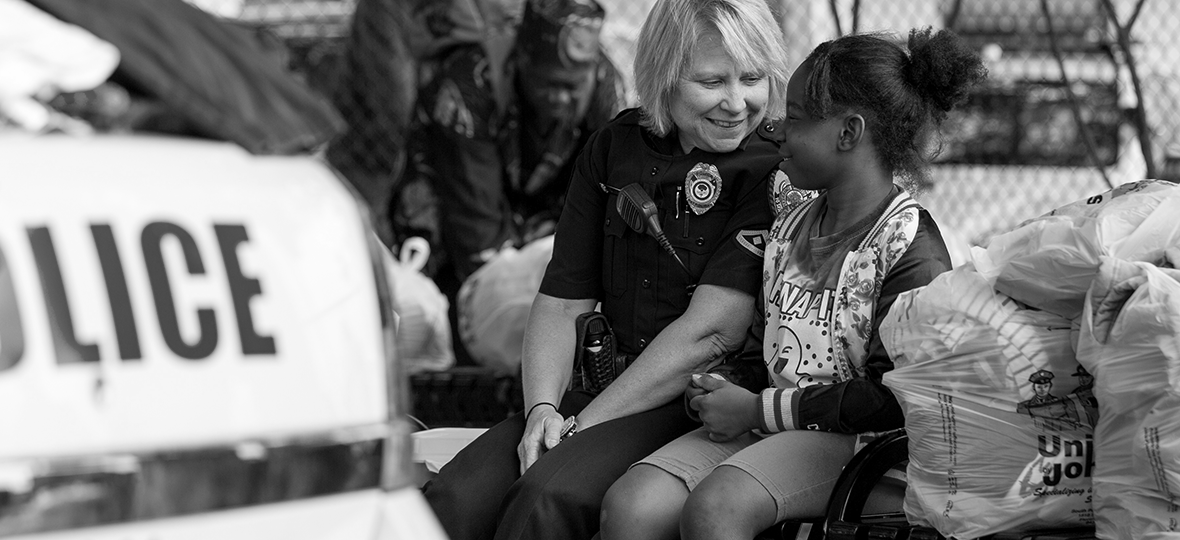
No single factor has been more crucial to reducing crime levels than the partnership between law enforcement agencies and the communities they serve. In order for law enforcement to be truly effective, police agencies cannot operate alone; they must have the active support and assistance of citizens and communities. High profile incidents and allegations of police misconduct may drive a wedge between law enforcement officers and the citizens they are sworn to protect. Establishing and maintaining a safe community requires ongoing concerted effort.
This page serves as a clearinghouse of resources to help guide law enforcement agencies as they continue to strengthen and build sustainable community relations and are confronted with difficult questions relating to the state of police-community relations.
Messaging Worksheets
These messaging worksheets break down the topic of community-police relations and provide key talking points and facts to assist law enforcement professionals in daily communications about the subject.
Model Policies & Papers
Police Chief Articles
Additional Resources
4. Enhancing Law Enforcement Response to Victims: Training Supplement
Click here for the new Enhancing Law Enforcement Response to Victims Strategy Second Edition!

The Training Supplement is designed to assist in an effort to train law enforcement personnel, from recruit to executive, to be knowledgeable about victim rights, sensitive to their needs, and familiar with victim services.
Click on the links below to go to a specific section in the Training Supplemental.
- Preface
- Snapshot: A 21st Century Strategy for Enhancing Law Enforcement Response to Victims
- Snapshot: Implementation Guide
- Core Curriculum
- Agency-Wide Personnel Training on Victim Issues
- Field Training Program Victim-Focused Enhancements
- Recruit Training Enhancements
- Crime Prevention
- Crisis Intervention
- Ethics
- Police-Citizen Relations
- Problem-Oriented Policing
- Service Calls
- Other Ways of Applying Content Provided in the Supplemental
- References
- Handout
- Acknowledgements
Contact
For more information: [email protected]
Partners
This Web site is funded in whole or in part through a grant from the Office for Victims of Crime, Office of Justice Programs, U.S. Department of Justice. Neither the U.S. Department of Justice nor any of its components operate, control, are responsible for, or necessarily endorse, this Web site (including, without limitation, its content, technical infrastructure, and policies, and any services or tools provided).
Explore more victim assistance resources:
Firearms STI

Gun safety, firearms training, and the investigation of gun crime is fundamental to the mission of protecting and serving the community and must be factored into each law enforcement agency’s overall policing strategy. This page will serve as a clearinghouse of resources to help guide law enforcement as they tackle issues related to firearms security, training, and the investigation of gun crimes.
MESSAGING RESOURCE
Firearms: Security, Training and Investigations Messaging Sheet
MODEL POLICIES
Firearms Model Policy (Updated 2007)
OTHER RESOURCES
Crime Gun Information Sharing: The ATF i-Trafficking Project Integration of Firearms Trace/Ballistic Data into Fusion Center Intelligence Sharing (2014)
The IACP, in partnership with DOJ U.S. Department of Justice and the Bureau of Alcohol, Tobacco, Firearms and Explosives (ATF) led and an assessment of the Interstate Trafficking Program (iTrafficking), to promote a regional approach to firearms trafficking investigations. By analyzing key fusion centers in the northeast region of the United States (New York, Pennsylvania, Delaware, and Maryland) to analyze crime gun data, the goal of this project was to develop an innovative, multi-state approach to reducing violent crime through shared resources and increased collaboration. The information contained in this report are useful in guiding fusion center personnel, as well as state, local, and tribal law enforcement, in the utility and examination of firearms trace data for intelligence products, criminal investigations and prosecutions.
International Association of Chiefs of Police Firearms Position Paper (2018)
The IACP has long advocated for the adoption of common sense policies that will assist in reducing gun violence. These proposals were drawn from the association resolutions and policy positions adopted by the IACP membership.
This guide provides information about notable programs and policing strategies that can be implemented by law enforcement agencies, regardless of size, in order to enhance the critical and life-saving mission of reducing gun violence. By highlighting innovative approaches developed by law enforcement departments and communities across the country, local leaders are encouraged to expand upon their current efforts in order to create a comprehensive program to enhance community and officer safety.
Taking a Stand: Reducing Gun Violence in Our Communities (2007)
This report focuses on recommendations on three main areas: keeping communities safe by improving public understanding about the risks of gun violence; preventing and solving gun crime by stopping the flow of illegal guns; and keeping police officers safe by improving training and support for officers in handling guns.
Police Officer’s Guide to Recovered Firearms Mobile Application
The IACP, in collaboration with the Department of Justice (DOJ) Bureau of Justice Assistance (BJA), the IACP Firearms Committee, and the Bureau of Alcohol, Tobacco, Firearms and Explosives (ATF) developed a mobile application (app) designed to assist law enforcement officers with processing recovered firearms. The app has been downloaded over 25,000 times and features information on firearms safety, firearms marking identification tools, firearms tracing tools, and other valuable information.
RESOLUTIONS
Prohibition of Concealed Carry Weapons (CCW) on College and University Campuses (2012)
Support of Law Enforcement Officers to Receive Tactical Firearms Training During the Police Academy (2012)
Support for Firearms Offender Registries (2007)
Security of Firearms (1998)
Opposition to Federal Pre-Emption of Individual States Carrying of Concealed Weapons (CCW) Laws as They Apply to Active, Former, and /or Federal, State, and Local Law Enforcement Personnel (1996)
Support for Federal Legislation Banning Junk Guns (1996)
LEGISLATIVE INITIATIVES
IACP Supports the Stop Illegal Trafficking in Firearms Act of 2016, S. 2544
IACP Supports Bulletproof Vest Program Reauthorization Legislation
OTHER INITIATIVES
Project Safe Neighborhoods National Training and Technical Assistance
The IACP’s partnership with the Department of Justice (DOJ) Bureau of Justice Assistance (BJA) has a history of success and steady growth. The IACP Project Safe Neighborhoods National Training and Technical Assistance Initiative, with support from DOJ, works to improve law enforcement’s capacity to interdict firearms trafficking and disrupt gang activity. In collaboration with state, local, tribal, and federal partners, the IACP provides training, technical assistance and resources to improve law enforcement’s gun/gang violence reduction and prosecution efforts.
The National Law Enforcement Partnership to Prevent Gun Violence
The National Law Enforcement Partnership to Prevent Gun Violence (the Partnership) is an alliance of the nation’s law enforcement leadership organizations concerned about the level of gun violence in the United States. The Partnership works to address the pervasive nature of gun violence and its impact on community and officer safety.
Gun and Gang Violence Reduction Initiatives
The proliferation of violent crime in the United States and the criminal acquisition and use of firearms are critical issues for law enforcement. The IACP Gun and Gang Violence Reduction Initiatives include several partners, projects, and products that aim to improve the level of knowledge, communication, and collaboration to effectively address gun violence affecting communities throughout the nation.
IACP’s Project Safe Neighborhoods National Training and Technical Assistance Initiative
The IACP’s partnership with the Department of Justice (DOJ) Bureau of Justice Assistance (BJA) has a history of success and steady growth. The IACP Project Safe Neighborhoods National Training and Technical Assistance Initiative, with support from DOJ, works to improve law enforcement’s capacity to interdict firearms trafficking and disrupt gang activity. In collaboration with state, local, tribal, and federal partners, the IACP provides training, technical assistance and resources to improve law enforcement’s gun/gang violence reduction and prosecution efforts.
Police Officer’s Guide to Recovered Firearms Mobile Application
The IACP, in collaboration with the Department of Justice (DOJ) Bureau of Justice Assistance (BJA), the IACP Firearms Committee, and the Bureau of Alcohol, Tobacco, Firearms and Explosives (ATF) developed a mobile application (app) designed to assist law enforcement officers with processing recovered firearms. The app features information on firearms safety, firearms marking identification tools, firearms tracing tools, and other valuable information.
National Law Enforcement Partnership to Prevent Gun Violence
The National Law Enforcement Partnership to Prevent Gun Violence (the Partnership) is an alliance of the nation’s law enforcement leadership organizations concerned about the level of gun violence in the United States. The Partnership works to address the pervasive nature of gun violence and its impact on community and officer safety.
IACP and The Joyce Foundation Initiatives
The IACP, in collaboration with the Joyce Foundation, a Chicago-based organization that aids in reducing gun violence in the Great Lakes States, work to address illegal gun trafficking, officer safety, domestic and family violence, illicit drug markets and their tie-in to firearms and gang-related violence. As a result of the IACP and Joyce Foundation partnership, resources such as the Reducing Gun Violence in Our Communities: A Leadership Guide for Law Enforcement on Effective Strategies and Programs,the Taking a Stand: Reducing Gun Violence in Our Communities report, and the Law Enforcement Leadership Roundtables on Gun Violence brief were produced.
Web based tools, such as webinars, resource briefs, and podcasts are coming soon!
Additional Gun and Gang Violence Reduction Resources
For more information, email [email protected].
IACP Internal and Community Surveys
Questionnaires are typically used for survey research to determine the current status or to estimate the distribution of characteristics in a population. The effective use of an agency's internal survey or a community safety survey can allow an agency to respond to their employee's and communities needs in ways that can improve satisfaction and support. Agencies can use the results of the survey as a catalyst for continued improvement.
- Getting started can be daunting but much of the questionnaire construction is common sense. Some ground rules to keep in mind when writing a survey include the following:
- Each question should relate directly to your survey objectives.
- Every respondent should be able to answer every question (unless instructed otherwise).
- Each question should be phrased so that all respondents interpret it the same way.
- Each question should provide answers to what you need to know, not what would be nice to know.
Objective
First, determine the objective of the survey. What do I want to know? Having a clear, quantitative survey objective helps you define the scope of your survey and measure its success following completion.
Attributes
Next, decide the attribute you want to measure. As with determining the objective, choose which attribute to measure based on your objectives to compliment the data evaluation you plan to complete. Some attributes you may choose to measure include:
- Attitude
- Knowledge
- Skills
- Behaviors and practices
- Perceptions of knowledge, skills or behavior
- Goals, intentions, aspirations
- Demographics
Of course, it's possible you might measure more than one attribute, but the questions will be clearly different based on the information you are trying to gather.
Audience
Determine who your audience is. Are you seeking information from your department, the elderly, students, or citizens as a whole for example? Identifying your audience will affect how you compose your questionnaire.
Measurement
Use scales that are appropriate for the audience and for the information needed. Some choices are:
Fixed Response (Quantitative)
- Yes-No
- Multiple Choice
- Rating scale/Continuum - A typical question using a Likert Scale might ask the respondent:
How satisfied are you with the courtesy of the officers?- Very Satisfied
- Satisfied
- Neutral
- Dissatisfied
- Very Dissatisfied.
- Rank ordering – These questions ask the respondent to assign a ranking to a list of items.
What do you think are the current policing priorities of this Department? (Please rank the TOP THREE – 1 being the most important)
___ Responding to Emergency Calls
___ Service Calls and Assistance
___ Promoting Police-Community
___ Crime Prevention
___ Traffic Regulations & Enforcement
___ Public Order Maintenance
___ Drug & Alcohol Enforcement
___ Encouraging Voluntary Compliane of Laws & Regulations
___ Education
___ Problem Solving
___ Other:___________________________
These questions are quick to answer, which facilitates analyzing the results. Occasionally, however, fixed response questions may draw misleading conclusions because the respondent cannot qualify responses, e.g. "Yes, but…" or "It depends" where only Yes/No are given as options.
Narrative Response (Qualitative):
Narrative responses allow respondents greater freedom of expression. There is no bias due to limited response ranges and the respondents can qualify their answers. On the other hand, these responses are time consuming to code and the researcher may misinterpret (and therefore misclassify) a response.
Reliability
Finally, check the reliability of your survey before it is distributed. Conduct a test of a few respondents and analyze the results to determine if you are receiving the information you need or if the question/s need rephrasing.The Final Product
Once you have a clear objective, determined who will receive your survey and the survey is written, you next must invite the respondents to participate. Communicate the reason for the survey in the introduction. Identifying at least one tangible or intangible benefit to respondents for answering the survey will help you compose an invitation that encourages respondents to complete the survey. A tangible benefit could be in the form of money or a gift; whereas an intangible benefit is a chance to voice opinions or contribute to research they view as valuable. There are five main parts of an invitation:
- Introduction
- Why the respondents have been selected to respond
- How long will the survey take
- What benefit will they get for responding
- How their responses will be used / confidentiality
Gun and Gang Violence Reduction Resources
IACP Resources and Products:
- IACP ATF Police Officer’s Guide to Recovered Firearms Mobile Application
- Crime Gun Information Sharing: The ATF i-Trafficking Project
- Officer-Involved Shootings Investigative Protocols
- Reducing Gun Violence in Our Communities: A Leadership Guide for Law Enforcement on Effective Strategies and Programs
- Reducing Violence and Crime on Our Streets: A Guide for Law Enforcement Leaders
- Taking a Stand: Reducing Gun Violence in Our Communities
- IACP Crime Gun Interdiction Strategies for the 21st Century Summit Report
- Reducing Gun Violence In Your Community: A Planning Guide to Assess Local Needs and Implement Summit Recommendations
- National Law Enforcement Partnership to Prevent Gun Violence
- Firearms Committee
- Arson and Explosives Committee
- Crime Prevention Committee
- Patrol and Tactical Operations Committee
- IACP Net
- Law Enforcement Model Policy Center
- Legislative Agenda for the 114th Congress International Association of Chiefs of Police 2015 – January 2017
- IACP National Policy Summits
- Collaborative Reform Initiative Technical Assistance Center (CRI-TAC)
Additional Resources
- Department of Justice
- BJA, Project Safe Neighborhoods
- BJA, SMART Policing Initiative
- Office of Juvenile Justice and Delinquency Prevention
- Office of Juvenile Justice and Delinquency Prevention OJJDP, Comprehensive Anti-Gang Initiative
- Bureau of Alcohol, Tobacco, Firearms and Explosives
- Federal Bureau of Investigation
- National Institute of Justice, Crime Solutions.Gov
- COPS Office
- George Mason University, Center for Evidence-Based Crime Policy
- Johns Hopkins University, Center for Gun Policy and Research
- The University of Chicago, Gun Lab
- Gang Resistance Education and Training- G.R.E.A.T.
- Mayors Against Illegal Guns
- National Gun Violence Research Center
- Project Safe Neighborhoods - Chicago
- Brady Campaign
- International Firearm Injury Prevention and Policy
- Law Center to Prevent Gun Violence
- American Psychological Association, Recommendations to Prevent Gun-Related Violence
- The Joyce Foundation
- Shot Spotter
- National Institute of Justice, Gun Violence Section
- National Institute of Justice, Gangs and Gang Crime Section
- Harvard Injury Control Research Center
- Center for Disease Control and Prevention
- National Law Enforcement Officers Memorial
Publications
- Promising Strategies for Violence Reduction: Lessons from Two Decades of Innovation
- Identifying and Working With a Research Partner
- Project Safe Neighborhoods Case Study: Promising Violence Reduction Initiatives
- Project Safe Neighborhoods - A National Program to Reduce Gun Crime: Final Project Report
- Department of Justice Program Brief: Project Safe Neighborhoods: America’s Network Against Gun Violence
- Promising Strategies to Reduce Gun Violence
- Gun Violence Among Serious Young Offenders
- Focused Deterrence Strategies for Reducing Gun Violence
- Youth Crime Gun Interdiction Initiative
- Changing Course, Preventing Gang Membership
For more information on the IACP’s programmatic work concerning gun violence reduction please contact: Courtney E. Mariette – Project Manager at [email protected].
Health and Nutrition

Eating right, maintaining a healthy weight, and exercising are key to overall well being and are particularly important for officers given the demands of the job. The resources below will be helpful for an agency seeking to build out their health and nutrition education programs.
Sleep:
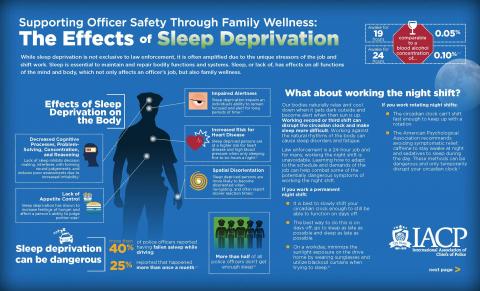
Supporting Officer Safety Through Family Wellness: The Effects of Sleep Deprivation. Sleep deprivation takes a toll on an officer’s wellbeing. This infographic discusses the effects on the body and other dangers associated with sleep deprivation and offers helpful suggestions for families of law enforcement.
Fitness:
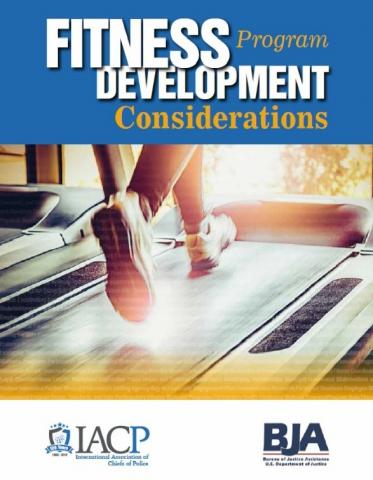
Fitness Considerations Guide. Fitness and wellness programs are an important part of reducing officer injuries on the job. This guide provides law enforcement agencies with tips and recommendations on how to start a fitness/wellness program within an agency.
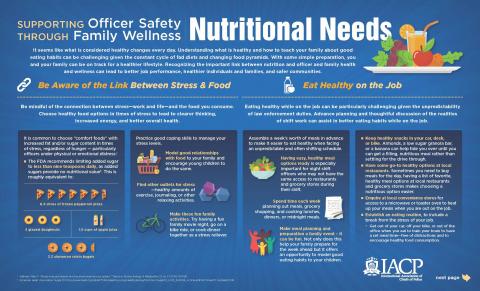
Supporting Officer Safety Through Family Wellness: Nutritional Needs. Proper nutrition is an important factor in the job performance of law enforcement officers. This infographic suggests some tips for making proper eating and nutrition a priority for officers and families and includes some ideas on how to make eating and preparing food more family friendly.
Diet:
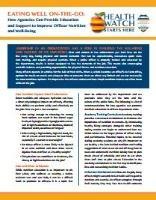
Eating Well on the Go - Leadership Guide. This fact sheet provides information on how agencies can provide education and support to improve officer nutrition and well-being, highlighting the impact nutrition has on an officer’s performance, ranging from long-term effects to shift-by-shift consequences.
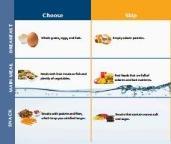
Eating Well on the Go - Officers' Guide. This pocket-sized brochure gives officers nutritious options for meals on the go, including guidance on which items to choose and which to skip for breakfast, snacks, and a main meal.
Medical Care:
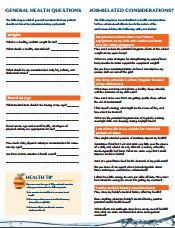
Doctor's Visit Checklist - This helpful brochure contains recommended questions officers can pose to their physicians addressing common medical concerns affecting law enforcement personnel.
Training Keys
IACP has several Training Keys® related to health and fitness. Training Keys® are six-page loose-leaf monographs summarizing key policing topics and issues in a succinct, reader-friendly format, suitable for academy, roll-call, or in-service training. Training Keys are available to IACP members only.
More about Training Keys.
-
Police Fatigue
-
Health & Fitness
-
Exercise & Nutrition
Several of the projects highlighted within these pages are partially or wholly supported by:


High Visibility Education and Enforcement
As part of a continued focus on enhancing traffic safety and reducing fatal crashes nationwide, the IACP, the National Highway Traffic Safety Administration (NHTSA), the Governors Highway Safety Association, and other partners created the High-Visibility Education and Enforcement (HVEE) pilot program. Four states participated in the pilot program: Delaware, Maryland, North Caroline, and Wisconsin.
The pilot program focused on using federal and state crash data and leveraging partnerships to respond to a particular traffic challenge in each area. Representatives from state and local law enforcement, state highway safety offices, and other public and private stakeholders, partnered with IACP staff to look at NHTSA Fatality Analysis Reporting System (FARS) data and state crash data to determine their topic of focus for the pilot. Each group collected promising practices and lessons learned, focusing on officer safety while conducting traffic enforcement and highlighting the importance of engaging stakeholders and community members. The campaigns began in November 2015 and ended in early February 2016.
Articles, information, and additional resources from each of the pilot sites, as well as general resources from the IACP, can be found below.
High-Visibility Education and Enforcement: A Collaborative Approach to Traffic Safety
Click here to download the booklet outlining the promising practices and lessons learned from each state that participated in the HVEE pilot project. If you would like hard copies of this booklet, please contact the IACP Traffic Safety Initiatives Team at [email protected]..
Are You Ready for High Visibility Enforcement? Preparation Packet
Click here to download the full "Are You Ready for High Visibility Enforcement? Preparation Pack" PDF. If you would like hard copies of this packet, please contact the IACP Traffic Safety Initiatives Team at [email protected].
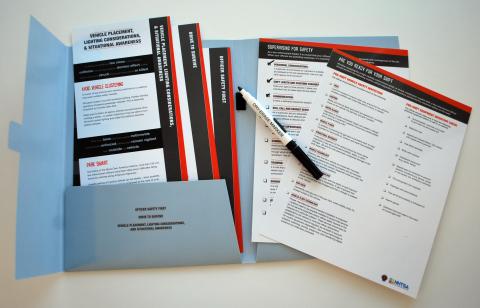
HVEE Campaign Resources and Checklists
High-Visibility Education and Enforcement: A Collaborative Approach to Traffic Safety
Are You Ready for High Visibility Enforcement? Preparation Pack (full packet)
If you would like hard copies of these resources, please contact the IACP's Traffic Safety Initiative Team at [email protected].
State Campaign Information
Maryland (Impaired Driving)
North Carolina (Speed Enforcement)
Photo Album - Statewide Law Enforcement Press Conference
Wisconsin (Impaired Driving)
Press Releases
IACP Official Press Release
Press Release - IACP, GHSA, NHTSA, DE, MD, NC, and WI Kick Off Traffic Safety Campaign
Delaware (Pedestrians)
Press Release - The Increased Fight to Prevent Pedestrian Deaths
Wisconsin (Impaired Driving)
IACP - Smaller Law Enforcement Agency Program Training & Professional Development
Savvy executives are always seeking out training opportunities for themselves and their staff. There are many sources for training, including in person and online, and there are many forms of training available, including tuition-based, low-cost, and grant-funded. Explore these resources for high quality training opportunities.


