
Resources
IACP's resources are aimed at helping law enforcement executives do their jobs better and cover a variety of topics, including professional development, leadership, management, and supervision, as well as hot topics such as ethics.
Resources
Smaller Law Enforcement Agency Program - E-Source
The New Executive E-Source
The New Executive E-Source is designed to provide easy access to resources for newly appointed or elected law enforcement executives. The information and resources are categorized into topical areas that are common concerns for newer executives in smaller law enforcement agencies. This initiative is the result of partnership between the International Association of Chiefs of Police and the Bureau of Justice Assistance.
There are several initiatives associated with the New Executive E-Source:
- Guidance for New and Aspiring Executives
- Leadership and Management
- Personnel Administration
- Operations
- Community Outreach
- Training and Professional Development
- Resource Center
Smaller Agency Program
The IACP Smaller Law Enforcement Agency Program provides training, technical assistance, policy guidance, and other support to the nearly 15,000 smaller law enforcement agencies across the US. The Smaller Agency Program, in partnership with BJA, provides a variety of resources for smaller agencies.
Disclaimer
Taking advantage of the services offered by the New Executive E-Source through the IACP, any advice received in the use of this website is purely informal non-binding on anyone and solely for the purpose of guiding users in their career. This site is intended simply as an educational resource to review general issues confronted in the process of becoming or aspiring to be a law enforcement executive including, but not limited to, administration and management, professionalism and professional ethics. Users should not rely upon any advice and/or statements provided from New Executive E-Source as binding or as a substitute for their professional judgment or own professional opinions.
Neither the IACP nor any mentor provides any warranty of any kind regarding information shared with, divulged to, or given to any user.
As a condition of use of the New Executive E-Source, users agree that they will not file suit or otherwise attempt to hold liable for damages, the IACP, the IACP Smaller Agency Program, and/or any mentor, member, staff or agent of the foregoing (the “released parties”) as a result of or in connection with participation to this site.
Users hereby agree to release, indemnify, defend and hold harmless the released parties from any and all claims, suits, actions or proceedings of any kind arising out of, or in connection with, any advice or guidance given in relation to this program.
The Effects of Adolescent Development on Policing

The Effects of Adolescent Development on Policing
 The IACP resource brief titled, The Effects of Adolescent Development on Policing, which was developed with support from the Office of Juvenile Justice and Delinquency Prevention, Office of Justice Programs, U.S. Department of Justice. The brief provides an overview of adolescent brain development, impact on youth/police communications, strategies to improve law enforcement interactions with youth, and tips to foster positive youth development.
Download it now or contact us for more information at [email protected].
Adolescent Development: Strategies for Youth and Law Enforcement Interactions Webinar
The purpose of this webinar is to discuss adolescent brain development and how it affects youth behavior. The presenter will discuss youth thinking and behavior, protective factors for youth and the impact of this information on law enforcement. He will cover strategies to improve police interaction with youth and legal considerations when interviewing or interrogating youth, as well as some resources to improve your interactions and outcomes when dealing with youth.
Upon completing this webinar, you will be better able to:
- Explain adolescent development
- Describe the impact of youth development on law enforcement interactions
- List five protective factors for youth
- List five protective factors for youth
- Implement five strategies to increase positive adolescent interaction
- Display four legal considerations for interacting with youth
Related Trainings
Online trainings for law enforcement on the IACP Learning Management System. Webinars and training topics include:
Juvenile Interview and Interrogation Techniques
School Safety
Human Trafficking
Safeguarding Children of Arrested Parents
Click here to see all the courses and register for an account.
Technology and Social Media

This section examines law enforcement technologies such as body worn cameras, unmanned aircrafts, and less lethal weapons as well as the topic of social media. While these technologies cover a broad range of products and uses, many of the considerations for law enforcement agencies are similar.
Model Policies & Concept Papers
Reports & Publications
Articles & Blog Posts
Other Resources
- Training Key: Technology and Social Media
- IACP Technology Center
- Testimony of Executive Director and Chief Executive Officer Vincent Talucci - Technology
- Testimony of Former Research and Programs Director - Social Media
- IACP Social Media Resources
- Facebook Checklist
- Twitter Checklist
- LinkedIn Checklist
- LinkedIn Factsheet
- YouTube Checklist
- YouTube Factsheet
- Pinterest Factsheet
- Blog Factsheet
- Blogging Guide
- Crime Prevention Factsheet
- Cyberbullying Factsheet
- Recruitment Factsheet
- Virtual Communities Factsheet
- Building Your Presence with Facebook Pages
- Ready, Set, Go: Creating an Engaging Social Media Presence
- Making Social Media Part of the Uniform
Large Trucks and Buses
Large trucks and buses are disproportionately involved in both fatal and injury crashes. These vehicles account for only 4 percent of registered vehicles in the U.S., but they are involved in roughly 12 percent of the fatal crashes.
It is important for law enforcement agencies to understand that these crashes are caused by both the passenger vehicles driving around the commercial vehicles, as well as the large truck and bus drivers. Many fatal crashes result from an illegal action or unsafe behavior on the part of at least one driver involved in the crash, including speeding, following too closely, improper lane changes, and distracted driving (including texting while driving).
Below are no-cost resources that have been developed to assist officers when conducting enforcement on large trucks and buses, and tools to help chief executives educate their communities on the importance of safe driving practices around these large vehicles.
In 2018, the IACP held a large truck and bus collaborative education and enforcement forum to discuss strategies to utilize high-visibility enforcement practices to target unsafe driving behavior that often lead to commercial motor vehicle-involved crashes. The collaborative meeting held breakout sessions that allowed state partners to collectively create campaigns that incorporate issues specific to the regions surrounding the high-risk crash corridors. Following the event, each state created a report including information on the collaborative education and enforcement campaigns that incorporated the problem statement, goal, planning, enforcement education and media outreach, and results from the pilot program. Below are campaign reports from the states that participated in the forum.
Contact
For other inquiries regarding traffic safety initiatives, please contact the IACP's Traffic Safety Initiatives team at [email protected].
State High Visibility Enforcement (HVE) Campaign Information
Large Truck and Bus Resources
Blogs
Colonel Tracy Trott (retired) of the Tennessee Highway Patrol has provided best practices and lessons learned around large truck and bus enforcement for all agencies no matter the size. Read more.
Colonel Paul Pride, Ohio State Highway Patrol, provides best practices around the Road Watch 100 campaign and lessons learned. Read more.
Lessons learned around Nevada's Badge on Board program from Colonel Dennis Osborn. Read more.
Police Chief Magazine Articles
Move Over Initiative - Tracy Trott, Colonel, Tennessee Highway Patrol
Regular Traffic Enforcement Can Play a Crucial Role in Defining Commercial Vehicle Safety - Jack Van Steenburg, Federal Motor Carrier Safety Administration, U.S. Department of Transportation
Saving Lives by Citing Truck and Bus Violations - Stephen A. Keppler, Executive Director, Commercial Vehicle Safety Alliance
An Enhanced Statewide Approach to Commercial Motor Vehicle Traffic Safety - Lou Jogman, Deputy Chief of Police, Park Ridge, Illinois, Police Department
Critical Issues: Use of Force

Issue Overview
For decades, the IACP has played a central role in the research, development, and implementation of model policies and best practices regarding the use of force by law enforcement officers. Clearly, this issue is a critical one for both the law enforcement profession and the communities they serve. The IACP is committed to ensuring that officers respond to situations with the appropriate level of force.
This page provides a listing of IACP model polices and other publications that address issue related to law enforcement use of force.
Messaging Worksheet
The following messaging worksheet breaks down the topic of use of force, and provides key talking points and facts to assist you in your daily communications about the subject. This worksheet is exclusively available to IACP members.
Model Policies & Papers
Additional Resources
Collaborative Reform Initiative Technical Assistance Center (2018)
A partnership between the COPS Office, the IACP, and eight other law enforcement organizations, the Collaborative Reform Initiative Technical Assistance Center (CRI-TAC) advances the practice of community policing in law enforcement agencies by providing customized technical assistance to state, local, territorial, tribal, and campus agencies on a variety of topics.
Officer-Involved Shootings: A Guide for Law Enforcement Leaders (2016)
This guide is intended to provide guidance for preparing officers and departments prior to an officer-involved shooting, suggested incident scene actions and procedures, recommended procedures for conducting criminal and administrative investigations, suggestions for working with the media, and mental health and wellness considerations and procedures.
Officer-Involved Shootings Investigative Protocols (2014)
In response to the growing national concern about officer involved shooting incidents, IACP, in partnership with COPS Office released this guide for law enforcement leaders. The Guide looks closely at four critical policy areas: administrative investigation, criminal investigation, officer mental health/wellness considerations and informing the community/transparency.
Officer Involved Shooting Guidelines: IACP Psychological Services Section (2013)
In 2013, the IACP’s Police Psychological Services Section released a set of guidelines on how local agencies should engage/manage individual officers when an officer involved shooting occurs. Key points within the guidelines included: pre-incident preparation, at the scene of the incident, post-incident, the investigative period, and post-shooting interventions.
Emerging Use of Force Issues: Balancing Public and Officer Safety (2012)
Teaming up with the COPS Office, IACP held a symposium on emerging use of force issues in 2011 that resulted in this 2012 summary report. Recommendations stemming from the symposium addressed: public perception, factual documentation of incidents, managing force (chief’s duty), officer training post-academy, and officer mindset.
Law Enforcement Officers Killed by Felonious Assault in 2011 (2011)
In collaboration with the Bureau of Justice Assistance, IACP’s National Center for the Prevention of Violence against the Police took a look at use of force from another perspective, force used by suspects against the police. The report focused on types of encounters most likely to result in felonious assault and death: disturbances, arrest, ambush, traffic pursuit/stop, warrant service, investigating suspicious circumstances, and prisoner transport.
Police Chiefs Desk Reference (2008)
Working with the Bureau of Justice Assistance, IACP created the first ever ‘Police Chiefs’ Desk Reference’ modelled after the historic Physicians’ Desk Reference (PDR)—addressing every possible aspect of modern day policing and police leadership. Throughout the document, references to instituting best practice policies and training on all police performance issues- including use of force- are made.
Protecting Civil Rights: A Leadership Guide for State, Local, and Tribal Law Enforcement (2006)
In partnership with the COPS Office and the Department of Justice Civil Rights Division, IACP took a look at numerous Federal Consent Decree and MOU actions involving local law enforcement agencies. Using the data from those investigations, IACP created a best practice guide on all aspects of policing.
Electro-Muscular Disruption Technology (2005)
In collaboration with the National Institute of Justice and the Montgomery County Police Department, IACP developed a nine-step strategy for effective deployment of this force technology. The report focuses on policies, training, and the role of police leaders in overseeing the acquisition and successful deployment of EMDT.
Police Use of Force in America (2001)
Partnering with the National Institute of Justice and the Bureau of Justice Statistics, IACP created and piloted the first ever national database on police use of force. Over a 36-month period, data was collected from a sample of 564 state and local law enforcement agencies. That data included 45,913,161 calls for service, 177,215 use of force incidents, and 8,082 use of force related citizen complaints.
Pepper Spray Evaluation Project (1995)
In collaboration with National Institute of Justice and the Baltimore County Police Department, IACP conducted a comprehensive study on outcomes and impact of pepper spray (oleoresin capsicum) as it was introduced for use across BCPD.
Critical Issues: Use of Military Equipment

Issue Overview
For decades, the Department of Defense Excess Property Program (1033 Program) has assisted U.S. law enforcement agencies in acquiring unused and surplus military equipment. Agencies have used this surplus military equipment to save civilian lives, protect law enforcement personnel, and enhance public safety.
Contrary to popular belief, the vast majority of the equipment transferred from federal sources to law enforcement agencies is fairly routine—office furniture, computers, and other technology equipment; personal protective equipment; and basic firearms. Federal agencies do also transfer or fund the purchase of surplus military equipment, tactical vehicles, specialized firearms, and aircraft. The transfer of these items is important to law enforcement and their critical mission in helping to keep citizens safe. This page will serve as a clearinghouse of resources to help guide law enforcement as they are confronted with difficult questions related to the use of military equipment.
Messaging Worksheet
The following messaging worksheet breaks down the topic of use of military equipment, and provides key talking points and facts to assist you in your daily communications about the subject. This worksheet is exclusively available to IACP members.
Legislative Initiatives
Police Chief Magazine Articles
Youth Focused Policing Agency Self-Assessment

Agency Self-Assessment Tool
 What are your agency strengths in responding to youth crime, delinquency, and victimization? What areas need improvement? Could your agency benefit from implementing a Youth Focused Policing strategy? Assess your agency’s current state of policy and practice with the Youth Focused Policing Agency Self-Assessment. This IACP resource, supported by the Office of Juvenile Justice and Delinquency Prevention, Office of Justice Programs, U.S. Department of Justice, aims to assist law enforcement agencies in early identification of trends, resources, and community partnerships that may be helpful in identifying best practice responses to improving the safety and well-being of youth in their communities.
Upon completion, your agency may discover opportunities that can serve as the foundation of an action plan to implement new or enhance existing strategies that improve capacity to respond to youth crime, delinquency, and victimization.
Download the self-assessment tool now or for more information, contact 1-800-THE-IACP x 831 or [email protected].
Partners
IACP - Smaller Law Enforcement Agency Program Community Outreach
- Learn about the variety of resources available through the Community Oriented Policing Services (COPS) Office
- Read the Final Report of the President's Task Force on 21st Century Policing
IACP Resources
Volunteers in Police Service (VIPS)
External Resources
Access resources related to community engagement programs
IACP - Smaller Law Enforcement Agency Program Operations
Operations manager is one of the many hats that law enforcement executives have to wear. Newer executives may feel uncertain about how to manage some of the operational responsibilities that come with being an executive. These resources can help build a solid foundation for an executive to move forward with confidence.
View new technology resources through the National Law Enforcement and Corrections Technology Center.
Guarding against common liabilities:
Response to Stalking Report Review Checklist

The crimes of violence against women, including sexual assault, domestic violence, and stalking, are complex and can pose challenges to responding officers. Oftentimes, significant details are missed and necessary elements to document these crimes are left out of reports. In order to support law enforcement first-line supervisors as they review reports for stalking, strangulation, sexual assault, domestic violence, and protection order violations, the IACP created five violence against women Report Review Checklists.
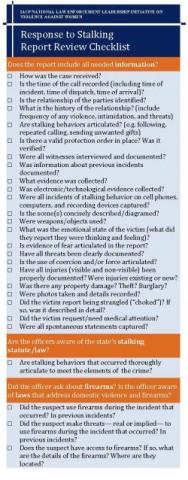
These tools serve to assist supervisors in ensuring that reports capture significant and comprehensive details and the totality of crimes that occurred. The checklists can also be utilized by first-responders as a training tool to highlight the specifics needed in a thorough report, and as a resource for first-responders as they complete reports, interview victims, and reflect on whether pertinent information has been effectively documented.
Explore the full Violence Against Women resource library:
Response to Non-Lethal Strangulation Report Review Checklist
The crimes of violence against women, including sexual assault, domestic violence, and stalking, are complex and can pose challenges to responding officers. Oftentimes, significant details are missed and necessary elements to document these crimes are left out of reports. In order to support law enforcement first-line supervisors as they review reports for stalking, strangulation, sexual assault, domestic violence, and protection order violations, the IACP created five violence against women Report Review Checklists.
The crimes of violence against women, including sexual assault, domestic violence, and stalking, are complex and can pose challenges to responding officers. Oftentimes, significant details are missed and necessary elements to document these crimes are left out of reports. In order to support law enforcement first-line supervisors as they review reports for stalking, strangulation, sexual assault, domestic violence, and protection order violations, the IACP created five violence against women Report Review Checklists.
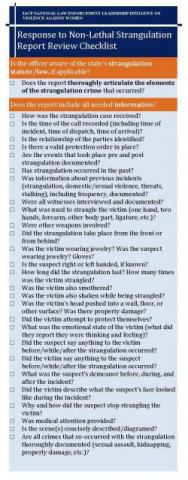
These tools serve to assist supervisors in ensuring that reports capture significant and comprehensive details and the totality of crimes that occurred. The checklists can also be utilized by first-responders as a training tool to highlight the specifics needed in a thorough report, and as a resource for first-responders as they complete reports, interview victims, and reflect on whether pertinent information has been effectively documented.
Explore the full Violence Against Women resource library:
IACP - Smaller Law Enforcement Agency Program Personnel Administration
Personnel administration is an area in which newer law enforcement executives may not have been exposed to earlier in their careers. This is an area that can cause significant challenges, but there are also many resources available to help new executives navigate this terrain.

Click here to return to the New Executive E-Source homepage.


