
Resources
IACP's resources are aimed at helping law enforcement executives do their jobs better and cover a variety of topics, including professional development, leadership, management, and supervision, as well as hot topics such as ethics.
Resources
IACP - Smaller Law Enforcement Agency Program Resource Center
Newer executives may feel isolated and disconnected from the resources they need. However, there are many organizations and networks that are available to provide support and assistance to law enforcement executives.
Learn More About the International Association of Chiefs of Police
Member Benefits
Membership Criteria
Member Discounts
Learn About Other Law Enforcement Member Organizations
Other Law Enforcement Resource Centers
Learn about the Bureau of Justice Assistance
- BJA’s Bulletproof Vest Partnership
- BJA’s Public Safety Officers’ Benefits Program
- BJA’s Gang Resistance Education and Training Program
- BJA's National Training and Technical Assistance Newsletter
Learn about the National Criminal Justice Reference Service (NCJRS)
Learn about Community Oriented Police Services (COPS)
IACP History & Resolutions
Officer safety has always been an issue of paramount importance for the IACP. As police leaders, the IACP membership understands the threats and dangers encountered by officers on a daily basis and the need to provide all possible information, awareness, and training to give officers an advantage when these situations arise. For these reasons, in 2002, the IACP Division of State Associations of Chiefs of Police (SACOP) created the SafeShield initiative.
Dedicated to protecting our nation’s law enforcement officers, the SafeShield Committee is made up of devoted IACP/SACOP members who are committed to officer safety. It is the belief of SafeShield that although police chiefs have limited control over dangerous situations an officer may face in the line of duty, they can control the outcomes through comprehensive planning, awareness, and the use of protective equipment.
In 2006, the IACP membership adopted a SACOP resolution, “A Vision for Officer Safety”, which embraced the philosophy of the SafeShield initiative and the vital role that police chiefs must play. The resolution states that law enforcement leadership must set the tone to create an environment in which officer safety is the top priority of every department, and although no one can control the dangerous situations that officers face in the line of duty, we can control how officers are prepared to face these situations through policies, training, equipment, and uniforms.
Resolutions
- Mandatory Vest Use by Police Officers (2011) – A call on all law enforcement executives to immediately develop and implement a mandatory body armor wear policy for their department.
- Mandatory Seat Belt Use by Police Officers (2011) – A call on all law enforcement executives to immediately develop and implement a mandatory seat belt use policy for their department.
1. Enhancing Law Enforcement Response to Victims: 21st Century Strategy

Click here for the new Enhancing Law Enforcement Response to Victims Strategy Second Edition!

Enhancing Law Enforcement Response to Victims of Crime is a joint effort of the Office for Victims of Crime and the International Association of Chiefs of Police.
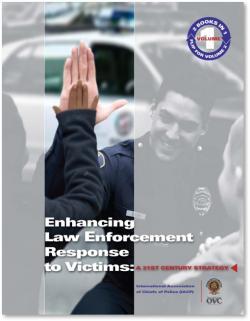
Click on the links below to go to a specific section in the Strategy.
- Message from Site Leaders
- I. Executive Summary
- II. Evolution of Law Enforcement Response to Victims and
Scope of the Project - III. Benefits and Challenges of Enhancing Response to Victims
- IV. Seven Critical Needs of Victims Law Enforcement Must Address
- V. Core Elements of Enhancing Response to Victims
- VI. Roles and Responsibilities of Law Enforcement Personnel
- VII. Importance of Community Partners
- VIII. Conclusion
Contact
For more information: [email protected]
Partners

This Web site is funded in whole or in part through a grant from the Office for Victims of Crime, Office of Justice Programs, U.S. Department of Justice. Neither the U.S. Department of Justice nor any of its components operate, control, are responsible for, or necessarily endorse, this Web site (including, without limitation, its content, technical infrastructure, and policies, and any services or tools provided).
Explore more victim assistance resources at:
2. Enhancing Law Enforcement Response to Victims: Implementation Guide

Click here for the new Enhancing Law Enforcement Response to Victims Strategy Second Edition!

The Implementation Guide consists of four instructive sections, which outline the steps to implement the strategy.

Click on the links below to go to a specific section in the Implementation Guide:
How to Get the Most Out of this Guide
- I. Starting
- II. Charting
- III. Implementing
- IV. Sustaining and Expanding
Contact
For more information: [email protected]
Partners
This Web site is funded in whole or in part through a grant from the Office for Victims of Crime, Office of Justice Programs, U.S. Department of Justice. Neither the U.S. Department of Justice nor any of its components operate, control, are responsible for, or necessarily endorse, this Web site (including, without limitation, its content, technical infrastructure, and policies, and any services or tools provided).
Explore more victim assistance resources:
3. Enhancing Law Enforcement Response to Victims: Resource Toolkit

Click here for the new Enhancing Law Enforcement Response to Victims Strategy Second Edition!

The Resource Toolkit Contains templates which assist in following the Implementation Guide.
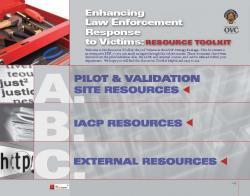
Click on the links below to go to a specific section in the Resource Toolkit.
- PILOT and VALIDATION SITE RESOURCES
- IACP RESOURCES
- Victim References
- Identity Theft
- Violence Against Women
- Juveniles, Family, and Children
- Offender Re-entry and Sex Offenders
- Gun Violence
- Protecting Civil Rights
- Hate Crimes
- Leadership
- Terrorism and Intelligence
- Forensics
- Resources for Smaller Agencies
- Volunteers in Police Agencies
- Research Guides
- IACP General Information
- EXTERNAL RESOURCES
Contact
For More Information: [email protected]
Partners
This Web site is funded in whole or in part through a grant from the Office for Victims of Crime, Office of Justice Programs, U.S. Department of Justice. Neither the U.S. Department of Justice nor any of its components operate, control, are responsible for, or necessarily endorse, this Web site (including, without limitation, its content, technical infrastructure, and policies, and any services or tools provided).
Explore more victim assistance resources:
A Guidebook for Families of Deployed Law Enforcement Officers

This family guidebook focuses on the families of military veterans in law enforcement. The guide will not only help families understand their obligations and expectations through the deployment cycle, but will detail the interaction that their spouses will experience between the military and law enforcement communities. Information on what law enforcement agencies can do to support the families of their deployed officers is also included. It is encouraged that law enforcement leaders provide this guide to the families of Guard and Reserve service members in their agency.
A Transition Guide for Veterans Beginning or Continuing Careers in Law Enforcement

This veteran’s guidebook developed from interviews and focus groups with military veterans serving in law enforcement, shares experiences and tips for veterans as they transition from deployment to resuming or beginning law enforcement careers. A comprehensive list of support agencies and networks available to veterans is also included.
Law Enforcement Leader's Guide on Combat Veterans

The International Association of Chiefs of Police (IACP) and law enforcement leaders across the United States recognize that combat veterans face many issues when they are deployed to combat duty and then return to either new or previously held positions as federal, state, local, and tribal law enforcement officers.
This guidebook provides recommendations to law enforcement leaders on how they can successfully improve the quality of support to returning combat veterans who are reentering law enforcement or launching a new career in policing. The guide also contains a training curriculum outline for incorporating relevant topics into specialized academy instruction and in-service training for both combat veterans and their supervisors. This curriculum will assist both hiring agencies and returning veterans to effectively address, discuss, and overcome any transitional obstacles.
Current Outreach Strategies and Marketing Techniques for Recruiting Combat Veterans
This document outlines the current outreach strategies and marketing techniques that law enforcement agencies use to market, recruit, and employ returning combat veterans. While some departments are successful in reaching out to combat veterans, others have not taken full advantage of modern marketing and recruiting tools, and have had limited success in recruiting service members who have served in Iraq or Afghanistan. This document provides relevant background information and summarizes some particularly outstanding policies, recommendations, and recruitment strategies currently offered by law enforcement agencies.
Employing Returning Combat Veterans: Findings and Recommendations from Field Research
The Employing Returning Combat Veterans as Law Enforcement Officers project team designed a series of five project activities: three data collection methods and two discussion groups, to capture a maximum amount of information, provide structured analysis of that information, and to develop recommendations and guidance for both law enforcement leaders and veteran officers
Ambush Fact Sheet

This report provides a comprehensive look at the nature of ambush attacks perpetrated against law enforcement officers in the United States since 1990, based on findings from the FBI’s Law Enforcement Officers Killed and Assaulted (LEOKA) in the Line of Duty data collection program.
Preventing Line of Duty Deaths: A Chief's Duty

This agency self-assessment tool is designed to help law enforcement leaders evaluate their agency’s efforts to address the safety needs of officers. Use this tool to proactively examine the range of critical officer safety strategies and determine areas where your agency can improve.


