Resources
IACP's resources are aimed at helping law enforcement executives do their jobs better and cover a variety of topics, including professional development, leadership, management, and supervision, as well as hot topics such as ethics.
Resources
Safe, Quick Clearance of Traffic Incidents Toolkit


The International Association of Chiefs of Police (IACP) and the National Highway Traffic Safety Administration (NHTSA) created the Safe, Quick Clearance of Traffic Incidents toolkit to provide law enforcement executives with information that demonstrates the importance of adopting practices that facilitate the safe, quick clearance of traffic incidents in order to increase responder and public safety; reduce traffic congestion and the risk of secondary crashes; and the overall quality of life in communities.
This toolkit includes:
- A white paper that highlights ef
 fective strategies that law enforcement agencies can utilize to improve their response to traffic incidents;
- How to get legislative buy-in
- Laws that promote safe, quick clearance
- Execution, Evaluation, and Education
- Talking points for law enforcement leadership, government officials, and roll call trainings;
- Infographic and poster for frontline officers including officer safety considerations;
- Press releases for general and specific incident use; and
- A comprehensive list of resources to assist agencies with implementing practices that ensure safe, quick clearance of traffic incidents.
To pre-order a copy of the Safe, Quick Clearance of Traffic Incidents toolkit, please click here and complete the requested information.
For other inquiries regarding traffic safety initiatives, please contact the IACP's Traffic Safety Initiatives team at [email protected].
Enhanced Collaborative Model (ECM) Anti-Human Trafficking Task Force Protocol Development Checklists
Development & Operations Roadmap for Multidisciplinary Anti-Human Trafficking Task Forces

Developing a multidisciplinary anti-human trafficking task force is a process that requires significant time, attention, and intention. In recognition of the challenges involved in...
The Crime of Human Trafficking: A Law Enforcement Guide to Identification and Investigation

The International Association of Chiefs of Police (IACP) offers a toolkit of Enhanced Collaborative Model (ECM) protocol development checklists that provide a list of items human trafficking task forces should consider when developing protocols specific to their local task force. These checklists encompass best practices, a trauma-informed and victim-centered approach, and are guided by the ECM, directing the development and implementation of strong and effective protocols.
- Information Sharing
- Trauma-informed Protocols for Accessibility of Services for Victims Who Are Deaf and/or Hard of Hearing
- Language Access
- Referrals to/from Law Enforcement and Victim Service Providers
- Communication and Working with the Media
- Confidentiality
- Data Collection
- Grant Reporting
For more information, please contact the IACP Anti-Human Trafficking team at [email protected] or visit the IACP Anti-Human Trafficking Webpage.
This project is supported by Grant Nos. 2015-VT-BX-KOO1 awarded by the Bureau of Justice Assistance. The Bureau of Justice Assistance is a component of the Department of Justice's Office of Justice Programs, which also includes the Bureau of Justice Statistics, the National Institute of Justice, the Office of Juvenile Justice and Delinquency Prevention, the Office for Victims of Crime, and the SMART Office. Points of view or opinions in this document are those of the author and do not necessarily represent the official position or policies of the U.S. Department of Justice.
Community Safety Policy Council Webinar
In this webinar, IACP Community Safety Policy Council Chair and IACP 2nd Vice President, Chief Dwight Henninger, led a discussion with committee and section chairs to provide their perspectives on community safety and impact the current events have on community trust building strategies.
Webinar
U.S. Presidential Candidate Responses to IACP Questionnaire

In keeping with the IACP’s mission to support and advance the policing profession, the IACP submitted to the two leading 2020 U.S. presidential nominees a questionnaire on pressing criminal justice policy issues. The questionnaire was sent to both President Donald J. Trump and Vice President Joe Biden and was designed to provide the IACP membership, and the policing profession, with important insight into their respective policy initiatives, in their own words.
While as a non-partisan, 501(c)3 non-profit organization, the IACP does not, and cannot, endorse or support candidates for political office, we are pleased to share the responses of President Trump and Vice President Biden. Their respective responses can be found here.
Developing Specialized Hybrid Units Webinar
IACP Midsize Agencies Division General Chair, Chief Ed Walsh from the Taunton, Massachusetts, Police Department led a discussion with officers from the Burbank, California, Police Department on Developing Specialized Hybrid Units.
Whether from budget cuts or staffing shortages, many agencies have had to rethink their approach to specialized units. The Burbank Police Department, CA used a matrix approach to draw on available time from existing staff across the department to create a hybrid gang unit. This cost neutral approach has been successful in re-establishing and maintaining positive community-police relations while reducing gang related offenses. Their example is scalable to any agency with similar challenges. During the webinar, Burbank Police Department leaders will share their approach, management of this hybrid unit, and lessons learned.
For more information on the IACP Midsize Agencies Division, click here.
Webinar
IACP 2020 Social Media Toolkit Assets

Thank you for serving as a presenter for the IACP 2020 Virtual Training Event and Expo. The IACP will be highlighting many excellent education sessions on our social media platforms in the weeks leading up to the event but personally promoting your session can create additional interest.
The IACP has provided this social media resource to support you in promoting your session and your event experience – leading up to, during, and after the event.
On this page you will find social media images for promoting IACP 2020 for Twitter, Facebook, and Instagram as well as your IACP 2020 Speaker Badge.
Speaker Badge
Social Media Images
Messaging About Suicide Prevention in Law Enforcement
Words matter and talking about suicide can be difficult. The way a police agency talks about suicide can have a significant impact on suicide prevention. Agencies, officers, and family members can learn how to properly talk about the topic of suicide in Messaging about Suicide Prevention in Law Enforcement: Strategies for Safe and Positive Messaging. This resource helps encourage conversation, promote resiliency, boost help-seeking, and encourage other behaviors that will help prevent suicide.
You can also watch the Preventing Law Enforcement Suicide Strategies for Effective and Positive Messaging here.
Police Communication Strategies for Navigating Difficult Dialogues Webinar
The IACP Public Information Officers Section hosted a webinar on Police Communication Strategies for Navigating Difficult Dialogue. Panelists discussed challenging conversations and social media messaging during public demonstrations and calls for police reform and restructuring. Attendees learned how to navigate difficult discussions and effectively communicate with the public. Facilitated by PIO Section Chair, Dionne Waugh from the Jefferson County, Colorado, Sheriff’s Office, the webinar included perspectives from public information officers and social media strategists from across the United States.
For more information on the IACP Public Information Officers Section, visit the PIO Section webpage. Please contact IACP staff at [email protected] with any questions.
Webinar
Evaluation of Implicit Bias Training
Racial and ethnic disparities in law enforcement outcomes are a topic of national debate, yet the factors which give rise to these disparities are not well understood. Many, including the President’s Task Force on 21st Century Policing, point to implicit bias as one factor which explains disparate treatment and recommend training on the topic. Although many law enforcement agencies have trained on implicit bias, there is no scientific evaluation of implicit bias training on police and policing.
This randomized experiment will determine the effectiveness of the training in raising officers’ awareness of and knowledge about unconscious bias, providing officers skills to manage their unconscious biases, and reducing the disparities in enforcement actions against different racial and ethnic groups.
Domestic Violence Analysis
The IACP Center for Police Research & Policy partnered with the Tulsa Police Department (TPD) to conduct a problem analysis regarding domestic violence in the City of Tulsa. A problem analysis is a systematic examination of the underlying conditions of local problems police are tasked with solving. This process is critical to developing solutions that fit the police problem in a community.
The problem analysis was completed in mid-2018 and resulted in some important findings for the TPD. One important and unintended finding was the discovery of substantial measurement error within the domestic violence data coding—but these inconsistencies led the agency to identify important patterns on which to focus their efforts. The problem analysis also revealed that many of the promising practices implemented in other agencies to combat specific types of domestic violence problems were somewhat inapplicable to the specific problem patterns identified in Tulsa. This demonstrates that evidence-based solutions which are readily available in other jurisdictions may not necessarily fit the crime problems in a different setting.
A problem analysis is an extremely helpful process to conduct when considering implementing an evidence-based solution to a problem. It is vital to start with the problem rather than solutions, because what works in one jurisdiction may not fit a specific problem in another locale.
Examining Case Clearance
The IACP Center for Police Research & Policy partnered with the Knoxville Police Department (KPD) in an evaluation of KPD’s investigatory process. This evaluation examined the impact of solvability factors and investigatory efforts by KPD on the likelihood of case clearance for burglary and robbery offenses. Solvability factors refer to the pieces of information about a crime that can provide the basis for determining who committed the offense.
While research regarding the productivity and effectiveness of police investigations in solving crime was conducted in the 1970s and 80s, few recent studies have evaluated the process of police investigatory work. It is possible that improvements in investigatory technologies since the 1980s (e.g., computers, license plate recognition, CCTV, DNA analysis) have enhanced the effectiveness of police investigations. However, many agencies – similar to KPD – report clearance rates that are stable or have declined over time.
The IACP Center for Police Research & Policy seeks to reinvigorate this line of research with the hope that this work can help inform police investigatory practices and further enhance both the effectiveness and efficiency in policing.
De-escalation (Use of Force)
These resources present studies of use of force and de-escalation training, synthesized into guidance for agencies to conduct their own evaluations for continual improvements to policies and practice.
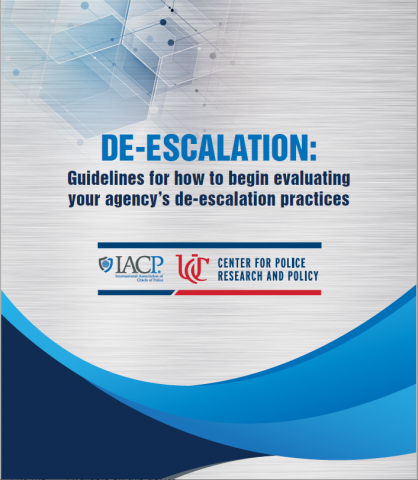
This comprehensive reference provides an overview of de-escalation including its theoretical foundations. It then offers a number of supplementary sections including examples of real-life evaluations and worksheets to help agencies evaluate their own de-escalation practices.
Evaluation of De-escalation Training
The IACP Center for Police Research and Policy evaluated de-escalation training using versions of the Integrating Communications, Assessment, and Tactics (ICAT) training program within the University of Cincinnati, OH Police Department (UCPD) and the Louisville Metro, KY Police Department (LMPD).
First, the evaluation within the UCPD served as a pilot study, which tested survey instruments with a medium-sized police department. The study was aimed at assessing the influence of ICAT training on officer attitudes, perceptions, and confidence. The findings of this evaluation demonstrate that the ICAT course increased UCPD’s officers’ reported confidence in and attitudes toward de-escalation skills. However, these changes were small, and decayed over time (with the exception of de-escalation specific to persons in crisis). Nonetheless, the results of this evaluation indicate potential for the ICAT program to improve officers’ attitudes and perceptions. In turn, improved attitudes toward de-escalation techniques are thought to make officers more amenable to practicing these techniques designed to save lives and reduce injuries to both community members and police officers, alike.
Read the full report of the pilot evaluation at UCPD.
Second, the evaluation in partnership with the LMPD presented a robust multi-method study, including a randomized control trial component, which examined the impacts of ICAT training on officer attitudes, first-line supervisor functions and attitudes, and officer behavior including uses of force, citizen injury, and officer injury. Most importantly, this research is the first known study to demonstrate significant changes in officer behavior as a direct result of de-escalation training. Specifically, this study demonstrated reductions in uses of force, citizen injuries, and officer injuries that were directly attributed to de-escalation training.
Read the full report of the initial findings of the multi-method study at LMPD.
A supplementary evaluation was conducted within the LMPD several months after the initial evaluation to further examine officers' and supervisors' attitudes, perceptions, and self-reported use of skills in the field. This evaluation used a repeated measure survey design to assess officers’ knowledge and attitudes; a cross-sectional survey design to identify first-line supervisors’ perceptions and self-reported activities; and a stepped-wedge randomized control trial to coordinate the LMPD’s training schedule and assess behavioral outcomes. The evaluation identified factors associated with receptivity to ICAT training, use of ICAT skills in the field, attitudes toward persons in crisis, and attitudes toward use of force.
Read the full report of the supplementary findings of the multi-method study at LMPD.
A Multi-Method Investigation of Officer Decision-Making and Force Used or Avoided in Arrest Situations
The IACP Center for Police Research and Policy partnered with researchers from the University of Texas at San Antonio (UTSA) to examine officer decision-making and use of force in arrest situations. This work was completed in collaboration with the Tulsa, OK Police Department (TPD) and the Cincinnati Police Department (CPD).
The goal of this work was to provide a better understanding of how and why police officers use force or desist in their use of force in encounters involving arrest. Relevant information on officers, citizens, incidents, and neighborhood context will be used to assess how and why some arrests turn violent when most do not.
This research aims to identify policies and practices for law enforcement agencies that may reduce the need for police use of force, lower the rate of injuries or deaths to citizens in police encounters, and reduce the likelihood of officer injury in their interactions with the public.
Read the full report detailing analysis of administrative data from the Tulsa, OK Police Department or a summary of the report.
Read the full report detailing analysis of narrative reports from the Tulsa, OK Police Department and the Cincinnati, OH Police Department or a summary of the report.