
Resources
IACP's resources are aimed at helping law enforcement executives do their jobs better and cover a variety of topics, including professional development, leadership, management, and supervision, as well as hot topics such as ethics.
Resources
Leading by Legacy Resource Toolkit
This toolkit is organized into three resource areas: individual, organization, and community. These areas were derived from the Leading by Legacy Program's training curriculum and have been identified as critical elements essential to promoting a positive legacy. This toolkit contains a fourth section dedicated to additional resources that do not necessarily fall under the three core areas, but provide supplemental information for smaller law enforcement agencies on leadership, management, and more.
About Leading by Legacy
Through the Leading by Legacy Program, the IACP seeks to meet the leadership and management needs of executives, command staff, and first line supervisors from smaller law enforcement agencies. Frequent changes in leadership and significant resource limitations are commonplace in smaller agencies as a result of the unique environment in which they operate. The Leading by Legacy Program offers assistance to smaller agencies to meet these challenges and build legacies focused on three core areas: individual, organization, and community. Building a legacy strengthens the capacity of individual leaders and organizations and one-agency-at-a time, enhances the reputation of the law enforcement profession.
Request Assistance
If you encounter any problems accessing the materials in this toolkit, you can contact a Leading by Legacy staff member for more information at [email protected].
Media
Toolkit Resources
Individual
Organization
Community
Additional Resources
The Leading by Legacy Online Resource Toolkit was funded with support from the Bureau of Justice Assistance, U.S. Department of Justice, Grant No. 2012-DP-BXK002 . Neither the U.S. Department of Justice nor any of its components operate, control, are responsible for, or necessarily endorse, this website (including, without limitation, its content, technical infrastructure, and policies, and any services or tools provided).


Critical Issues: Marijuana Legalization and Traffic Safety

Messaging Worksheet
The following messaging worksheet breaks down the topic of marijuana legalization and traffic safety and provides key talking points and facts to assist you in your daily communications about the subject. This worksheet is exclusively available to IACP members.
Resolutions
- Supporting the Collection and Reporting of Data on THC Extraction Laboratories to the Drug Enforcement Administration (2014)
- Opposition to the Legalization of Marijuana by States for “Recreational” Purposes (2013)
- Combating the Dramatic Increase in Drug-Impaired Driving Offenses (2012)
- Support for Drug-Impaired Driving Legislation, Research, and Training (2011)
- Increased Use of Drug Recognition Experts (2008)
- A Renewed Effort to Eliminate Alcohol and Drug Impaired Driving (2006)
Legislative Initiatives
Police Chief Articles
- Measuring the Impact of Marijuana Legalization with the Washington Roadside Survey of Driver Drug and Alcohol Use
- Rising Concerns over Marijuana-Impaired Driving
- Marijuana and Driving
- IACP Efforts to Combat Legalization of Marijuana Continue
- Drug Legalization: Why It Wouldn't Work in the United States
- IACP Opposes California Marijuana Legalization Effort
- Proposition 19: California’s Marijuana Legalization Debate
Critical Issues: Naloxone

The opioid epidemic has increased the likelihood that first responders will encounter overdose victims. Given that the success of reviving an overdose victim is dependent on swift treatment at the onset of the overdose, many law enforcement agencies are training and equipping officers to administer naloxone to overdose victims. This page will serve as a clearinghouse of resources to help guide law enforcement as they are confronted with difficult questions related to naloxone, more commonly known by the brand name Narcan.
Messaging Worksheet
The following messaging worksheet breaks down the topic of naloxone and provides key talking points and facts to assist you in your daily communications about the subject. This worksheet is exclusively available to IACP members.
Model Policy
This document is intended to explore the primary issues surrounding the use of naloxone, commonly known by the brand name Narcan, by patrol officers in cases of opioid overdose. This document examines the predominant issue areas with the intention of providing law enforcement executives with essential information to make informed decisions—whether that decision is to implement a naloxone program, modify an existing program, or reject or defer decision-making on this matter.
Resolutions
- Increasing Safety for Law Enforcement Personnel and First Responders in Response to the Dangers of Fentanyl (2016)
- Raising Awareness That Opioid Abuse May Lead to Heroin Addiction (2014)
- Raising Awareness of the Dangers of Fentanyl to Law Enforcement Personnel (2014)
- Bringing Awareness to Effective Tools Being Used to Combat Opiate Pain Reliever Overdose Deaths in the U.S. (2013)
Police Chief Articles
Other Resources
Addressing 21st Century Drug Issues: Law Enforcement’s Leadership Role (2016)
This report addresses the entire spectrum of current and emerging U.S. drug issues including illegal drug sources, at-risk populations, Naloxone Reversal programs, drugged driving, drug courts, drug treatment, and diversion. The report discusses selected drug issues concretely, such as those surrounding opioids, prescription drugs, heroin, methamphetamines, and marijuana, and concludes with an action agenda for law enforcement leaders, positioning them to take a lead role in addressing all drug issues from a systematic, community-based perspective.
Drugs of Abuse: Part 1 and Part 2 Training Key (2012)
This is a two-part Training Key® that discusses the current state of the drug trade and provides detailed information regarding the most commonly encountered drugs of abuse.
National Policy Summit on Community Police Relations
In response to events in Ferguson (MO), New York City (NY), and Cleveland (OH), the IACP held a National Policy Summit on Community-Police Relations in October 2014 to open dialogue regarding ways to build and sustain trusting communitypolice relationships. The summit brought together police chiefs from around the nation, national leaders of community- and faith‐based organizations, researchers, and representatives from nationally renowned and distinguished professional organizations such as the American Civil Liberties Union (ACLU), the Leadership Council on Civil Rights, the Police Foundation, the National Association for the Advancement of Colored People (NAACP), Lawyers Committee for Civil Rights, and the National Organization of Black Law Enforcement Executives (NOBLE) to discuss and debate this challenge.
This document is the resulting summit report. It is a call to action for every police executive and every police agency to take stock and recommit to the principles of justice and freedom as set forth in the Constitution and its amendments. Each citizen’s safety and civil rights are at the core of the oath that police officers take at the outset of their careers.
The report is designed to serve as a roadmap for law enforcement, communities, and stakeholders to build meaningful, sustainable, trusting, and effective working relationships. Summit participants outlined three conceptual elements of building community-police relationships. The report defines those elements—communication, partnerships, and trust—and provides recommendations for improvement in each. In addition, the report outlines a series of tangible strategies and steps for law enforcement executives to begin to build trust in their communities.
Critical Issues: Firearm Background Checks

Issue Overview
Dangerous people acquiring firearms is a serious problem that demands a federal response. State and local governments cannot go it alone, as ineligible firearm purchasers are able to circumvent the strong laws of some cities and states by obtaining guns in other states or jurisdictions with weaker gun laws where they can avoid a background check. Interstate trafficking is a critical problem, and requiring a background check for every gun sale reduces the flow of guns to criminals. This page will serve as a clearinghouse of resources to help guide law enforcement as they are confronted with difficult questions related to firearm background checks.
Messaging Worksheet
The following messaging worksheet breaks down the topic of firearm background checks and provides key talking points and facts to assist you in your daily communications about the subject. This worksheet is exclusively available to IACP members.
Model Policies & Papers
Resolutions
- Support for Regulating Sales of Firearms at Gun Shows (2007)
- Support for Firearms Offender Registries (2007)
- Unlawful Possession of Firearms (1998)
- Support for Federal Bureau of Investigation Checks on Applicants for State Private Security Officer Licensing(1997)
- Brady Extension Act (1997)
- Requirements for Concealed carry Weapons Permits
- Prosecution of Brady Act Violations
Legislative Initiatives
Police Chief Articles
Background Checks

Dangerous people acquiring firearms is a serious problem that demands a federal response. State and local governments cannot go it alone, as ineligible firearm purchasers are able to circumvent the strong laws of some cities and states by obtaining guns in other states or jurisdictions with weaker gun laws where they can avoid a background check. Interstate trafficking is a critical problem, and requiring a background check for every gun sale reduces the flow of guns to criminals. This page will serve as a clearinghouse of resources to help guide law enforcement as they are confronted with difficult questions related to firearm background checks.
Messaging Worksheet
Model Policies & Papers
Resolutions
Legislative Initiatives
Other Resources
International Association of Chiefs of Police Firearms Position Paper (2018)
The IACP has long advocated for the adoption of common sense policies that will assist in reducing gun violence. These proposals were drawn from the association resolutions and policy positions adopted by the IACP membership.
Reducing Gun Violence in Our Communities: A Leadership Guide for Law Enforcement on Effective Strategies and Programs(2011)
This guide provides information about notable programs and policing strategies that can be implemented by law enforcement agencies, regardless of size, in order to enhance the critical and life-saving mission of reducing gun violence. By highlighting innovative approaches developed by law enforcement departments and communities across the country, local leaders are encouraged to expand upon their current efforts in order to create a comprehensive program to enhance community and officer safety.
Taking a Stand: Reducing Gun Violence in Our Communities (2007)
This report focuses on recommendations on three main areas: keeping communities safe by improving public understanding about the risks of gun violence; preventing and solving gun crime by stopping the flow of illegal guns; and keeping police officers safe by improving training and support for officers in handling guns.
The National Law Enforcement Partnership to Prevent Gun Violence
The National Law Enforcement Partnership to Prevent Gun Violence (the Partnership) is an alliance of the nation’s law enforcement leadership organizations concerned about the level of gun violence in the United States. The Partnership works to address the pervasive nature of gun violence and its impact on community and officer safety
Officer Safety and Wellness
Explore the collection of IACP resources that support the safety, health, and wellness of every officer, and use these resources when developing comprehensive officer safety and wellness strategies. Learn about building resilience, injury prevention, peer support programs, physical fitness, proper nutrition, stress, mindfulness, suicide prevention, and more.
New Resource Spotlight
Check out the newest Officer Safety and Wellness resources from the IACP:
IACP Officer Safety and Wellness Conference
The 2026 OSW Conference will be taking place March 6-8 in New Orleans, Louisiana. Visit the OSW Conference event page for the latest updates.
Building Resiliency in Officers and Leaders
To overcome challenges officers face on a daily basis and to recover from a critical incident, officers need to develop resiliency within themselves. The IACP offers resources and guidance for every officer on and off the job, and across every rank. Learn how to navigate adversity and thrive in the face of challenges.
Tools and Resources
- Enhancing Officer Wellness and Resiliency in Policing
- Mastering Work-Life Balance
- Providing Officers Support through Police Chaplains
- Resilience: Keys to Helping Law Enforcement Children Thrive
- Resilience Strategies for Your Role
- The Critical Components of Officer Mental Wellness and Resiliency Brochure
- Justification Toolkit for Law Enforcement Resilience
- The Impact of Facility and Therapy Dogs on Resilience
- Families in Focus: How Agencies Can Support Personnel and Their Families
Videos and Virtual Events
- Perspective Series: The Role of Resilience in Officer Safety and Wellness
- Thriving in the Face of Adversity
- Trauma Webinar Series
- Integrating Resilience into Established Wellness Program
- VALOR Law Enforcement Resilience Training Program Short Overview
Current IACP Initiatives
For more information, please contact [email protected].
Law Enforcement Suicide Prevention
Officers experience job-related stressors ranging from interpersonal conflicts to traumatic events. This cumulative exposure may affect officers’ mental and physical health, contributing to problems such as post-traumatic stress symptoms, substance misuse, depression, and suicidal ideation. One officer suicide is one too many.
Browse through available resources and tools to raise awareness of and prevent officer suicide.
If you or someone you know needs help, please reach out.
- National Suicide Prevention Lifeline: 1-800-273-8255
- Crisis Text Line: Text HOME to 741741 in the United States. Text 686868 in Canada.
- The International Association for Suicide Prevention
Tools and Resources
- National Consortium on Preventing Law Enforcement Suicide™: Visit this page for resources created by multidisciplinary experts with a common goal of preventing officer suicide. Convened by the IACP, the Consortium focuses on solutions to emerging challenges and successes in addressing mental health and preventing officer suicide.
- Officer Wellness Dashboard: This dashboard provides an organized, easy-to-use database highlighting legislation in each state for peer support confidentiality protections and mental health & post-traumatic stress disorder (PTSD) in workers' compensation.
- Suicide Resource Webpage: The IACP and the National Consortium on Preventing Law Enforcement Suicide continue their commitment to reducing officer suicide deaths. This page provides information, resources, and contacts to help agencies with suicide prevention and provide support after a suicide death or attempt. If you need resources or information on preventing law enforcement suicide, supporting officer mental health, or responding after an officer suicide death occurs.
- The Signs Within: Suicide Prevention Education and Awareness
Policy Papers
(Note: access to most Model Policies is limited to IACP members only)
For more information, please contact [email protected].
Family Wellness
Police officers are routinely exposed to stressful, demanding incidents that challenge them both physically and mentally. While an officer’s individual health and wellness is important, the lifestyle and culture of policing has effects far beyond the officer themselves. Spouses, partners, parents, children, and companions of law enforcement are an essential support system for their loved one when they return home after every shift. These families and friends also need support to respond to the unique challenges they and their officer face on and off the job.
Tools and Resources
For Agencies
- Creating an Online Support Group: Digitally Connecting Officer Families
- Emergency Preparedness Considerations Toolkit
- Executive Guide for Developing Family-Friendly Law Enforcement Policies, Procedures, and Culture
- How to Start a Law Enforcement Family Support Group: Insights and Considerations
- If You Build It, Will They Come? Creating Wellness Opportunities for Law Enforcement Families
- Law Enforcement Family Engagement Assessment Tool
- Metrics Matter: Program Tracking and Evaluation
For Officers and Families
- Emergency Preparedness Considerations Toolkit
- Employee and Family Wellness Guide
- How Law Enforcement Parents Can Talk to Their Children about Current Events
- Resilience: Keys to Helping Law Enforcement Children Thrive
- Social Media Safety for Law Enforcement Families
- Supporting Law Enforcement Families in Understanding Trauma
- Supporting Officer Safety Through Family Wellness Infographic Series
Videos and Virtual Events
- Family Wellness Speaker Series
- Supporting Officer Safety Through Family Wellness Video Series
- Law Enforcement Family Wellness During COVID-19 Webinar
- Family Wellness Podcast Series
Policy Papers
- Employee Mental Health and Wellness
- Family and Medical Leave
(Note: access to most Model Policies is limited to IACP members only)
Current IACP Initiatives
For more information, please contact [email protected].
Officer Mental Health
Prioritizing officer mental health is essential for the well-being of officers and their colleagues, agencies, and communities. The IACP has developed resources promoting an environment that encourages law enforcement personnel to seek help, supporting officers in feeling and performing their best.
Tools and Resources: Guidance for Officers
- Identifying and Managing Anxiety in Law Enforcement Officers
- Identifying Grief and Loss in Law Enforcement
- Mindfulness Toolkit
- Preventing Problematic Alcohol Use among Police
- Overcoming Cumulative Stress and Burnout
- Vicarious Trauma Toolkit
Tools and Resources: Guidance for Agency Leaders
- Addressing Law Enforcement Mental Health
- Agency Assessment Tool and Action Planning Roadmap
- Identifying Grief and Loss in Law Enforcement
- Mass Violence Incident Quick Reference Guide
- Preparing for the Unimaginable: How Chiefs Can Safeguard Officer Mental Health Before and After Mass Casualty Event
- Preventing Problematic Alcohol Use among Police
- Overcoming Cumulative Stress and Burnout
- Implementing Peer Support Services in Small and Rural Law Enforcement Agencies
- What Does Wellness Look Like? Academy Curriculum Flyer
Videos and Virtual Events
- Grief & Loss in Law Enforcement: Helping Officers and Agencies Recover and Heal
- Individual Strategies to Address Officer Stress and Burnout
- Mindfulness Strategies for Law Enforcement Webinar
- Organizational Strategies to Address Officer Stress and Burnout Video
- Understanding Grief Strategies for Coping with Tough Losses
Policy Papers
- Employee Mental Health and Wellness
- Post-Shooting Personnel Support
- Responding to Persons Experiencing a Mental Health Crisis
- Temporary Light Duty
(Note: access to most Model Policies is limited to IACP members only)
Officer Safety
It is essential for police officers to be prepared with the knowledge and tools to protect and serve their communities to the best of their abilities. The IACP offers the following resources and considerations regarding officer safety in the field.
Tools and Resources
- Law Enforcement Equipment Basics
- Mass Violence Incident Quick Reference Guide
- P.R.E.P for Duty Poster
- Reducing Officer Injuries Final Report
- Traffic Safety
- Distracted Driving Toolkit
- Safer Roads, Stronger Communities
- Safe, Quick Clearance Toolkit
- Additional resources can be found on the IACP Traffic Safety webpage
Videos and Virtual Events
- Traffic Safety: Is Today Your Day?
- Traffic Safety Initiatives Video Series
- Webinar: Officer Safety Considerations for Domestic Violence Calls
Policy Papers
- Arrests
- Body Armor
- Hostage Situations
- Investigation of Officer-Involved Shootings
- Post-Shooting Personnel Support
- Response to Barricaded Individuals
- Special Weapons and Tactics (SWAT)
(Note: access to most Model Policies is limited to IACP members only)
Physical Wellness
Officers can enhance their physical health through diet, exercise, and adequate sleep. Maintaining good physical health can reduce officers’ risk of developing hypertension, heart disease, cancer, degenerative joint diseases, and diabetes. Those who maintain a healthy weight, or an active lifestyle, can reduce their risk and severity of injury. The resources below will be helpful for an agency seeking to build out their physical health and nutrition education programs.
Tools and Resources
Nutrition
- Nutrition Infographic
- Eating Well On-The-Go Fact Sheet
- Eating Well on the Go: Agency Considerations
- Eating Well on the Go: Healthy Eating and Sugar Consumption Wallet Card
- This or That: Choosing Healthy Meal Components
Sleep
Physical Wellness
- Acquired Brain Injuries (ABI) Infographic
- Fitness Considerations Guide
- Reducing Officer Injuries Resource Series
Medical Care
Videos and Virtual Events
Policy Papers
(Note: access to most Model Policies is limited to IACP members only)
For more information, please contact [email protected].
Retirement
The transition into retirement comes with many adjustments and questions. Planning for retirement throughout an officer’s career can help navigate changes in finances, family wellness, and social identity.
Tools and Resources
- Law Enforcement Retirement Toolkit
- Supporting Officers after the Badge
IACP Officer Safety and Wellness Section
Join the IACP Officer Safety and Wellness Section. Members of the section will have access to the expertise of safety and wellness professionals from around the world, as well as exclusive content produced by the section. Members will also be able to join the Officer Safety and Wellness IACPengage online community where fellow section members share best practices, engage in collective problem-solving, and network.
Learn more about the section and membership opportunities here.
Police Family Support Training and Technical Assistance (TTA) Program

National Consortium on Preventing Law Enforcement Suicide™
Officer Response To Mental Illness
 As first responders, law enforcement professionals encounter individuals with mental illness or intellectual/developmental disabilities every day. Family members or members of the community are often involved as well. And while some individuals are in an emotional crisis, others exhibit behavior that maybe or is perceived to be linked to criminal acts. Sometimes crisis can occur because the disability was not recognized quickly enough. Too often these encounters result in tragedy.
Click here for the guide in PDF format.
Please contact Rosemary Demenno for more information: [email protected].
Policy and Oversight

This section outlines particular policy areas that should be addressed by agencies. However, having these policies is not enough; policies must reflect community values in order to enhance trust and legitimacy.
Reports & Publications
Articles & Blog Posts
Other Resources
- Law Enforcement Policy Center
- Training Key: Policy and Oversight
- Testimony of IACP - Policy and Oversight
Pre-Arrest Diversion Webinar Series


Law enforcement agencies across the United States are planning or implementing pre-arrest diversion (PAD) programs to address the needs of low-level non-violent offenders and the challenges of drug abuse and crime. But just how does an agency or jurisdiction start such a program? How do they create partnerships with behavioral health and other community-based service providers? How do they gain community support? This webinar series is intended to help leaders take the first steps in establishing a program that will fit the needs of their community.
Webinar 1: Starting Your Pre-Arrest Diversion (PAD) Effort: Law Enforcement, Behavioral Health, and Community Together
Police officers consistently encounter the criminal and non-criminal impacts of drug use and mental illness: disruptive behavior, overdoses, homelessness. Providing treatment and behavioral health services is not part of the traditional core mission of law enforcement, but some law enforcement agencies across the nation are launching innovative PAD programs that rely on partnerships with community-based organizations to create pathways to behavioral health, housing, and other social supports, so that individuals can get the services they need. These programs are experiencing promising results: crime reduction, improved community-police relations, reduction of the treatment burden on the justice system, restored lives and families, and jurisdictional cost savings.
This webinar:
- Webinar Provides a national overview of PAD
- Describes the five primary models currently in practice
- Covers the eight questions to be asked prior to starting your jurisdiction’s PAD initiative
- Shares key tips for establishing and maintaining partnerships between law enforcement and behavioral health and social service providers
- Introduces the Police, Treatment & Community Collaborative, a newly established national coalition of law enforcement and behavioral health practitioners and researchers tasked with advancing PAD goals, successes, and research
Panelists:
- Jac Charlier, National Director for Justice Initiatives, Center for Health and Justice at TASC, Chicago, IL
- Gregory A. Frost, President, Civil Citation Network, Tallahassee, FL
Handouts:
Panelist Bios
PowerPoint Slides (PDF)
Webinar and Q&A Transcript
Webinar 2: Law Enforcement’s Path to Improving Public Safety: Partnering with Local Behavioral Health Agencies
The nation’s opioid epidemic and a growing recognition of the impact of mental health issues are causing a shift in the way law enforcement responds to individuals suffering from addiction and mental illness. While it is not part of the core mission of law enforcement to provide treatment and behavioral health services, many are finding that by partnering with organizations that are equipped to meet these challenges, substantial strides can be made to address substance use and mental health issues within their communities.
This webinar provides information on how law enforcement can build relationships with behavioral health organizations to address community drug problems as well as treatment alternatives for mentally ill individuals.
Presenters will discuss:
- How the opioid crisis and overdose deaths led to current partnerships and Cape Cod’s Overdose Intervention Program (OIP);
- Why the OIP has grown in the greater community and how it elevated community policing; and
- Lessons learned about the benefits of working together in the community, including:
- a reduction in the number of overdose-related deaths,
- changing attitudes about the stigma attached to addiction, and
- the improvement of relations between law enforcement and the community
Panelists:
- Jac Charlier, National Director for Justice Initiatives, Center for Health and Justice at TASC, Chicago, IL
- Gregory A. Frost, President, Civil Citation Network, Tallahassee, FL
Handouts:
Panelist Bios
PowerPoint Slides (PDF)
Webinar and Q&A Transcript
Webinar 3: Promoting Public Safety through Diversion and a Housing First Approach
Since announcing their Plan to End Chronic Homelessness in 2015, including a community-wide adoption of Housing First, Milwaukee County is on the verge of being the largest county in the nation to hit functional zero for chronic homelessness later this year. Part of the success is due to an innovative partnership with local law enforcement, including the Milwaukee Police Department. By implementing new pre- and post-booking strategies, to include a focus on permanent housing instead of arrests for homeless individuals, Milwaukee County has seen a dramatic reduction in criminal justice activity for the homeless population.
Facilitated by the International Association of Chiefs of Police, this webinar will provide attendees with an overview of the Housing First approach to providing housing and support services to homeless individuals, including individuals with mental illness and behavioral health issues who are involved or at risk of involvement with the justice system. Presenters will explain the importance of providing stable housing and services as a platform from which people can pursue personal goals, such as seeking and participating in the treatment and social services provided in tandem with pre-arrest diversion programs.
Attendees will learn about Milwaukee’s successful Housing First program, including how housing navigators and law enforcement have worked together to reduce arrests, and how to access housing resources locally through the homeless services system.
Panelists:
- Kim Keaton, Director of Data and Analytics, Corporation for Supportive Housing, Washington, DC
- Cassandra Libal, Lieutenant, Milwaukee Police Department, Milwaukee, WI
- James Mathy, Housing Administrator, Milwaukee County Housing Division, Milwaukee, WI
Handouts:
IACP Safety and Justice Challenge
Reducing Police Officer Injuries
No injury or death to a law enforcement officer is acceptable, and the IACP is committed to helping instill a culture of safety in every agency, extending from the chief executive to the newest recruit. Understanding and tracking officer injuries are key elements of prevention.
Seatbelt Postcard
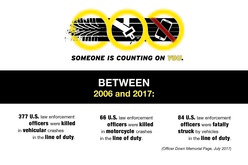
Too many officers have been killed in traffic related line-of-duty deaths. The Reducing Officer Injury postcard, developed with funding from the Bureau of Justice Assistance, Office of Justice Programs, U.S. Department of Justice, provides statistics, raises awareness, and educates via traffic related safety tips.
Please contact [email protected] to request a postcard.
Seatbelt Decal

Too many officers have been killed in traffic related line-of-duty deaths. The Reducing Officer Injury decal, developed with funding from the Bureau of Justice Assistance, Office of Justice Programs, U.S. Department of Justice, reminds officers to slow down, wear their seatbelt, and refrain from using in-vehicle technologies while driving. Please hand out these decals to your officers to put in their vehicles as a safety reminder.
Please contact [email protected] to request a decal.
Reducing Officer Injuries Study
This 12-month national study of 18 law enforcement agencies sought to examine and quantify the spectrum of injuries sustained by officers. The results documented nearly 1,300 reported injuries, nearly 6,000 missed work days, and nearly $2 million in estimated overtime costs. Examples of key findings include:
-
Officers with less than five years of service were most likely to sustain injuries
-
Officers wearing seatbelts during a crash missed an average of five fewer days compared with officers not wearing seatbelts
-
Officers trained in arrest procedures, tactics, and use of force sustained less severe injuries.
|
Final Report |
Executive Summary |
Infographic |
| |
|
|
|
Fact Sheet: The Importance of Tracking Injuries |
Fact Sheet: The Impact of Fitness & Weight on Injuries |
|
| |



Tracking officer injuries can contribute to an organizational culture of safety. Detailed, consistent tracking at the agency level allows department officials to identify common injuries, better evaluate risk, and implement or improve agency injury prevention and mitigation policies, practices, and training. To assist and encourage injury tracking at the agency level, IACP has created an online injury tracking database which is being piloted in the state of Delaware currently.

Tracking "Near Misses"
The IACP is a partner in the Police Foundation's LEO Near Miss Reporting System, a voluntary, non-disciplinary reporting system that allows law enforcement personnel to read about and anonymously share “close calls” or “near misses,” provide lessons learned that can protect others from similar incidents. A near miss is defined as a close call and/or unsafe occurrence that could have resulted in a serious injury or fatality if not for a fortunate break in the chain of events.
Safety & Wellness Pages
Related Projects
Reducing Risks: An Executive's Guide to Effective Juvenile Interview and Interrogation
The juvenile interview and interrogation landscape is undergoing an unprecedented upheaval. Over the past decade, numerous studies have demonstrated that juveniles are particularly likely to give false information – and even falsely confess – when questioned by law enforcement. Based on this research, court decisions are leading police to question juveniles differently than adults.
The juvenile interview and interrogation landscape is undergoing an unprecedented upheaval. Over the past decade, numerous studies have demonstrated that juveniles are particularly likely to give false information – and even falsely confess – when questioned by law enforcement. Based on this research, court decisions are leading police to question juveniles differently than adults.


