
Youth Focused Policing: Sample Impact Evaluation Plans
These sample evaluation plans illustrate the evaluation process for five law enforcement youth programs. They demonstrate how various components of a program build on each other to display the impact of a program. They provide applied examples of the impact evaluation process, as demonstrated in the diagram below:
Read more about the eight steps of impact evaluation.
These plans include examples of programs that fall under five youth program categories:
Athletics: Programs or services involving athletic or recreational activities to improve relationships between youth and law enforcement

Diversion: Programs or services designed to provide early intervention for juvenile offenders to avoid entry into the criminal or juvenile justice system

Mentoring: Programs or services in which law enforcement officers serve as mentors to youth in need of guidance and positive adult relationship

- Prevention and/or Intervention: Programs or services that target youth at risk for delinquency or have exhibited problem behavior

Police Department Impact Evaluations
To view examples of impact evaluations on various youth/police programs. Check out the evaluation studies below:
Las Vegas Metropolitan Police Department School Violence Initiative
Memphis School House Adjustment Program Enterprise (SHAPE)
Related Content
Response to Stalking Report Review Checklist

The crimes of violence against women, including sexual assault, domestic violence, and stalking, are complex and can pose challenges to responding officers. Oftentimes, significant details are missed and necessary elements to document these crimes are left out of reports. In order to support law enforcement first-line supervisors as they review reports for stalking, strangulation, sexual assault, domestic violence, and protection order violations, the IACP created five violence against women Report Review Checklists.
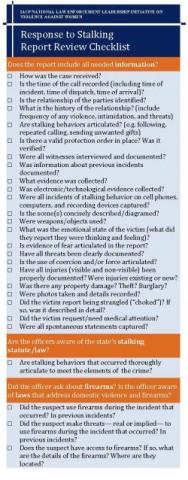
These tools serve to assist supervisors in ensuring that reports capture significant and comprehensive details and the totality of crimes that occurred. The checklists can also be utilized by first-responders as a training tool to highlight the specifics needed in a thorough report, and as a resource for first-responders as they complete reports, interview victims, and reflect on whether pertinent information has been effectively documented.
Explore the full Violence Against Women resource library:
Traffic Enforcement During the COVID-19 Pandemic

While COVID-19 cases are steadily increasing within the U.S., law enforcement agencies continue to respond to incidents and enforce traffic laws in their communities, despite the operational challenges they may face on roadways due to the pandemic. Below are considerations to take when making traffic stops or conducting traffic safety initiatives.
The following recommendations were created in consultation with a small sample of police agencies from around the United States.
For specific considerations related to impaired driving
during the COVID-19 pandemic, please see the tool,
Processing DUIs during the COVID-19 Pandemic:
Considerations for Law Enforcement.
PROCEDURAL CONSIDERATIONS FOR MAKING TRAFFIC STOPS DURING COVID-19
Police officers responding to traffic infractions should consider implementing the following directives:
- Wash or sanitize hands promptly after physically interacting with others. Wash hands for at least 20 seconds with soap and water. If soap and water are not readily available, use a hand sanitizer with at least 70% alcohol. Wash or sanitize hands after coughing or sneezing.
- Maintain safe distancing when conducting traffic stops and other contacts with victims, witnesses, suspects, and others. A minimum of six feet is recommended between individuals. Examples of physical distancing include:
- Passenger-side approaches
- Taking statements from at least six feet away
- Glove use during traffic operations with glove holders being attached to duty belts;
- Use of electronics:
- Physical document exchange may be avoided through capturing images of licenses, registrations, etc.; consult agency policy.
- Physical signatures may not be required; consult agency policy.
- Use a PA system to give directions.
- Minimize the amount of contact during a traffic stop by reducing time spent at the window with the driver.
- Sanitize items you frequently touch during a shift as COVID-19-infected droplets may be able to live on nearly any surface. Items may include:
- Phone
- Laptop
- Clipboard
- Pens
- Patrol car equipment:
- Steering wheel
- Seat belt buckles
- Gear shift
- Dispatch radio module and microphone
- Door handles and edges
- Drive with windows open (at least partially) to ventilate the patrol vehicle.
- Wear appropriate Personal Protective Equipment (PPE). Wear a mask during interactions with others.
- Use non-latex gloves (nitrile or vinyl). Follow guidance or procedures from your agency for other PPE recommendations or requirements.
POLICY CONSIDERATIONS FOR LAW
ENFORCEMENT EXECUTIVES
Police leaders should consider implementing the
following directives for modifying agency policy and
guiding line officers in their response to traffic infractions.
Also, consider the above procedural guidelines and
determine which (if any) will be added to agency policy
and which will be left to officer discretion.
Prepare Officers
Consider the following to better prepare your officers to
respond to traffic infractions:
- Communicate to officers what violations are essential to uphold public safety, and consider limiting traffic enforcement for non-critical concerns, such as parking violations, expired tags, and inoperable headlights, etc. Consider advising officers to:
- Stop drivers who are severely threatening safety.
- Tailor traffic enforcement by only responding to aggressive, egregious violations.
- Monitor for minor violations that may indicate impairment. Examples include:
- Driving outside the lanes or aloft of center,
- Failing to signal,
- Improper left turns,
- Running a stop sign, or
- Failing to yield to oncoming traffic on an Interstate.
- Issue guidance on whether officer response is necessary for minor traffic crashes without injuries and with no indication that an operator is impaired by drugs or alcohol, which may be handled by an exchange of driver information and a report submitted by mail or online.
- Caution officers to be more mindful and conservative when conducting proactive traffic stops.
- Ensure officers continue to make traffic stops when violations are observed, as departments may observe an increase in speeding. For example, based on 18 days’ worth of data in April 2020, one agency projected:
- A possible 40% increase in speeds 70 – 79 MPH
- A possible 500% increase in speeds 100 – 109 MPH8
- Provide training on effective practices for traffic stops during the COVID-19 pandemic.
- Develop plans for officers to monitor arterial roadways.
- Discourage unsafe driving practices by keeping officers as visible as possible to the public.
- Consider assigning officers for site security and traffic control in areas such as COVID-19 test sites, grocery stores, and pharmacies.
- Create a plan to safely obtain document information, which may include:
- Writing down driver license number or insurance number without physically handling the documents. Consider taking a picture of the car with its license plate visible.
- Wearing gloves and using hand sanitizer afterwards (or washing hands at a sink, if available).
- Working with your agency’s legal advisor to explore possibilities for suspending the signature requirement on citations.
- Wiping down the pen with sanitizer before and after use, if you must exchange a pen with others for ticket signatures.
- Equip personnel with appropriate PPE, including but not limited to:
- N95 masks
- Nitrile or vinyl gloves
- Goggles
- Disinfectant spray and wipes.
- Continue to re-stock supplies by ordering sufficient quantities of PPE.
- Consider suspending duties which are largely impractical in the current environment – for example, Child Passenger Safety Details such as fitting stations, which cannot be completed under state physical distancing mandates.
- Instruct officers to clean and sanitize hands and vehicle interior after conducting a traffic stop:
- Sanitize and wash patrol vehicles after contact with others through traffic stop or arrests using bleach/sanitizer and water and/or wipes.
- Park patrol vehicles in a designated garage with windows open to air out after cleaning.
- Instruct officers to shower and wash uniforms at the end of the day. Upon entering home or station house, use grass or sand as a shuffle pit to clean debris from the bottom of work shoes or boots.
Use Technology
Leverage technology, as applicable. For example:
- Consider that automated enforcement may be necessary to help prevent the number and seriousness of traffic collisions.
- Consider use of aviation assets (such as Ohio State Highway Patrol’s TRIAD: Targeting Reckless Intimidating Aggressive Distracted Drivers) to spot violations in a measured speed zone 1-2 miles long, if available.
- Utilize digital speed boards in neighborhoods to remind drivers of their speed.
- Collect speed data to help the department better assign resources.
- Use speed measuring devices to collect data and information on traffic volume.
- Work with traffic safety partners, like the Highway Safety Office, to spread messages such as reminding drivers to:
- utilize their seat belts just like they are wearing masks;
- share the road, and
- be alert for increased pedestrian and bicycle traffic; and
- focus on driving when behind the wheel.
Communicate with the Public
- Communicate your agency’s traffic enforcement plans to the public. For example:
- Communicate how the agency will be conducting traffic enforcement and what community members should expect in that interaction, including how officers will limit physical contact and maintain physical distance.
- Provide information on the use of speed measuring devices and violations.
- Consider increasing communication through the media by providing positive stories about community engagement. Avoid focusing on only traffic-related issues.
While police agencies will never be able to eliminate close contact, they are developing ways to mitigate the risk of virus transmission to protect their officers and community members. This will be an ongoing process. Some agencies have observed a shift in driver’s attitudes and reactions. Consider the driver’s state of mind, as this is a stressful time for everyone.


