
Resources
IACP's resources are aimed at helping law enforcement executives do their jobs better and cover a variety of topics, including professional development, leadership, management, and supervision, as well as hot topics such as ethics.
Resources
Law Enforcement Cyber Center
The Law Enforcement Cyber Center (LECC) is a centralized resource hub designed to support law enforcement agencies in investigating cyber incidents, managing digital evidence, and collaborating effectively across disciplines. The LECC provides practical tools, training, and guidance to help agencies build capacity and stay ahead of emerging threats in the digital landscape.
Whether you're an agency leader, frontline officer, investigator, or prosecutor, LECC offers tailored support to help you navigate the complexities of cybercrime investigations and invest in the professional development of your personnel.
Visit the LECC
Key Resources Available Through LECC
- Training Modules: Self-paced and instructor-led courses covering cybercrime investigations, digital forensics, and online safety.
- Webinars and Events: Opportunities for ongoing professional development and peer learning.
- Toolkits and Guides: Practical resources for managing digital evidence, securing devices, and implementing cybercrime response protocols.
- Personnel Development Tools: Resources that support individual skill-building, career advancement, and agency-wide capacity development in cybercrime response.
- Policies and Legal Guidance: Information on jurisdictional issues, privacy considerations, and legal frameworks relevant to cyber investigations.
- Case Studies and Promising Practices: Real-world examples and lessons learned from successful cybercrime investigations.
Who Should Use the LECC
LECC is designed to support:
- Local, state, tribal, and federal law enforcement
- Agency leadership and policymakers
- Digital forensic examiners and cybercrime investigators
- Prosecutors and legal professionals
November 2018 Monthly Line of Duty Deaths Report
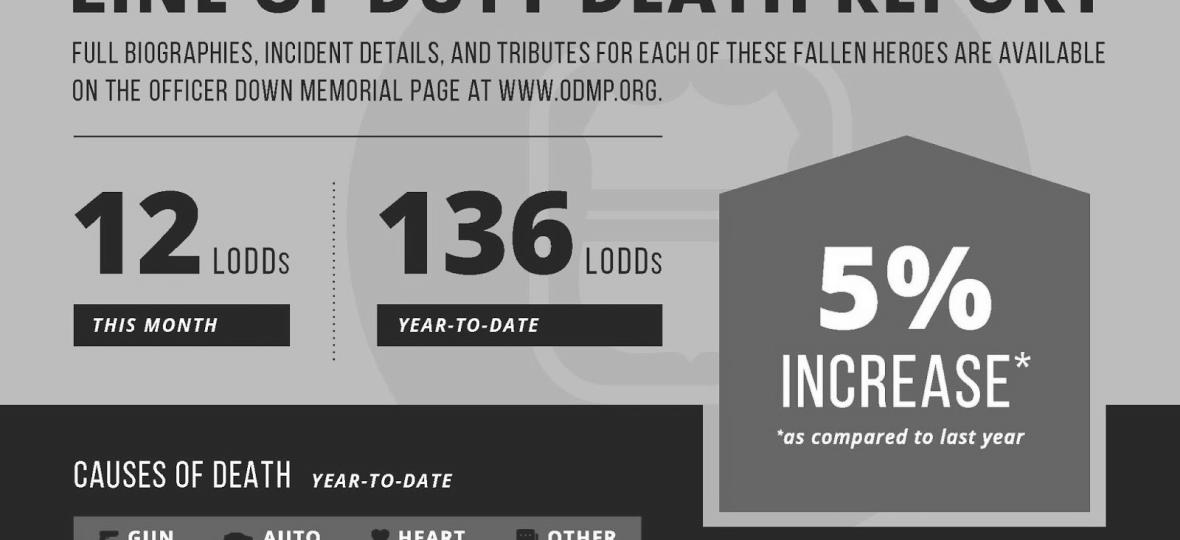
The monthly United States Line-of-Duty Deaths Report is a joint publication of the International Association of Chiefs of Police (IACP) and the Officer Down Memorial Page (ODMP). IACP and ODMP are committed to honoring fallen law enforcement officers while also raising awareness about line-of-duty deaths, including related trends and casual factors.
Responding to Hate Crimes: A Police Officer's Guide to Investigation and Prevention
December 2018 Monthly Line of Duty Deaths Report
The monthly United States Line-of-Duty Deaths Report is a joint publication of the International Association of Chiefs of Police (IACP) and the Officer Down Memorial Page (ODMP). IACP and ODMP are committed to honoring fallen law enforcement officers while also raising awareness about line-of-duty deaths, including related trends and causal factors.
Supporting Officer Safety Through Family Wellness: Injury Reduction
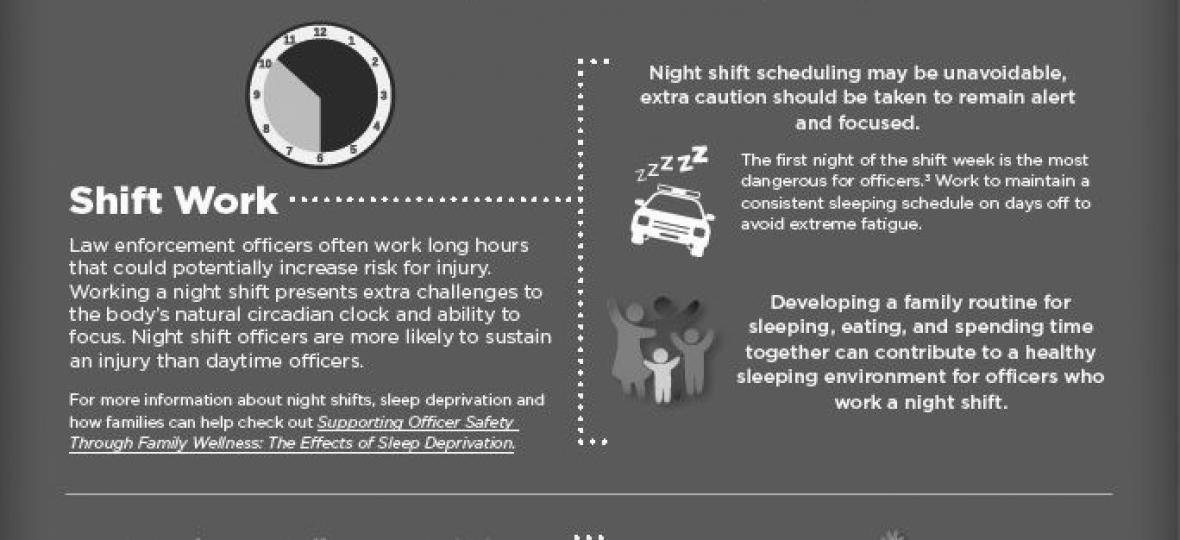
Taking efforts to decrease the likelihood of injury is a crucial part of officer safety and wellness. This infographic discusses the prevalence of injuries and suggestions on how to reduce injuries to both law enforcement officers and their families.
Action Agenda for Community Organizations and Law Enforcement to Enhance the Response to Hate Crimes

The IACP partnered with the Lawyers’ Committee for Civil Rights Under Law to launch the Enhancing the Response to Hate Crimes Advisory Committee, which convened leaders in law enforcement, civil rights, and academia for a series of discussions examining promising practices for response to hate crimes. The committee members identified five critical issues that are imperative to enhancing hate crimes response practices, as well as an action agenda for community organizations and law enforcement to address each critical issue.
The goal of these action items is to help break down barriers and strengthen trust between law enforcement and the communities they serve to enhance the prevention, reporting, investigation, and successful prosecution of hate crimes. Once implemented, these action items will enhance the ability of law enforcement, civil rights organizations, and community organizations to more effectively address hate and bias-motivated crimes in their communities and to help ensure the safety of all individuals threatened by hate.
The Five Critical Issues for Addressing Hate Crime:
- Increasing Community–Law Enforcement Collaboration to Address Hate Crimes, Including Partnerships with Civil Rights and Community Organizations
- Enhancing Training and Education About Hate Crimes for Law Enforcement, Prosecutors, and Community Members
- Strengthening Data Collection, Reporting, and Analysis
- Improving Hate Incident and Crime Management Policies and Responses for Law Enforcement
- Role of Prosecutors: Early and Ongoing Communication with Law Enforcement, Proactive Engagement with Community, Development of Hate Crimes Expertise
Support for Participation in the National Use-of-Force Data Collection

OVERVIEW
On January 1, 2019, the FBI launched the National Use-of- Force Data Collection as a voluntary program to gather data on law enforcement use-of-force incidents and provide an aggregate view of the associated circumstances, subjects, and officers involved.
The IACP has supported this effort since its conception and strongly encourages all agencies to participate.
Up to this point, major news outlets have been the only source for use of force statistics in the U.S., having compiled and analyzed their own version of this data since 2015. The FBI’s national data collection is an opportunity for the law enforcement community to take the lead and fill a void in use-of-force reporting. The National Use-of-Force Data Collection will foster more informed conversations around use-of-force incidents and demonstrate law enforcement's commitment to transparency, fair and impartial policing, and community trust.
This can only happen if agencies opt in to participate.
USE OF FORCE INCIDENTS DEFINED
Not all uses of force are reportable to the new system. The only cases where police use of force is reportable to the FBI is where an officer’s use of force results in
- the death of a person,
- the serious bodily injury* of a person, or
- the discharge of a firearm at or in the direction of a person that did not otherwise result in death or serious bodily injury.
*“Serious bodily injury” means “bodily injury that involves a substantial risk of death, unconsciousness, protracted and obvious disfigurement, or protracted loss or impairment of the function of a bodily member, organ, or mental faculty.” This definition is based, in part, upon Title 18, United States Code, Section 2246 (4).
NOTE: Police leaders should not wait for a qualifying use-of-force incident to enroll; "zero reports" are equally important and should be filed for each month where no qualifying uses of force occur.
IACP INVOLVEMENT AND SUPPORT
Members should know their interests have been well represented throughout the collection’s development, with IACP participation on the FBI’s Criminal Justice Information Services Advisory Policy Board and the National Use-of-Force Collection Task Force. Further, IACP Resolution CRC. 11.t16 supports building public trust through effective reporting of police use of deadly force.
HOW TO SUBMIT
Agencies may report to the FBI only through the FBI’s Law Enforcement Enterprise Portal (LEEP). To apply for a LEEP account, a chief or officer should go to www.cjis.gov and click on “Apply for an Account.” Once the LEEP account is authorized, users may register for the “National Use-of-Force Data Collection.” Use of this portal requires no financial investment and allows agencies and state programs to manage all aspects of their use-of-force data.
MORE INFORMATION
The checklist linked at right is available to assist chiefs with this issue. The sample letter can be used by state and regional chiefs associations to urge participation among their memberships.
See also www.fbi.gov/useofforce for additional information. The National Use-of-Force Data Collection publications are available on the FBI’s Crime Data Explorer website at fbi.gov/cde.
The Use-of-Force Help Desk may be reached via telephone 304-625-9998 or email [email protected].
RELATED RESOURCES
IACP Law Enforcement Policy Center
Reporting Use of Force Model Policy & Issues Paper
Critical Issues Messaging
Police Chief Magazine Articles
June 2019 Police Chief Magazine - several articles
The National Use-of-Force Data Collection: Now Enrolling Agencies and Accepting Data
The Pursuit of Reliable and Accurate Data: One City’s Experience with Use-of-Force Reporting
National Use-of-Force Data Collection
Building Community Trust Through Transparency: The FBI's National Use-of-Force Data Collection
January 2019 Monthly Line of Duty Deaths Report
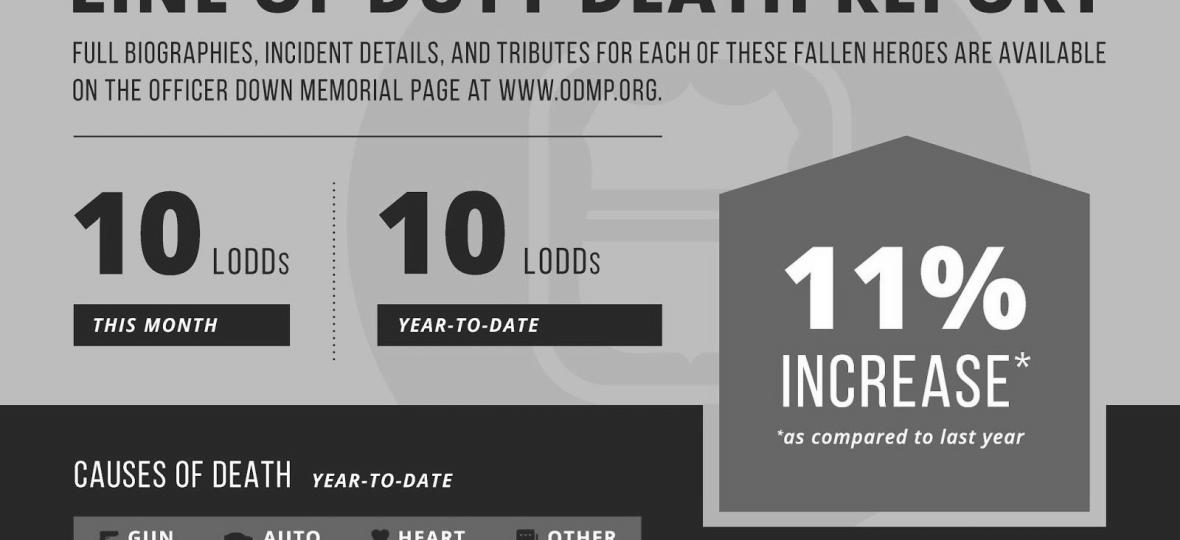
The monthly United States Line-of-Duty Deaths Report is a joint publication of the International Association of Chiefs of Police (IACP) and the Officer Down Memorial Page (ODMP). IACP and ODMP are committed to honoring fallen law enforcement officers while also raising awareness about line-of-duty deaths, including related trends and causal factors.
February 2019 Monthly Line of Duty Deaths Report
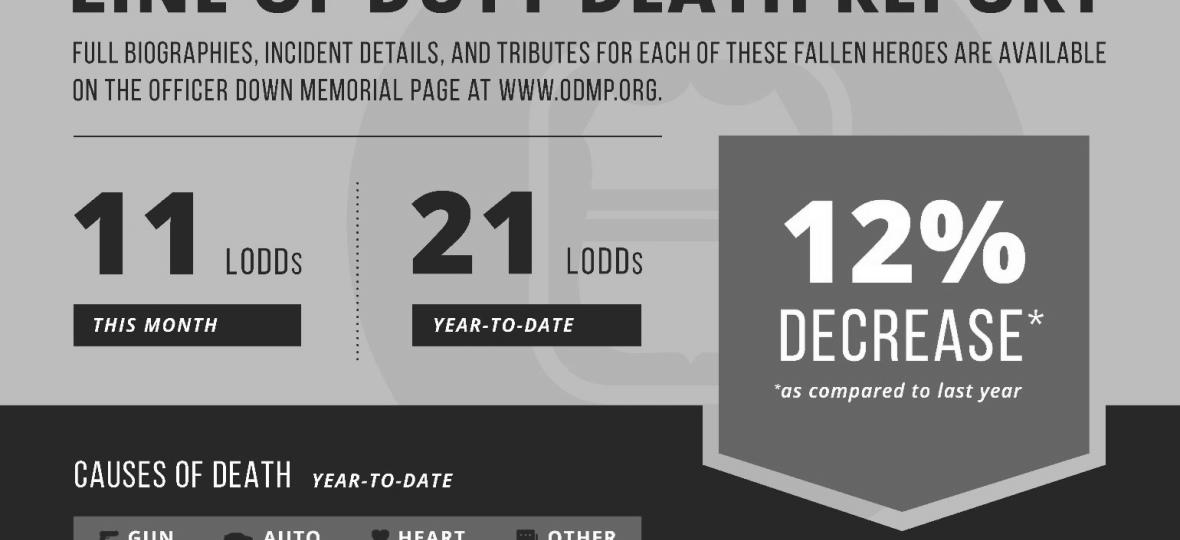
The monthly United States Line-of-Duty Deaths Report is a joint publication of the International Association of Chiefs of Police (IACP) and the Officer Down Memorial Page (ODMP). IACP and ODMP are committed to honoring fallen law enforcement officers while also raising awareness about line-of-duty deaths, including related trends and causal factors.
21st Century Policing: Innovation in Local Communities

The 21st Century Policing: Innovation in Local Communities Report was created by the IACP learn and support innovative and evidence-based practices in 21st century. In the report, various agencies of different sizes and geographic locations are represented and share promising practices, common challenges, and community-focused solutions.
For more case studies and resources on how your community can implement policies, procedures, and programs that increase community trust by facilitating dialogue, increasing transparency, leveraging technology, training officers, and more, contact the IACP Institute for Community-Police Relations at [email protected] or visit http://www.theiacp.org/icpr.
EXPIRED Support of Environmental Protection and Environmental Enforcement Officers

Support of Environmental Protection and Environmental Enforcement Officers
Submitted by the IACP Environmental Crimes Committee
ECC.06.t2018
WHEREAS, the value of environmental crime, globally, is estimated at $91-258 billion annually;[1] and
WHEREAS, weak laws and poorly funded security forces are enabling international criminal networks and armed rebels to profit from a trade that fuels conflicts, devastates ecosystems and is threatening species with extinction; and
WHEREAS, environmental crime is the world's fourth-largest criminal enterprise after drug smuggling, counterfeiting and human trafficking.[2] The amount of money lost due to environmental crime is 10,000 times greater than the amount of money spent by international agencies on combatting it - just $20-30 million;[3] and
WHEREAS, environmental crime can aid in the finance of terrorism and conflicts. Both non-state armed groups, terrorist groups and other networks thrive on the exploitation of natural resources to fund their activities. Examples include Taliban funded by drugs, and both Janjaweed operating from Darfur into Central African Republic and Democratic Republic of Congo (DRC), and Lord's Resistance Army in DRC poaching elephants. At least 40 percent of internal conflicts in the last 60 years have a link to natural resources; and
WHEREAS, international criminal cartels are also involved in the trafficking of hazardous waste and chemicals including electronic waste, often mislabeling these wastes in order to evade law enforcement agencies. The illegal trade in e-waste alone is estimated at $12 billion annually[4]; and
WHEREAS, armed groups worldwide, use environmental crimes as a low-risk high-profit source of revenue, depriving governments of revenues while threatening peace, development and security; and
WHEREAS, over 1,000 protected-area-officers[5] have been killed worldwide and many more injured over the last 12 years (IUCN).[6] Over 740 of those from 2009-2017;[7] and
WHEREAS, the vast sums of money generated from environmental crimes not only degrade and harm the environment and threaten the safety of protected-area officers, but keep sophisticated international criminal gangs in business, fueling insecurity around the world; and
WHEREAS, enhanced law enforcement response can help deter current trends. Such collaboration, sharing and joining of efforts within and across borders, whether formal or informal, is our strongest weapon in fighting environmental crime. Now, therefore, be it
RESOLVED, the International Association of Chiefs of Police (IACP) calls for all enforcement agencies to highlight and bring attention to the scale of environmental crime, resources and lives lost, and to partner with and support agencies’ efforts to maximize the security and safety of environmental resources and protected-area officers worldwide.
[1] The Rise of Environmental Crime, A UNEP-INTERPOL Rapid Response Assessment, 2016, Page 7, http://web.unep.org/environmentalgovernance/erl/resources/publications/rise-environmental-crime
[2] Interpol Report on Human Trafficking: https://www.interpol.int/Crime-areas/Trafficking-in-human-beings/Trafficking-in-human-beings
[3] The Rise of Environmental Crime, A UNEP-INTERPOL Rapid Response Assessment, 2016, Page 7, http://web.unep.org/environmentalgovernance/erl/resources/publications/rise-environmental-crime
[4] The Rise of Environmental Crime, A UNEP-INTERPOL Rapid Response Assessment, 2016, Page 20, http://web.unep.org/environmentalgovernance/erl/resources/publications/rise-environmental-crime
[5] Employees of a “clearly defined geographical space, recognized, dedicated and managed, through legal or other effective means, to achieve the long-term conservation of nature with associated ecosystem services and cultural values.” (IUCN Definition 2008 - https://www.iucn.org/theme/protected-areas/about)
[6] Park Rangers on the Frontline Being Killed at an Astonishing Rate from India to Thailand to Africa, Global Conservation, March 31, 2016, http://globalconservation.org/news/park-rangers-frontline-being-killed-astonishing-rate-new-solutio/
[7] World Ranger Day 2017 – Ranger Roll of Honour In Memoriam, International Ranger Federation, 2017, http://www.internationalrangers.org/wp-content/uploads/2017/08/1.-2016_2017-Honour-Roll.pdf
EXPIRED Support for the Rescinding of the Cole Memo

Submitted by: IACP Board of Directors
BOD.01.t2018
WHEREAS, as law enforcement professionals, the top priority of the membership of the International Association of Chiefs of Police (IACP) is safeguarding their communities; and
WHEREAS, an essential element in safeguarding communities is reducing citizen exposure to controlled substances; and
WHEREAS, empirical evidence demonstrates that marijuana use is dangerous and a threat to the safety of the public; and
WHEREAS, in states that have legalized marijuana there has been a notable increase in the number of traffic crashes related to marijuana. For example, the percentage of traffic deaths related to marijuana doubled in Washington State the year retail marijuana sales were allowed.[1] In Colorado, marijuana is now involved in more than one of every five deaths on the road, and that number is rising;[2] and
WHEREAS, additionally, emergency room admissions for marijuana-related incidents have increased in states that have legalized marijuana use. Colorado has experienced an over 70 percent increase in hospitalizations related to marijuana since legalization, an average of over 30 percent per year;[3] and
WHEREAS, marijuana use has an adverse effect on the youth in our communities. In both Colorado and Washington, regular use of the drug among children aged 12-17 has been both above the national average and rising faster than the national average;[4] and
WHEREAS, in August 2013, Deputy Attorney General James Cole issued a memorandum that announced that the United States Department of Justice would not challenge marijuana legalization policies enacted by several states; and
WHEREAS, the Cole Memo also limited the ability of U.S. Attorney’s to investigate and prosecute marijuana cases in the various states that have chosen to legalize or decriminalize marijuana production, sale and use in violation of federal law; and
WHEREAS, the IACP strongly opposed the Department of Justice’s policy as set forth in the Cole Memo and believed that the decision to not challenge state marijuana laws ignored the connection between marijuana and crime, the enforcement problems created by trafficking marijuana across state, local and tribal borders, as well as the adverse economic and social costs that marijuana legalization causes; and
WHEREAS, the IACP believes that the Department of Justice’s unwillingness to challenge state marijuana legalization policies except under very narrow circumstances makes it infinitely more difficult for state, local and tribal law enforcement officers to keep their neighborhoods and communities safe from marijuana trafficking and its associated violence; and
WHEREAS, in January 2018, United States Attorney General Jeff Sessions issued a new memorandum rescinding the Cole Memo and directing all U.S. Attorneys to enforce the laws enacted by Congress and to follow well-established principles when pursuing prosecutions related to marijuana activities; and
WHEREAS, restoring discretion to U.S. Attorneys on how they prioritize the investigation and prosecution of violations of federal drug laws involving marijuana is an important and needed policy change that will allow federal prosecutors to work with their state and local counterparts to effectively deploy federal resources to reduce crime, combat drug use, target criminal gangs and promote safer communities. Now, therefore, be it
RESOLVED, that the International Association of Chiefs of Police reaffirms its long-standing opposition to the legalization and/or decriminalization of marijuana; and be it
FURTHER RESOLVED, that the International Association of Chiefs of Police commends United States Attorney General Jeff Sessions for his action in rescinding the Cole memo and ensuring that U.S. Attorney’s maintain the ability to effectively investigate and prosecute those individuals involved in the production and sale of marijuana in violation of federal law.
[1] AAA Foundation for Traffic Safety. Prevalence of Marijuana Involvement in Fatal Crashes: Washington, 2010-2014. May 2016. Web. 23 Oct. 2016.
[2] AAA Foundation for Traffic Safety. Prevalence of Marijuana Involvement in Fatal Crashes: Washington, 2010-2014. May 2016. Web. 23 Oct. 2016.
[3] Rocky Mountain Poison and Drug Center, as analyzed and reported in Colorado Department of Public Safety, Division of Criminal Justice, Office of Research and Statistics. Marijuana Legalization in Colorado: Early Findings. Mar. 2016. Web. 21 Oct 2016.
[4] Substance Abuse and Mental Health Services Administration (SAMHSA). National Survey on Drug Use and Health. Rockville, MD: Office of Applied Studies, SAMHSA. 2016


