
Resources
IACP's resources are aimed at helping law enforcement executives do their jobs better and cover a variety of topics, including professional development, leadership, management, and supervision, as well as hot topics such as ethics.
Resources
Preparing for the Unimaginable: How chiefs can safeguard officer mental health before and after mass casualty events

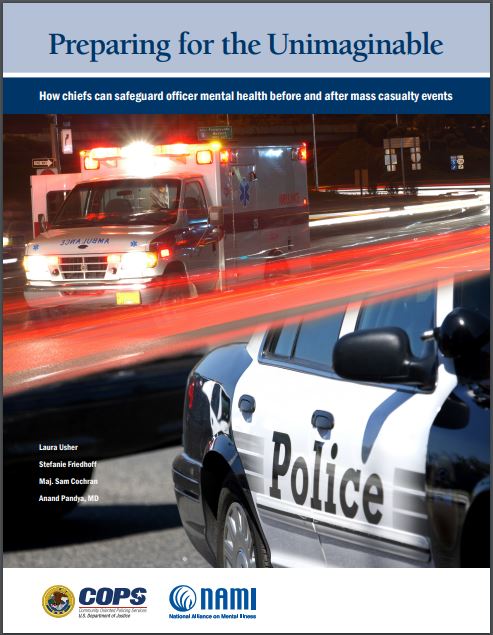 The goal of this guide is to provide law enforcement executives with best practices regarding first responder mental health—best practices learned from colleagues unfortunate enough to have experienced a mass casualty event. The National Alliance on Mental Illness brought together chiefs, mental health professionals, and others with first-hand knowledge to provide readers with a concise compendium of what worked and what did not.
This guide is chronologically organized, beginning with pre-incident preparation and concluding with long-term aftercare. It provides chiefs and command staff with concrete tools to set up a mental health response structure now, when there is time. Trauma is an occupational hazard for first responders, yet officer mental health is a topic that often does not receive proper attention. It has become clear that psychological trauma is every bit as devastating as physical trauma, and the cumulative nature of these events can lead to post-traumatic stress disorder, alcoholism, divorce, depression, suicide, and other emotional problems that manifest years after the events occurred. This is why law enforcement agencies must explore long-term care.
The Oath of Honor

About the Oath
The IACP Governing Body recently revised the IACP Oath of Honor to punctuate the importance of treating all individuals with dignity and respect and ensuring the preservation of human life. This important document is available in five languages.
Understanding the Oath of Honor
A public affirmation of adhering to an Oath of Honor is a powerful vehicle demonstrating ethical standards. Before officers take the Policing Oath of Honor, it is important that they understand what it means. An oath is a solemn pledge individuals make when they sincerely intend to do what is said.
Using the Oath of Honor
To be successful at enhancing integrity within an organization, leaders must ensure the oath is recited frequently and displayed throughout the organization as well as ensuring ethical mentoring and role modeling are consistent, frequent, and visible. The Oath of Honor's brevity allows it to be constantly referred to and reinforced during conversations and ceremonies. Below are some suggestions.
- Recite the oath at all official police ceremonies and gatherings
- Create posters of the oath and display in strategic and visible places, including police academies, briefing rooms, offices, and hallways as well as public access areas
- Have each academy class sign a large poster of the oath and display this signed copy
- Print on the reverse side of officers' business/commission cards
- Include the oath on training certificates and awards
- Print the oath on department items such as coffee mugs, key chains, patches, pins
- Refer to the oath when communicating with others;
- Use the oath as a backdrop in citizens' meetings and news media events.
Out of the Shadows: Policy Research for Midsize Law Enforcement Agencies: A Call to Action
Large cities benefit from problem- and issue-oriented research, conferences, and forums sponsored by academic institutions, think tanks, and national organizations. Smaller communities benefit from problem- and issue-focused work by rural development institutions.The challenges facing midsize city governments and communities tend to be overlooked, however. Organizations and associations that champion the interests of cities, including the National League of Cities, the United States Conference of Mayors, and the International City/County Management Association, are almost silent regarding information for understanding the nature and needs of midsize cities.
The single item of direct value discovered in general literature pertained to the Rochester Conversation on Mid-Size Cities (2002). Sponsored by Cornell University, the Ford Foundation, Eastman Kodak, and several nongovernmental organizations in the Rochester, New York area, this Conversation discussed ”...whether being mid-size calls for developing a new awareness of the importance...of these special places.” Not surprisingly, their answer was “Yes.” It is contextually useful, as well as logical, to recognize that midsize city governments confront issues and needs that parallel those of midsize city police departments, none more evident than a search for identity and definition. The issue is taken up later in the report.
Officer Safety and Wellness Symposium Brochure

Improving officer safety and wellness enhances the health and effectiveness of officers, as well as the safety of the community. This symposium is a unique occasion for law enforcement professionals to learn from experts in the field about resources, best practices and strategies for comprehensive officer safety and well. Participants will learn about building resilience, financial wellness, injury prevention, peer support programs, physical fitness, proper nutrition, sleep deprivation, stress, mindfulness, suicide prevention, and more.
IACP National Policy Summit on Community-Police Relations: Advancing a Culture of Cohesion and Community Trust

 The report is designed to serve as a roadmap for law enforcement, communities, and stakeholders to build meaningful, sustainable, trusting, and effective working relationships. Summit participants outlined three conceptual elements of building community-police relationships. The report defines those elements—communication, partnerships, and trust—and provides recommendations for improvement in each.
Youth Focused Policing: 8 Steps to Measure Impact
- Step 1 – Identify Program Type: What type of youth program are you planning to evaluate? View Examples
- Step 2 – Identify Problem(s): What issue(s) are you trying to address through the program? View Examples
- Step 3 – Identify Goal(s): What is the purpose of your program? What do you hope to achieve through the program? View Examples
- Step 4 – Identify Objective(s): How do you plan to achieve your program goals? View Examples
- Step 5 – Identify Program Activities: What program activities will you use to reach your goals and objectives? View Examples
- Step 6 – Identify Output Measures: What data do you need to collect to show your program’s impact? View Examples
- Step 7 – Identify Short-Term Outcome Measures: How will you apply the output data to demonstrate your program’s short-term changes? View Examples
- Step 8 – Identify Long-Term Outcome Measures: How will you apply the output data to show your program’s long-term changes? View Examples
Glossary of Terms
Below are some definitions to help differentiate between key terms used in the impact evaluation process.
Goals- broad definitions of what the program plans to achieve.
Objectives- specific and measurable statements regarding what the program will accomplish.
Outputs- describes and/or counts program activity data. Output data is used to assess program outcomes.
Short-Term Outcomes- results or accomplishments of program activities measured at the end of program participation.
Long-Term Outcomes- results or accomplishments of program activities measured 6-12 months after program participation.
Youth Focused Policing: Sample Impact Evaluation Plans
These sample evaluation plans illustrate the evaluation process for five law enforcement youth programs. They demonstrate how various components of a program build on each other to display the impact of a program. They provide applied examples of the impact evaluation process, as demonstrated in the diagram below:
Read more about the eight steps of impact evaluation.
These plans include examples of programs that fall under five youth program categories:
Athletics: Programs or services involving athletic or recreational activities to improve relationships between youth and law enforcement

Diversion: Programs or services designed to provide early intervention for juvenile offenders to avoid entry into the criminal or juvenile justice system

Mentoring: Programs or services in which law enforcement officers serve as mentors to youth in need of guidance and positive adult relationship

- Prevention and/or Intervention: Programs or services that target youth at risk for delinquency or have exhibited problem behavior

Police Department Impact Evaluations
To view examples of impact evaluations on various youth/police programs. Check out the evaluation studies below:
Las Vegas Metropolitan Police Department School Violence Initiative
Memphis School House Adjustment Program Enterprise (SHAPE)
Evaluation Plan Template
To guide you through the impact evaluation process, IACP has developed a template you can use to create your youth program impact evaluation plan. As indicated by the “8 Steps of Impact Evaluation” diagram below, complete the template with your program type, problem(s), goal(s), objective(s), program activities, output measures, short-term outcome measures, and long-term output measures. This template will provide a convenient way to organize your ideas, track your progress, and serve as a reference guide as you work through the impact evaluation process for your agency’s youth program(s).


Law Enforcement's Role
Why Focus on Children Exposed to Violence (CEV)?
According to a Department of Justice national survey, 60% of American children were either a witness or victim to violence, crime, or abuse in their homes, communities and schools.i Almost 40% of children were victims of two or more violent attacks, while one in 10 were victims of violence five or more times.ii
Children who are exposed to violence and trauma can suffer a number of long-term consequences affecting how they think, feel, behave and learn. These can include post-traumatic stress disorder, chronic depression, anxiety, poor social adjustment, and emotional difficulties.
The criminal justice implications of CEV are grave. Exposed children are at greater risk for drug and alcohol abuse, as well as becoming perpetual offenders, the consequences of which commonly require police involvement. Suffering from abuse or neglect increases the likelihood of arrest as a juvenile by 59%, as an adult by 28%, and for a violent crime by 30%.iii
Traumatic stress can be caused through repeated exposure to violent events. These reactions can affect children at any age and can consist of feeling helplessness, intense terror, anxietyiv or post-traumatic stress disorder. Early identification and coordinated interventions can interrupt the cycle of violence, allowing children and families an opportunity for recovery.
What Law Enforcement Need to Know
The 2008 National Survey of Children Exposed to Violence found that law enforcement were more likely to know about serious victimizations including kidnapping, neglect, sexual abuse, physical assaults and witnessing domestic violence than any other authority figure.v Officers are in a unique position to intervene during violent situations and their actions are key in reestablishing order, instilling a sense of safety, and obtaining medical care for victims and witnesses involved during violent and traumatic events. They are the first to respond to the scene and make initial contact with child witnesses or victims. Law enforcement can greatly benefit their agency’s practices and procedures by increasing their knowledge of identifying and responding to CEV.
Children look up to law enforcement-- they are the first people after a violent event to interact with victims. When a child is exposed to a traumatic event, their first reaction may be to think that the situation is normal, which opens the possibility of them offending in the future. If an officer leaves without recognizing and responding, the opportunity to intervene is lost.vi
Through increasing their knowledge of CEV and sustaining collaborative efforts with community partners and outside resources, law enforcement can deliver a coordinated response to provide services to children and families exposed to violence and traumatic events.
How IACP Can Help
With the support of the Office of Juvenile Justice and Delinquency Prevention (OJJDP), Office of Justice Programs, U.S. Department of Justice, and in partnership with the Yale Child Study Center, IACP is dedicated to increasing the understanding of CEV among law enforcement leaders and equipping law enforcement professionals in their vital roles helping children and families through identification and trauma-informed response to violent events. The IACP and Yale Child Study Center will provide tools and resources deemed as best practices in the field to law enforcement.
For more information on best practices from the field and what IACP is doing to provide your agency with tools to combat CEV, visit our Enhancing Law Enforcement Response page Resource Library, Program Directory, and CEV Training and Technical Assistance page.
Questions? Email us at [email protected] or call 1-800-THE-IACP x 802.
Partners

Enhancing Law Enforcement's Response
Enhancing Law Enforcement Response
With the support of the Office of Juvenile Justice and Delinquency Prevention (OJJDP) Office of Justice Programs, U.S. Department of Justice, the IACP launched the Enhancing Law Enforcement Response to Children Exposed to Violence project in October 2012. This project focuses on increasing the understanding of children exposed to violence (CEV) among law enforcement leaders and officers. In partnership with the Yale University Child Study Center, IACP will provide law enforcement professionals with resources and tools to effectively identify and respond to violent events involving children. IACP and the Yale Child Study Center will achieve these goals by:
- Building on existing materials and resources recognized as best practices in law enforcement response to CEV to create a series of tools and resources that can equip law enforcement agency operations, activities, policies and procedures to meaningfully address CEV; and
- Refining existing models of training for law enforcement professionals to offer resources, training, and technical assistance related to law enforcement responses to CEV.
IACP will offer no-cost training and technical assistance to local, state, federal and international law enforcement and community partners who are engaged in efforts to enhance their agency’s response to CEV.
Upcoming tools and resources for law enforcement on recognizing and responding to CEV include:
- Responding to Children Exposed to Violence Self-Assessment Tool
- Model Training Curriculum
- Protecting and Serving: Law Enforcement Response to Childhood Trauma Classroom Training
- E-Learning Online Training
- Roll Call Videos
- IACP Training Key
- Publication, “Law Enforcement’s Role in Multi-disciplinary Approaches to Protecting Children”
- CEV Model Policy
- CEV Pocket Guide for Patrol Officers
For more information on best practices from the field and what IACP is doing to provide your agency with tools to combat the CEV epidemic, visit our Resource Library, Program Directory, and Training and Technical Assistance page. Questions? Email us at [email protected] or call 1-800-THE-IACP x 802.
Yale Child Study Center
Since 1991, the Yale Child Study Center has been on the cutting edge in developing collaborative efforts to address the children exposed to violence (CEV) epidemic. In partnership with the New Haven Department of Police Service, the Child Development-Community Policing Program (CD-CP) was developed to capitalize on the significant role that law enforcement could play in responding to and aiding in the recovery of children and families exposed to violence. Under the Deputy Attorney General Eric Holder, the U.S. Department of Justice launched a national CEV initiative in 1999 and took ground-breaking steps to focus national attention on child victims and witnesses to violence. The initiative recognizes the vital role law enforcement and criminal justice system reforms can have in addressing CEV, supporting innovative prevention and early intervention programs that break the cycle of violence and keep children and communities safe. The establishment of a national center on CEV was a vital part of the initiative, and in May 1999 Holder inaugurated the National Center for Children Exposed to Violence (NCCEV) at the Yale Child Study Center.
Since its inauguration, the NCCEV has:
- Developed and implemented innovative multi-disciplinary collaborative program models such as the CD-CP program, the Domestic Violence Home Visiting Intervention, and the Child and Family Traumatic Stress Intervention (CFTSI), which provide immediate coordinated police, mental health, and social service interventions, in addition to follow-up services to children and families exposed to violence and trauma;
- Provided CEV training, technical assistance and consultation to law enforcement, first responders, and emergency management personnel nationwide;
- Provided nationwide consultation in times of crisis (including school and community mass shootings, the terrorist attacks of 9/11, and natural disasters such as Hurricanes Katrina and Rita) to communities, law enforcement agencies, mental health providers, schools, media outlets, and local, state, and national government leaders;
- Supported public awareness and policy initiatives relating to CEV; and
- Provided extensive direct clinical services to children and families exposed to violence and other traumatic events.
The CD-CP has been used as a model for law enforcement-mental health partnerships across the country. CD-CP has been adapted in 16 US communities—including three tribal communities—as well as internationally
Tracking Agency Injuries
The first step to reducing officer injuries is understanding the type, frequency, and causal factors related to injuries
Injuries not only affect individual officers on a personal level but are detrimental to an agency's ability to perform its mission, straining manpower and budgets. Law enforcement agencies should prioritize injury reduction and mitigation and work to achieve a culture of safety within their departments.
One practice that can contribute to an organization culture of safety is tracking injuries sustained by officers while on duty. Detailed and consistent tracking at the agency level allows supervisors and manager to identify common injuries, better evaluate risk, and implement or improve upon agency injury prevention and mitigation policies, practices, and training.
Download a simple tool to assist in tracking your agency injuries.View the document for helpful troubleshooting tips.


