
Resources
IACP's resources are aimed at helping law enforcement executives do their jobs better and cover a variety of topics, including professional development, leadership, management, and supervision, as well as hot topics such as ethics.
Resources
Supporting Officer Safety Through Family Wellness: Financial Literacy

Financial planning is important for everyone, particularly for families of law enforcement officers, whose jobs are more unpredictable. This infographic breaks down some of the most important parts of financial planning including: budgeting, saving, debt management, and credit scores.
Supporting Officer Safety Through Family Wellness: Helping Your Child Understand Your Job
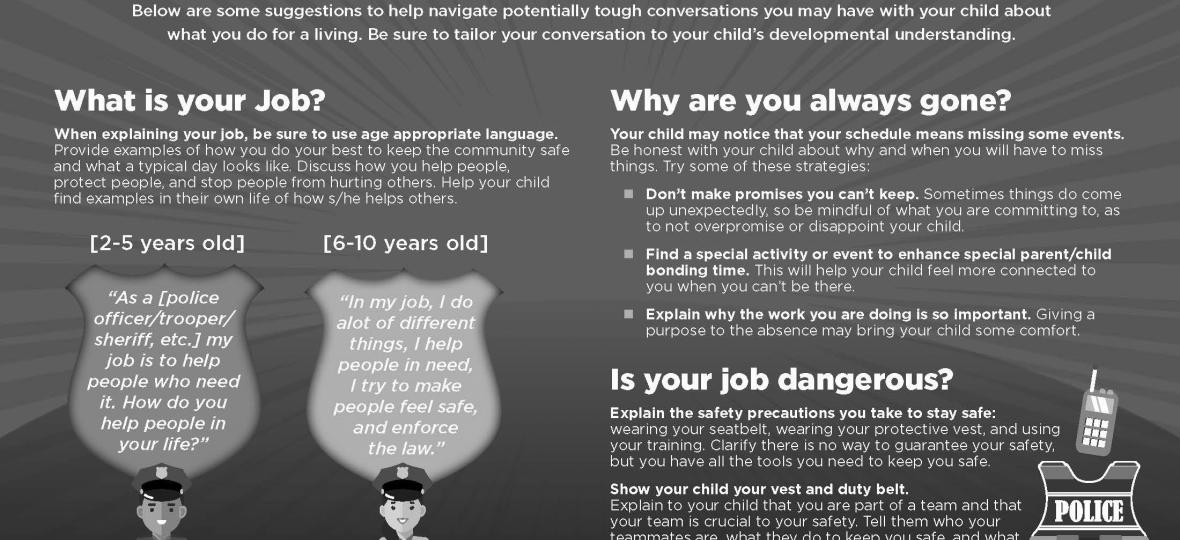
A law enforcement officer’s job may be difficult to explain to young children. This infographic includes conversation starters, suggestions of how to explain your daily duties, and answers to other questions your young child may have.
Public Private Partnerships: What Every Chief Needs to Know
There are many reasons for establishing collaborative efforts to ensure public safety. The Private Sector Liaison Committee recently completed a brochure highlighting the importance of establishing relationships between law enforcement and the private sector to address public safety concerns and crime in their community. The brochure includes suggestions for creating public-private relationships in your community and examples of how other communities across the country have used these relationships to start effective programs which address public safety and crime. This resource provides examples of when and why partnerships are beneficial, and offers steps to develop more effective partnerships with the private sector.
Additional Resources:
- National Policy Summit: Building Private Security/Public Policing Partnerships to Prevent and Respond to Terrorism and Public Disorder
- IACP/ASIS Memorandum of Understanding
- Primer on the Replacement of Law Enforcement Services by Private Security
- Private Security Officer Selection, Training, and Licensing Guidelines
Combined Response to Mass Casualty Attacks
In June 2017, the IACP and Target hosted a symposium on combined response to mass casualty attacks in Minneapolis, Minnesota. The symposium had more than 130 participants from the law enforcement, emergency medical response, private security, and business communities.
The purpose of the symposium was to examine effective practices for responding to mass casualty incidents and to incorporate those practices into a document aimed at engaging law enforcement, other first responders, and private sector leaders in conversations and partnerships to prepare for such incidents. These threats are ever-evolving and require a shift in focus from only active shooters to a broader spectrum of active assailants who use everything from knives to vehicles to cause widespread harm.
The symposium included case studies on the Century 16 Theater shootings in Aurora, Colorado, and the Fort Lauderdale-Hollywood International Airport shootings in Florida, highlighting issues encountered during the response and lessons learned. Participants discussed approaches to tactics integration with law enforcement, private security, and fire and emergency medical services working together.
The overarching themes were preparedness and the importance of a collaborative response between public responders and the private sector. Past incidents have demonstrated that prior engagement between private sector partners and the whole responder community, including law enforcement, fire, and EMS, can help improve response when a mass casualty attack occurs. The importance of training for mass casualty incidents on a continual basis and incorporating new threats as they evolve was also emphasized.
A working group of law enforcement, fire and emergency medical services, and private sector security subject matter experts assembled after the symposium to refine information discussed and to develop this summary document, which is divided into three categories: Preparation, Response, and Recovery. Within each category is a range of strategies and suggestions, as well as links to further resources.
Law enforcement, emergency medical response agencies, and private sector partners are encouraged to download the document not as a policy guide, but as a starting point for developing their own specific plans, policies, and training.
Partners
Developing an Anti-Bullying Program: Increasing Safety, Reducing Violence
Juvenile Justice Promising Practice Brief from May 2006. This publication is one in a series of briefs written for law enforcement leaders to facilitate the development of proactive juvenile justice programs. In This Issue:
• Bullying
• Bullying Research
• IACP Program Information
• Fight Crime: Invest In Kids
Juvenile Sex Offenders: Managing and Preventing Future Offenses
Summary of March 2009 brief:
Legislation and local policies regarding sex offenders have increased law enforcement’s operational responsibilities and simultaneously strengthened their abilities to manage juvenile sex offenders in the community. Amid growth in the number of juvenile sex offenders for whom specialized treatment and processing are required, law enforcement has found ways to prevent new victimizations and
ensure that already adjudicated juvenile sex offenders do not recidivate. Local law enforcement agencies have implemented multi‐agency collaborative programming strategies for managing juvenile sex offenders that has proven effective. A multi‐agency collaborative partnership not only give police a cost‐effective way to manage juvenile sex offenders, but also enhances and strengthens their resolve to
protect public safety. Law enforcement can lead or partner by taking the following steps:
- Establish regular meetings between law enforcement, community corrections officials, social service officials, prosecutors, and other relevant officials that handle juvenile, child, and sex crimes to share information and strategies.
- Designate agency‐specific staff to be the internal and external point persons.
- Implement computerized or electronic systems to collect registration and notification data as legislate‐ timely required. This system can be used to track offender contacts with the system and ensure that juveniles who are amenable to treatment receive necessary services.
Both featured programs have implemented policies and procedures creating a continuous loop of communication regarding juvenile sex offenders. These proactive police responses serve to enforce appropriate laws, comply with relevant legislation, and effect change in the community and the sex offender.
SHOCAP (Serious Habitual Offender Comprehensive Action Program)
Serious Habitual Offender Comprehensive Action Program
This three-day course introduces a comprehensive and cooperative case management process that enables the juvenile justice system to focus on youth who repeatedly commit serious crimes. SHOCAP brings together law enforcement, schools, juvenile corrections, and community partners to utilize all available resources to enable youth to become productive citizens. Agencies/individuals interested in reviewing this curriculum can access them using the links below. The curriculum is provided on an 'as-is' basis. Users will need to determine the relevance and accuracy of curriculum content for their jurisdictions.
Reclaiming Our Youth Through Tribal Collaboration
Reclaiming Our Youth Through Tribal Collaboration
This two-and-a-half day workshop assists tribal law enforcement in identifying high-risk juvenile offenses specific to their nations. Participants will develop action plans that they can implement to effectively address priority juvenile justice problems with particular emphasis on alcohol, drug use, and juvenile crime. Community and juvenile justice stakeholders are critical to the action plan development process. This course requires the submission of an application and a commitment on behalf of tribal leadership.
For more information, contact Erin Feeley.
IACP’s Youth Focused Policing Resource Center
IACP’s Youth Focused Policing Resource Center
The Youth Focused Policing Resource Center provides law enforcement with information, tools and resources focused on reducing youth delinquency, crime, and victimization, including:
- A clearinghouse of information and resources relating to youth crime, delinquency and victimization
- A searchable directory of law enforcement programs and services for youth from across the nation
- Training and technical assistance available in the areas of juvenile justice, children exposed to violence, and child sex trafficking
- A searchable resource library, including sample documents from law enforcement programs for youth such as brochures, applications, and program flyers as well as juvenile justice and child protection policies, procedures, and reports
- Information on IACP’s projects and resources
- A secure discussion forum for law enforcement officials to share information, obtain resources, and exchange ideas
- A Youth Program Impact Toolkit for evaluating law enforcement youth program(s), including a customizable evaluation template
To learn more, visit www.iacpyouth.org.
Related Resources
Youth Focused Policing Agency Self-Assessment
What are your agency strengths in responding to youth crime, delinquency, and victimization? What areas need improvement? Could your agency benefit from implementing a Youth Focused Policing strategy? Assess your agency’s current state of policy and practice in prevention and response strategies to reduce juvenile offending, reoffending and victimization with the Youth Focused Policing Agency Self-Assessment. This resource aims to assist law enforcement agencies in early identification of trends, resources, and community partnerships that may be helpful in identifying best practice responses to improving the safety and well-being of youth in their communities.
Upon completion, your agency may discover opportunities that can serve as the foundation of an action plan to implement new or enhance existing strategies that improve capacity to respond to youth crime, delinquency, and victimization.
Click here to view the self-assessment resource page.
Webinars
Threat Assessment Strategies for Schools & Higher Education
In September 2014, the IACP and the Department of Justice, Office of Juvenile Justice and Delinquency Prevention, hosted a webinar that provided an overview of threat assessment and management for K-12 schools and higher education campus settings. Panelists discussed key components for school/campus threat assessment programs and strategies and provided resources for facilitation of threat prevention and intervention..
View the archived webinar and handouts here
Effective Youth Diversion Strategies for Law Enforcement
On January 23rd, 2014, the IACP held a webinar intended to educate law enforcement and juvenile justice practitioners on youth diversion programs and strategies. It included a panel composed of a police chief, county prosecutor, and division director of juvenile services, who discussed development of their youth diversion programs, program successes, and challenges faced during implementation. A discussion of lessons learned was included to assist law enforcement agencies who are considering starting or improving a youth diversion program. View the archived webinar and handouts here.
Related Content
"Online trainings for law enforcement on the IACP Learning Management System. Webinars and training topics include:
Juvenile Interview and Interrogation Techniques
School Safety
Human Trafficking
Safeguarding Children of Arrested Parents
Click here to see all the courses and register for an account.
Law Enforcement’s Leadership Role in Juvenile Justice Reform: Actionable Recommendations for Practice & Policy
In 2011, the International Association of Chiefs of Police (IACP) conducted a juvenile justice training needs assessment survey of law enforcement around the nation to identify challenges and training needs facing law enforcement in addressing juvenile crime, delinquency and victimization. The survey identifies law enforcement needs and priorities, and will enable IACP, as well as the Office of Juvenile Justice and Delinquency Prevention (OJJDP), to assist the law enforcement community in their efforts to address juvenile justice issues. There were 672 responses to this national survey from participants representing 404 law enforcement agencies from 49 states and the District of Columbia. Survey responses include data on department training budgets and needs, juvenile justice operations, and the most pressing juvenile justice/youth issues identified by jurisdictions.
Law Enforcement’s Leadership Role in the Advancement of Promising Practices in Juvenile Justice Executive Officer Survey Findings
The IACP in partnership with the John D. and Catherine T. MacArthur Foundation has established a multiyear initiative entitled “Law Enforcement’s Leadership Role in the Advancement of Promising Practices in Juvenile Justice.” A research survey of law enforcement leaders was conducted to assess the current state of attitudes, knowledge and practices regarding how law enforcement agencies deal with juvenile offenders and collaborate with juvenile justice system partners.
Click here to read the report.
Reducing Officer Injuries Seatbelt Postcard

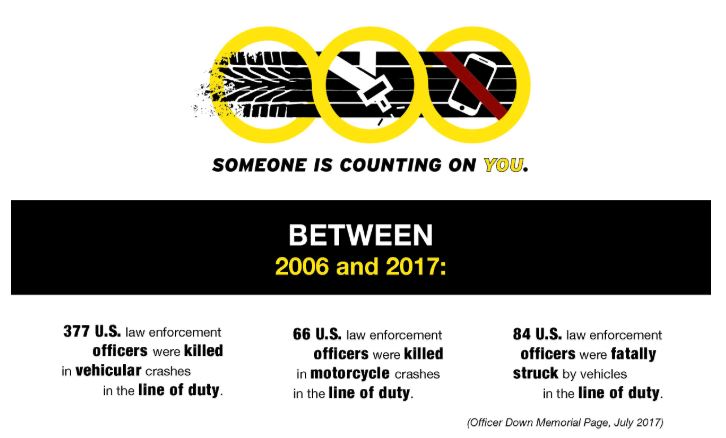 Too many officers have been killed in traffic related line-of-duty deaths. The Reducing Officer Injury postcard, developed with funding from the Bureau of Justice Assistance, Office of Justice Programs, U.S. Department of Justice, provides statistics, raises awareness, and educates via traffic related safety tips.
Please contact [email protected] to request a postcard.


