
Resources
IACP's resources are aimed at helping law enforcement executives do their jobs better and cover a variety of topics, including professional development, leadership, management, and supervision, as well as hot topics such as ethics.
Resources
Officer Suicide Prevention and Awareness Poster

The Officer Suicide Prevention and Awareness poster, funded by the Office of Community Oriented Policing Services, raises awareness and provides resources to prevent officer suicides. The poster is designed for law enforcement officers to remind them that suicide is preventable. Included on the poster is an awareness message along with potential warning signs and two hotlines numbers provided as a call to action. These posters can be hung up in break rooms, locker rooms, and roll call and training rooms as a reminder to all law enforcement officers that suicide is preventable.
The Signs Within: Suicide Prevention Education and Awareness

The Signs Within: Suicide Prevention Education and Awareness report provides suicide prevention education and awareness. The report includes recommendations for command staff, common factors associated with suicide, and national and local resources.
The executive overview also discusses the benefits of employee assistance programs, resiliency building, peer support teams, and staff psychologists specific to law enforcement as possible programs to help prevent officer suicide and increase officer wellness.
Officer-Involved Shootings Investigative Protocols: A Guide for Law Enforcement Leaders
Officer-involved shootings (OIS), though relatively rare when compared to the number of interactions law enforcement officers have with the public each day, tend to be high profile events that draw media coverage and sometimes citizen concern.
It is essential for police departments to demonstrate accountability to the community through an impartial, transparent, and systematic investigative process. Systematic investigations of officer-involved shootings may uncover deficiencies that lead to necessary changes in policy and training, and avert civil lawsuits. Officers need to understand the routine processes of OIS investigations so that they won’t feel singled out and unfairly scrutinized.
Intelligence-Led Community Policing, Community Prosecution, and Community Partnerships Final Report
This final report explores the implementation of an innovative approach to public safety known as Intelligence-Led Community Policing, Community Prosecution, and Community Partnerships (IL3CP). Developed by the Rockland County, New York, District Attorney’s Office, this approach synthesizes the philosophies of community policing, intelligence-led policing, and community prosecution into a single model that connects the criminal justice system and the community through seamless communication and partnerships.
Midsize Police Agencies: Surviving, Thriving, and Forging a New Business Model for Law Enforcement in a Post-Recession Economy
In 2013, the then Midsize Agencies Section set out to fulfill its promise to serve as an incubator for innovative police practices. With support and input from the COPS Office, the IACP Midsize Agencies Section (MAS) convened more than 40 police leaders and city managers to discuss their successes and challenges under the theme Sustaining and Advancing Community Policing in the New Economy. The forum’s goal was to set the foundation for a transferable framework to facilitate and advance thoughtful innovation in policing. Intended outcomes for the meeting were to create a:
- meaningful, continuous dialogue;
- rally point for the MAS;
- platform for the identification of gaps and challenges;
- blueprint for our collective way forward.
Forum objectives and topics for discussion were based on a MAS member survey that solicited areas of interest in a post-recession environment. Through an interactive facilitated discussion, participants were asked three questions:
In a time of increasing demands and diminishing resources, how is your agency:
- changing its business model? Explore alternative organizational and staffing arrangements, and identify options with the greatest potential for improving productivity or service delivery.
- maximizing technology? Identify and discuss promising practices in information and data management/analysis and affordable, attainable new technologies that generate positive return on investment.
- redefining community policing? Discuss the evolving definition and application of community policing.
Participating chiefs and city managers offered successful examples and case studies, candidly discussed challenges, and offered thought-provoking considerations and solutions for the future, proving midsize agencies are leaning forward in many ways. The pages that follow highlight the key themes and leading examples that emerged, providing the promised blueprint for progressive police service delivery.
Testimony of Executive Director and Chief Executive Officer Vincent Talucci - Technology

 The IACP is the world's largest association of law enforcement executives, with more than 22,000 members in 98 different countries. For over 120 years, the IACP has been launching internationally acclaimed programs, speaking out on behalf of law enforcement, conducting ground-breaking research, and providing exemplary programs and services to the law enforcement profession across the globe. One of the services we provide is developing and refining model policies for law enforcement on complicated issues like the use of technology.
Today I am focusing primarily on the use of cameras—and specifically body-worn cameras— because that has become the principal technology people are turning to in documenting police community-relations. I would like to emphasize that this certainly does not fully encompass the breadth of technology that can assist agencies, but evidence suggests that when body-worn cameras are implemented thoughtfully and with proper planning and management, that it holds significant promise in influencing behavior, providing transparency and accountability, and documenting critical interactions between police and citizens.
Testimony of Former Research and Programs Director - Social Media

 Commissioner Ramsey, Professor Robinson, Director Davis and members of the Task Force on 21st Century Policing, thank you for inviting me to testify today. My name is Hassan Aden and I am the former Chief of Police for the Greenville, North Carolina, Police Department and the Director of Research and Programs at the International Association of Chiefs of Police (IACP). I have over 27 years of law enforcement experience, and I am here today to testify on behalf of the IACP.
The IACP is the world's largest association of law enforcement executives, with more than 22,000 members in 98 different countries. For over 120 years, the IACP has been launching internationally acclaimed programs, speaking out on behalf of law enforcement, conducting ground-breaking research, and providing exemplary programs and services to the law enforcement profession across the globe. One of those programs is the IACP Center for Social Media which builds the capacity of law enforcement to use social media to prevent and solve crimes, strengthen police-community relations, and enhance services.
Law enforcement agencies of all sizes across the United States are using many forms of social media in innovative and effective ways. According to the fifth annual Center for Social Media Survey completed in late 2014, 95 percent of law enforcement agencies surveyed stated they were using some form of social media. Of those using social media, 78.8 percent indicated social media had helped to solve a crime in their jurisdiction and 77.5 percent stated that social media had improved police-community relations in their jurisdiction.
Social media allows law enforcement agencies to reach a broad, diverse audience, quickly, and in an unfiltered manner. These platforms also allow police to reach out in conversational ways to open lines of communication and show examples that break down stereotypes. By using these tools thoughtfully, agencies develop new levels of transparency and provide exceptional customer service, thereby enhancing relationships with individuals, businesses, and organizations throughout their community, not just online, but offline as well.
Vests Save Lives Poster

 Vests Save Lives Poster. Officers are aware that body armor can provide a degree of protection against violent attacks, yet many officers still refuse to wear it. Many feel vests are uncomfortable and hot in the warmer months. The IACP's Vests Save Lives campaign is geared at reminding officers of the importance of wearing soft body armor, making them realize that the benefits far outweigh any perceived negatives. Request a poster today by contacting the IACP Officer Safety Team.
Are You Ready for Duty? Poster

 This poster provides a comprehensive check-list of considerations that may potentially expose an officer to serious injury or an attack by a perpetrator. Perfect for your roll call or ready room, it covers a wide array of potential vulnerabilities, such as physical, mental, and situational circumstances that every officer should be aware of. Whether an officer is simply checking his vest or is making a traffic stop, this poster highlights the importance of always remaining vigilant, whether an officer is on or off-duty. Request a poster today by contacting the IACP Officer Safety Team.
Webinar: Officer Safety Considerations for Domestic Violence Calls

This webinar examines the complexities and challenges that may be faced by officers when interacting with DV offenders, victims, and witnesses. It identifies tactics and protocols for increasing officer, victim, and civilian safety, and presents quantitative research and case studies to demonstrate the possible dangers of responding to and managing on-scene investigations of domestic violence calls. http://www.theiacp.org/dvwebinar
Peer Support Guidelines

 The goal of peer support is to provide all public safety employees in an agency the opportunity to receive emotional and tangible support through times of personal or professional crisis and to help anticipate and address potential difficulties. Ideally, peer support programs are developed and implemented under the organizational structure of the parent agency. Receiving support from the highest levels within an organization helps a peer support program to work effectively.
These guidelines are intended to provide information and recommendations on forming and maintaining a peer support structure for sworn and civilian personnel in law enforcement agencies. The guidelines are not meant to be a rigid protocol but reflect the commonly accepted practices of the IACP Psychological Services Section members and the agencies they serve. The guidelines work best when applied appropriately to each individual and agency situation.
Officer-Involved Shooting Guidelines

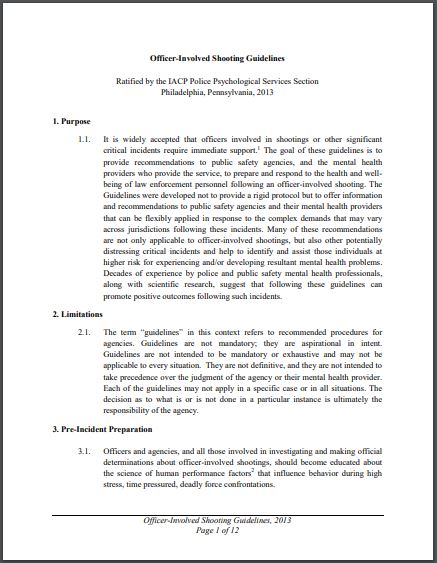 It is widely accepted that officers involved in shootings or other significant critical incidents require immediate support. The goal of these guidelines is to provide recommendations to public safety agencies, and the mental health providers who provide the service, to prepare and respond to the health and wellbeing of law enforcement personnel following an officer-involved shooting. The Guidelines were developed not to provide a rigid protocol but to offer information and recommendations to public safety agencies and their mental health providers that can be flexibly applied in response to the complex demands that may vary across jurisdictions following these incidents. Many of these recommendations are not only applicable to officer-involved shootings, but also other potentially distressing critical incidents and help to identify and assist those individuals at higher risk for experiencing and/or developing resultant mental health problems. Decades of experience by police and public safety mental health professionals, along with scientific research, suggest that following these guidelines can promote positive outcomes following such incidents.


