
Resources
IACP's resources are aimed at helping law enforcement executives do their jobs better and cover a variety of topics, including professional development, leadership, management, and supervision, as well as hot topics such as ethics.
Resources
Missing Persons: Volunteers Supporting Law Enforcement
This document discusses the use of affiliated and spontaneous volunteers in missing person investigations, how to deal with the media, types of missing persons cases, technology available, partner organizations, and individual agency experiences with missing persons.
Volunteers in Police Service Add Value While Budgets Decrease
As a result of recent economic strife, agencies are experiencing an increased workload in a resource-constrained environment. While in the midst of budget cuts, many law enforcement agencies are being asked to take on additional responsibilities due to cuts and restructuring in other government agencies. More than ever, volunteerism in the law enforcement arena has become a need and not a luxury. The financial return on investment of a volunteer program can be substantial, amounting to hundreds of thousands of dollars worth of value added to the agency each year.
Testimony of Chief Richard Beary - Building Trust and Legitimacy

 Commissioner Ramsey, Professor Robinson, and members of the Task Force on 21st Century Policing, thank you for inviting me to testify today at the first listening session. My name is Richard Beary and I am the Chief of Police at the University of Central Florida and the President of the International Association of Chiefs of Police (IACP). I have over 37 years of law enforcement experience, and I am here today to testify on behalf of the IACP.
The IACP is the world's largest association of law enforcement executives, with more than 22,000 members in 98 different countries. For over 120 years, the IACP has been launching internationally acclaimed programs, speaking out on behalf of law enforcement, conducting ground-breaking research, and providing exemplary programs and services to the law enforcement profession across the globe.
Over the past three decades, many communities throughout the United States have witnessed a remarkable decline in the rate of crime. America in 2015 is a far safer place than America in 1985. In fact, the most recent Federal Bureau of Investigation Uniform Crime Report shows that incidence of violent crime in the United States fell to the lowest number since 1978. This is a testament to both the great work done by law enforcement and a shared commitment by community and political leaders to create and maintain safer communities.
Reducing Violence and Crime on our Streets: A Guide for Law Enforcement Leaders

 Many communities in the United States are confronted by unacceptable levels of crime and violence on our streets. Typically, a disproportionate amount of this violence is the result of young males killing other young males. In the United States, homicide is the second leading cause of death for all young males 15–24 years old. According to the National Center for Injury Prevention and Control, homicide is the leading cause of death among 10–24-year-old African Americans. This is simply unacceptable. It is imperative that law enforcement works with our partners in the criminal justice system to reduce the level of violence through an array of successful approaches. These range from early intervention, to aggressive enforcement and prosecution, to enhanced penalties for those that commit crimes with a firearm. This guide was developed as part of an IACP Presidential Initiative and designed for the purpose of providing an action agenda for law enforcement leadership, their agencies, and the communities they serve.
Practices in Modern Policing: Police-Youth Engagement

 This guide demonstrates how positive police and youth engagement can increase public safety; reduce crime, victimization, and recidivism; and foster trust between young people and law enforcement. The guide includes background material on the issues surrounding police-youth interactions and examples of model programs for youth engagement.
Juvenile Interview and Interrogation
The juvenile interview and interrogation landscape has undergone an unprecedented upheaval in the last decade as numerous studies have demonstrated that juveniles are particularly likely to give false information – and even falsely confess – when questioned by law enforcement. Based on this research, court decisions, all the way up to the U.S. Supreme Court, are leading police to question juveniles differently than adults. The IACP, in partnership with the Office of Juvenile Justice and Delinquency Prevention, Office of Justice Programs, U.S. Department of Justice, have launched a series of training, tools, and resources for law enforcement on effective juvenile interview and interrogation.
Reducing Risks: An Executive's Guide to Effective Juvenile Interview and Interrogation
The IACP, in collaboration with OJJDP and the Center on Wrongful Convictions of Youth at Northwestern University School of Law, launched this publication in 2014 to provide a guidebook of effective, developmentally-appropriate and legally-sound methods for interviewing and interrogating youth. The guidebook includes:
- Recommended best practices for interrogation and investigative follow-up
- Key cases highlighting court decisions that affect the policing field
- Quotes from youth and investigators with experience in the interrogation room
- Sample documents (i.e. Juvenile Pre-Interview/Interrogation Checklist, Interview Plan, Custodial Considerations Checklist)
For more information on Reducing Risks: An Executive's Guide to Effective Juvenile Interview and Interrogation, click here.
Model Policy Concepts & Issues Paper
The purpose of the IACP Model Policy on Interviewing and Interrogating Juveniles is to provide police officers with procedures for interviewing and interrogating juveniles that are both legal and consistent with the limitations in maturity and emotional development characteristic of juveniles. The U.S. Supreme Court has recognized the emotional and developmental differences between adults and juveniles and the implications that this has on the conduct of juvenile interviews in general and interrogations in particular. These differences must be taken into account when an officer conducts an interview or interrogation of a juvenile. Officers shall follow this policy in order to observe the legal rights of juveniles and protect against charges of police coercion or intimidation during interviews and interrogations of juveniles. This 2012 Model Policy has an accompanying Concepts & Issues Paper, issued in 2013.
Classroom Training Curriculum
The IACP, in collaboration with OJJDP, created the classroom training curriculum, Introduction to Juvenile Interview and Interrogation Techniques. The IACP delivered this highly successful classroom training 39 times to over 2,100 law enforcement professionals, representing 38 U.S. states and three countries. The IACP is no longer federally-funded by OJJDP to provide this classroom training but is making the curriculum available to law enforcement and prosecution professionals. To request the classroom training curriculum, including the Facilitators’ Guide, Participant Workbook, activities and evaluation materials, and presentation slides, please email [email protected] or call us at 1-800-THE-IACP ext. 815.
Online Introductory Training Series
The IACP, in collaboration with OJJDP, launched an online training series on juvenile interview and interrogation techniques in 2014. This introductory-level series includes four courses, including:
- Introduction to Developing Rapport with Youth
- Introduction to Analyzing Juvenile Behavior
- Introduction to Juvenile Interviewing Techniques
- Introduction to Juvenile Interrogation Techniques
Through interactive lessons and activities, participants will learn the fundamental investigative skills, tactics, and procedures that result in effective juvenile interviews and interrogations. The courses include instruction on:
- Understanding adolescent development and youth culture and its impact on interviews and interrogations of juveniles
- Interpreting youth behavior during an interview or interrogation
- Techniques for building and establishing rapport with youth
- Constructing age-appropriate statements and questions
- Strategies and approaches designed for interviewing and interrogating youth
- Cautions and considerations for interviewing and interrogating youth, including how to reduce the likelihood of false or coerced confessions.
These self-paced courses can be taken individually or combined as an entire training series, and are available free of charge. The courses are based on IACP/OJJDP’s classroom training, Introduction to Juvenile Interviewing Techniques and Introduction to Juvenile Interrogation Techniques. These trainings are targeted to law enforcement who interview and/or interrogate youth. The techniques discussed in the courses focus on juvenile suspects and witnesses, ages 10 to 17, and do not cover child forensic interviewing. The training series is also open to allied juvenile justice professionals, but please note that only individuals legally authorized to interrogate youth will be granted access into the “Introduction to Juvenile Interrogation Techniques” course.
To register for Introduction to Juvenile Interviewing Techniques, visit: IACPlearn: Introduction to Juvenile Interviewing Techniques (theiacp.org)
To register for Introduction to Juvenile Interrogation Techniques, visit: IACPlearn: Introduction to Juvenile Interrogation Techniques (theiacp.org)
Online Intermediate Training Course
The IACP, in partnership with OJJDP, launched an online training titled Intermediate Juvenile Interview and Interrogation Techniques in 2015. This training provides information on best practices and procedures in juvenile interview and interrogation tactics for law enforcement, with a focus on age-appropriate methods for improving interactions with youth during investigations. Training topics include:
- Strategies for communicating with youth
- Understanding youth body language and how it differs from adults
- Developmentally appropriate strategies to elicit complete and accurate information during interviews and interrogations with youth
- Strategies to safeguard youth from trauma during interviews and interrogations
- Administering Miranda rights in an age-appropriate manner
- Special considerations for diverse populations when interviewing or interrogating youth
- Culturally specific communication styles that may impact interviewing youth
- Ensuring admissible and true youth confessions.
This self-paced, interactive course is available at no-cost and is targeted to law enforcement who interview and/or interrogate youth. The techniques discussed in the course focus on juvenile suspects and witnesses, ages 10 to 17, and do not cover child forensic interviewing.
To register, visit: IACPlearn: Intermediate Juvenile Interview and Interrogation Techniques (theiacp.org)
Effective Youth Diversion Strategies for Law Enforcement
Effective Youth Diversion Strategies for Law Enforcement
On January 23rd, 2014, the IACP held a webinar intended to educate law enforcement and juvenile justice practitioners on youth diversion programs and strategies. It included a panel composed of a police chief, county prosecutor, and division director of juvenile services, who discussed development of their youth diversion programs, program successes, and challenges faced during implementation. A discussion of lessons learned was included to assist law enforcement agencies who are considering starting or improving a youth diversion program. View the archived webinar and handouts here
Supporting Officer Safety Through Family Wellness: The Effects of Sleep Deprivation
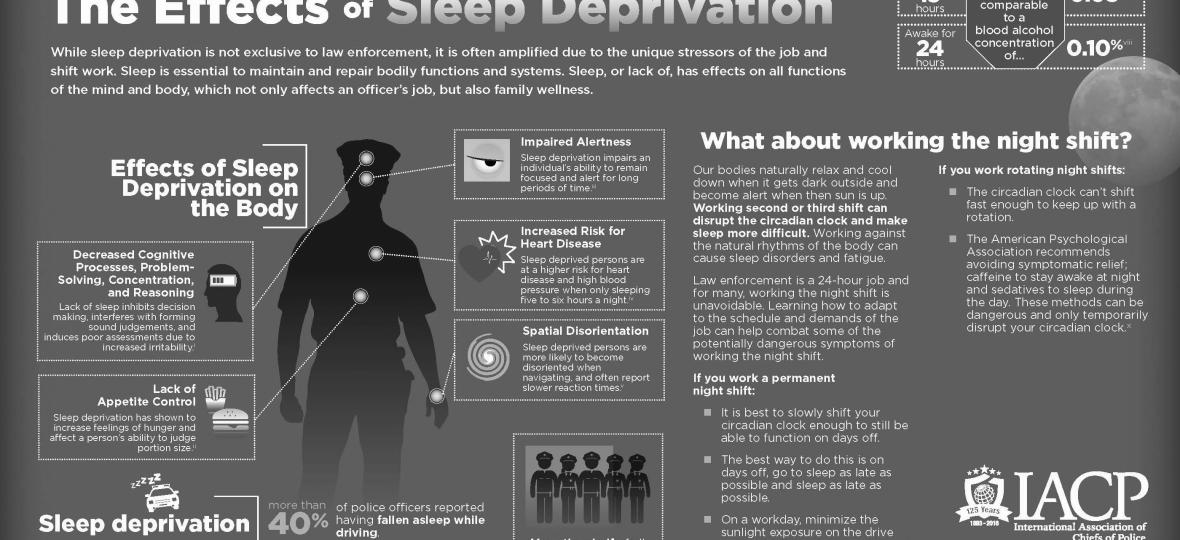
Sleep deprivation takes a toll on an officer’s wellbeing. This infographic discusses the effects on the body and other dangers associated with sleep deprivation and offers helpful suggestions for families of law enforcement.
Fitness Considerations Guide

 Fitness and wellness programs are an important part of reducing officer injuries on the job. This guide provides law enforcement agencies with tips and recommendations on how to start a fitness/wellness program within an agency.
Eating Well on the Go - Leadership Guide

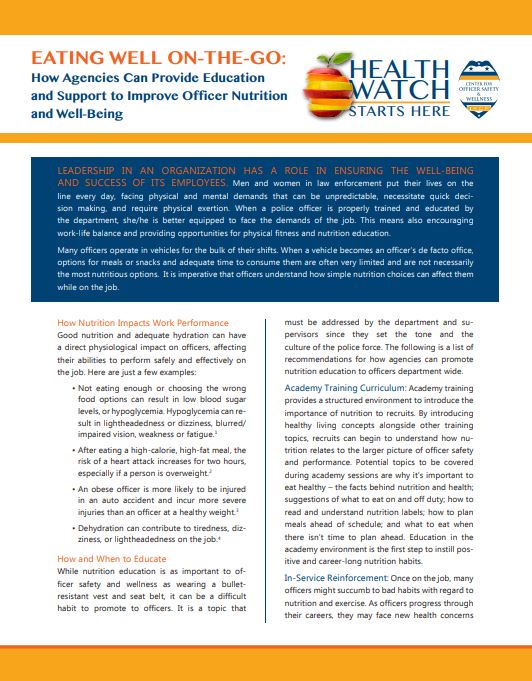 This fact sheet provides information on how agencies can provide education and support to improve officer nutrition and well-being, highlighting the impact nutrition has on an officer’s performance, ranging from long-term effects to shift-by-shift consequences.
Eating Well on the Go - Officers' Guide

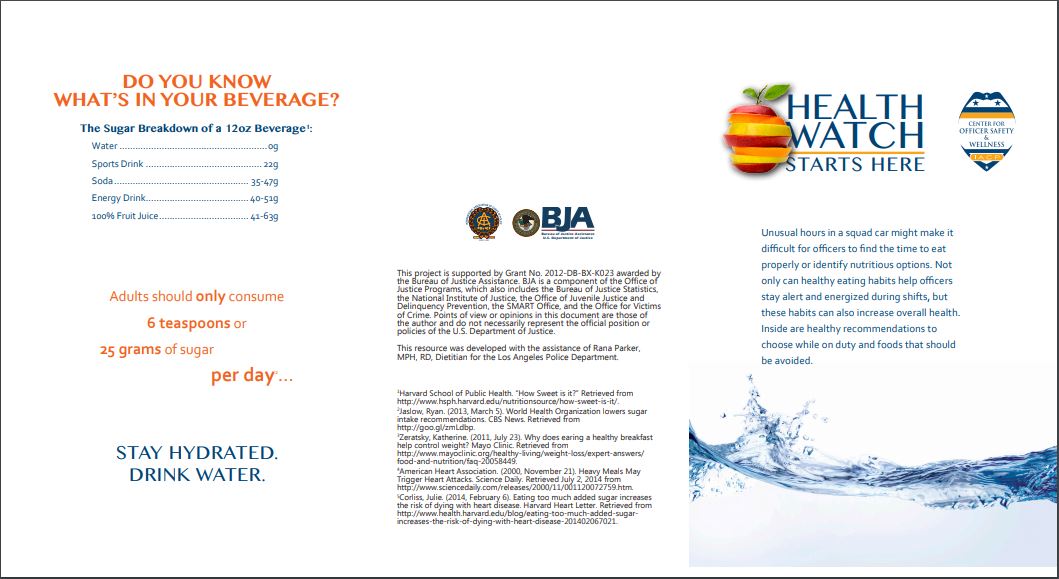 This pocket-sized brochure gives officers nutritious options for meals on the go, including guidance on which items to choose and which to skip for breakfast, snacks, and a main meal.
Doctor's Visit Checklist

 This helpful brochure contains recommended questions officers can pose to their physicians addressing common medical concerns affecting law enforcement personnel.


