
IACP VP at Large Attends Congressional Briefing on Pretrial Justice Research
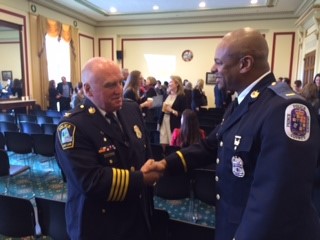
Recently IACP Vice President at Large, Chief James Craze, attended a Congressional Briefing on Pretrial Justice: Research Evidence and Future Prospects, held at the Rayburn Building on Capitol Hill. The briefing was conducted jointly by George Mason University’s Center for Evidence-Based Crime Policy (CEBCP) and the Pretrial Justice Institute (PJI).
This event brought together some of the top researchers and practitioners in the pretrial field to provide intensive 10 minute reviews of pretrial justice related research. The roster and range of topics covered was impressive:
In response to that information, Chief Craze said “it made me consider whether having 60% of our jail population awaiting trial is really a good use of public resources, and what impact it is actually having on public safety. I agree with the research presented; people who are assessed as being at a high risk to either fail to appear or to reoffend prior to trial should be detained pretrial with no bond; those that are assessed to be lower risk, we need to consider releasing them on their own recognizance or with appropriate supervision. I spend a lot of time and resources focusing on offender re-entry, but the research shows that it would be more effective for us to be focusing on pre-entry.”
The research presented during the congressional briefing supports the work of IACP’s Pretrial Justice Reform Initiative, demonstrating that seeking ways to improve the pretrial release/detention decision making process can positively impact public safety and significantly reduce costs.
The IACP encourages law enforcement leaders to learn more about the pretrial process in their community, understand the research on pretrial practices, and become engaged in improving the pretrial p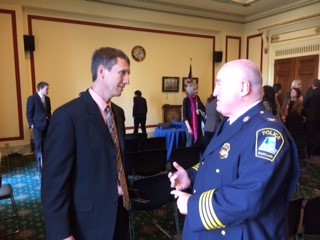 rocess locally, regionally, and nationally.
Videos of the congressional briefing are available online. Contact IACP Program Manager Dianne Beer-Maxwell at [email protected] or 703-647-6807 to learn more about IACP’s Pretrial Justice Reform Initiative.
This event brought together some of the top researchers and practitioners in the pretrial field to provide intensive 10 minute reviews of pretrial justice related research. The roster and range of topics covered was impressive:
- Moderator: The Honorable James G. Carr, US District Court Judge, Northern District of Ohio;
- Key National Trends in Crime, Arrests, and Jails: James Austin, Ph.D., President, The JFA Institute;
- Pretrial Decision Determine Mostly Everything: Marie VanNostrand, Ph.D., Justice Project Manager at Luminosity, Inc.;
- Federal Pretrial Detention: A Cancer We Could Cure: Tim Cadigan, Senior Associate at Chesterfield Associates of Maryland;
- The Importance and Development of Localized Pretrial Risk Assessment Development: Alex Holsinger, Ph.D., University of Missouri-Kansas City;
- Effective Community Corrections Practices in the District of Columbia: David Huffer, Ph.D., Director, Office of Research and Evaluation, Court Services and Offender Supervision Agency for the District of Columbia;
- Research on Prosecutor-Led Pretrial Diversion Programs: A Comprehensive Multi-Method Study: Melissa Labriola, Associate Director of Research, Center for Court Innovation;
- Bail in New York City: Jerry McElroy, Executive Director, New York City Criminal Justice Agency;
- Pretrial Cost-Benefit Analysis: Michael Wilson, Crime and Justice Institute.
In response to that information, Chief Craze said “it made me consider whether having 60% of our jail population awaiting trial is really a good use of public resources, and what impact it is actually having on public safety. I agree with the research presented; people who are assessed as being at a high risk to either fail to appear or to reoffend prior to trial should be detained pretrial with no bond; those that are assessed to be lower risk, we need to consider releasing them on their own recognizance or with appropriate supervision. I spend a lot of time and resources focusing on offender re-entry, but the research shows that it would be more effective for us to be focusing on pre-entry.”
The research presented during the congressional briefing supports the work of IACP’s Pretrial Justice Reform Initiative, demonstrating that seeking ways to improve the pretrial release/detention decision making process can positively impact public safety and significantly reduce costs.
The IACP encourages law enforcement leaders to learn more about the pretrial process in their community, understand the research on pretrial practices, and become engaged in improving the pretrial p
rocess locally, regionally, and nationally.Videos of the congressional briefing are available online. Contact IACP Program Manager Dianne Beer-Maxwell at [email protected] or 703-647-6807 to learn more about IACP’s Pretrial Justice Reform Initiative.


