Hantavirus and Andes Virus: Law Enforcement Awareness Brief

Hantavirus and Andes Virus: Law Enforcement Awareness Brief

Blog Post

Hantaviruses are rare but potentially severe rodent-borne viruses. In the United States, most cases are associated with exposure to infected rodent urine, droppings, saliva, or contaminated dust. Most hantaviruses in the United States do not spread person-to-person.

The major exception is the Andes virus, which has been documented to spread rarely through close, prolonged contact with a symptomatic person. Andes virus spread is usually limited to those with direct physical contact, prolonged time spent in close or enclosed spaces, and exposure to the sick person's body fluids.

Incubation of Andes Virus
The Centers for Disease Control and Prevention lists the Andes virus incubation as 4 to 42 days, median 18 days.

Signs and Symptoms of the Andes Virus
Signs and symptoms of hantavirus appear 4 to 42 days after exposure. Early symptoms of the virus can include:
•    fatigue
•    fever
•    muscle aches, especially in the large muscle groups like the thighs, hips, back, and sometimes shoulders

About half of all patients also experience:
•    headaches
•    dizziness
•    chills
•    abdominal problems, like nausea, vomiting, diarrhea, and abdominal pain

Avoid spread of the Andes virus between people by:
•    washing hands frequently
•    avoiding kissing and sexual contact with someone who may have Andes virus
•    avoid sharing drinks, cigarettes, hookah, and vapes with someone who may have Andes virus
•    avoid sharing eating utensils or eating food from the same plate or bowl as someone who may have Andes virus
•    maintaining distance from someone who may have Andes virus

Protection for Law Enforcement Personnel Managing Andes Virus Patients
The Andes version of the hantavirus requires more precautions in use of personal protective equipment (PPE). When the Andes virus or similar are suspected, use an N95 or higher respirator, gown, gloves, and eye protection.

The Hansen PPE chart has been updated and included below.

Standard Precautions when Managing the Public
Use standard precautions for routine interactions.  Consider hantavirus or Andes virus with exposed or infected patients, and upgrade scene safety.  Use masks and full PPE early.  If a person is suspected to be infected with the Andes virus, notify receiving facility and do not expose emergency medical services or hospital personnel or facilities unless they are protected. 

How U.S. Hantavirus Typically Spreads
Hantaviruses that are not the Andes version are found in the United States., and most can cause hantavirus pulmonary syndrome (HPS), a potentially serious disease that can cause damage to the lungs. Non-HPS hantavirus infection can also occur, where patients experience non-specific viral symptoms, but no cardio-pulmonary symptoms. Early symptoms can look like the flu.

Each hantavirus has one primary rodent that carries the disease. The most common hantavirus in the United States is spread by the deer mouse. Cases most often occur in rural areas where forests, fields, and farms offer habitats for rodents. The animals can get into homes and barns, where they may leave urine or feces. Dogs and cats in the United States are not known to become infected with hantavirus, but pets may bring infected rodents to people or into homes.

People can contract hantavirus if they have contact with urine, feces or saliva of a rodent carrying the virus. This can occur when people:
•    aerosolize contaminated dust
•    breathe in hantavirus-contaminated air when cleaning up after rodents
•    touch contaminated objects and then touch their nose, mouth, or eyes
•    are bitten or scratched by an infected rodent
•    eat food contaminated with hantavirus

Reducing Risk of Hantavirus 
The overall risk to the U.S. public and travelers remains extremely low. If you think you had contact with a person with Andes virus and are experiencing symptoms, contact a medical professional or your state or local health department immediately. For those with facility responsibilities, take the following precautions:
•    Keep police stations and corrections facilities free of rodents.
•    Do not sweep, vacuum, or blow rodent droppings in stations.
•    Where droppings are found, ventilate the area well; wet the droppings with disinfectant; and use gloves and respiratory protection when collecting and removing.

Disinfection Practices
Areas and materials exposed to the Andes virus should be disinfected using EPA-registered disinfectant products effective against enveloped viruses, such as products included on EPA List N. This includes Clorox Healthcare Hydrogen Peroxide Cleaner Disinfectant Wipes (EPA Reg. No. 67619-25). These wipes are EPA-registered health care disinfectants and are approved for safe use on law enforcement equipment and vehicles.

Testing for Suspected Hantavirus Illness
Persons who are suspected of having a hantavirus in the United Sates undergo specific testing of blood and other body fluids. Those who have symptoms and a known exposure to the Andes virus are tested in a similar way.

Treatment for Hantavirus Illness
There is no specific antiviral treatment or vaccine for the Andes virus currently available. Symptoms may develop rapidly. Early medical care is critical with care centered on managing symptoms.

Guidance may change as more knowledge of this virus is gained. Consult the CDC, local health departments, and medical personnel for timely updates.
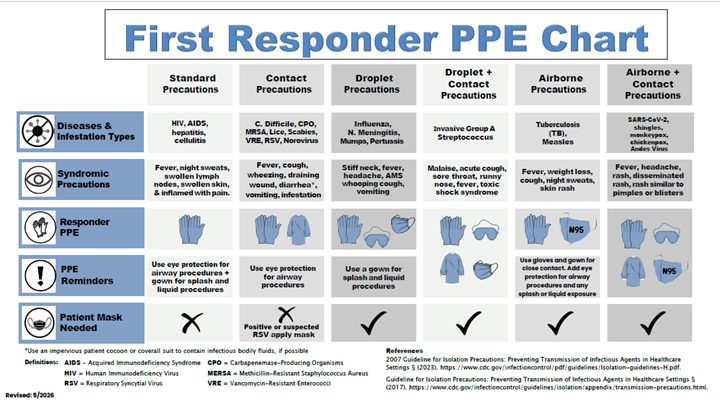
First Responder PPE Chart

Related Content

Sponsored Content: Ahead of the Call: How AACN and AI Are Giving Law Enforcement the Edge

Blog Post

The difference between a good response and a great one often starts before the first unit ever rolls.

Picture a vehicle crash on a highway overpass. Before the first 9-1-1 call is received, structured crash data is already flowing into the Emergency Communications Center: incident location, airbags deployed, number of occupants, and injury severity prediction. Is this a minor fender-bender or a high-severity event? Are there hazards on scene? Is the location precise? Answering these questions earlier changes everything about how a  response unfolds.

This is not a future-state concept. It is what Advanced Automatic Collision Notification (AACN) is making possible right now. 

At Intrado, we have spent decades focused on the 9-1-1 ecosystem. As we head to Fort Worth for the 2026 IACP Technology Conference, one thing is clear: as the Emergency Communications Center evolves, law enforcement gains greater advantages: earlier awareness, richer information, and a stronger foundation for every response. 

The ECC Is Where the Information Advantage Begins

The modern ECC is more than an answering point. It is an information hub.

For law enforcement, one of the biggest challenges in emergency response is uncertainty. Officers make split-second decisions with incomplete information, often en route to dynamic and potentially dangerous scenes.

AACN gives telecommunicators critical crash data at the outset of an incident, sometimes before a traditional 9-1-1 call is even established. Dispatchers build the incident faster. Officers receive better intelligence before they arrive. Approach decisions, scene safety, resource coordination: all of it benefits when the picture comes into focus sooner.

AACN is not just improving 9-1-1 intake. It is improving the quality of intelligence law 
enforcement receives before the first unit reaches the scene.

9-1-1, RTCCs, and RTICs: The Same Information Chain

The relationship between 9-1-1 and law enforcement does not end at dispatch. In many communities, ECCs work closely with Real-Time Crime Centers and Real-Time Information Centers, and when that partnership functions well, it creates a qualitatively different operational picture.

Think of it as layered intelligence. The ECC serves as the front door: telecommunicators gather and validate initial incident details, establishing what is happening and where. RTCCs and RTICs expand that picture, pairing ECC-sourced information with camera feeds, license plate reader data, historical call patterns, and BOLO-related intelligence.

A telecommunicator confirming a vehicle description from a 9-1-1 caller, paired with an RTCC analyst pulling camera coverage along that route, is a fundamentally different capability than either function working alone. Officers arriving with that level of awareness are better positioned to make sound decisions under pressure.

In a well-integrated system, the ECC anchors the real-time intelligence picture that law enforcement depends on.

#HumanInTheLoop: AI Should Strengthen the Human Decision-Maker

Law enforcement agencies have legitimate reasons to approach AI carefully. Questions around bias, transparency, accountability, and evidentiary integrity are not abstractions, they are operational and legal realities agencies navigate every day.

At Intrado, our position is straightforward: AI in public safety must support people, not replace them. The human stays in the loop. That is not a marketing posture, it is a design principle.

In the 9-1-1 environment, AI helps telecommunicators process information faster and surface what matters most. Real-time translation bridges language barriers without delay. Automated transcription creates a time-stamped record as the incident unfolds. Call summarization elevates critical details: location, incident type, evolving circumstances, so dispatchers move faster and officers receive cleaner dispatch notes.

None of that removes the judgment of a trained telecommunicator. It enhances it.

As Next Generation 9-1-1 capabilities expand, Incident-Related Imagery (caller-submitted photos and video) adds another dimension. For law enforcement, how that media is received, logged, and preserved inside the ECC has direct relevance to chain of custody and evidentiary integrity. AI-assisted image analysis may accelerate awareness, but human review and clear policy frameworks are essential. This is an area where 9-1-1 and law enforcement need to be thinking together.

Better Triage Means Better Deployment

High call volume, staffing strain, limited resources; every agency knows this reality. A non emergency AI agent can help identify calls better suited for online reporting, follow-up services, or community resources. That is not a reduction in service. It is smarter allocation of it.

For law enforcement, the result is direct: officers spend less time on calls that could be handled through other channels, and more time where their presence is genuinely needed.

Come Talk With Us in Fort Worth

Law enforcement, emergency communications, and RTCC and RTIC operations are tightly connected parts of the same response ecosystem. What happens at the front end shapes everything that follows. When we improve crash intelligence, strengthen the ECC-to-RTCC handoff, and apply AI responsibly, we give officers a clearer picture before they arrive and a stronger foundation for what comes next.

Communities expect positive outcomes in emergency situations, and Intrado is here to support them. With 45 years of experience, we save lives and protect communities by preparing for, responding to, and recovering from critical events. Our innovative and reliable technology connects help to those in need.

As a global leader in emergency communication services, we partner with first responders to ensure the right help reaches the right place quickly. Always there in an emergency, we are Intrado.

We look forward to connecting with you in Ft. Worth!

IACP and Axon Name Minneapolis Finalists As Police Officers of the Year

POY award background
Blog Post

The International Association of Chiefs of Police (IACP) and Axon Police Officer of the Year Award is designed to recognize and honor police officers who have demonstrated exceptional valor, bravery, and dedication in the line of duty.

This award highlights officers who have gone above and beyond the call of duty, often in life-threatening or high-risk situations, to protect the public, uphold justice, and demonstrate unwavering commitment to their communities.

The IACP/Axon Police Office of the Year Award seeks to inspire excellence within the policing profession by celebrating acts of heroism, leadership, and exemplary service.

The IACP and Axon honors Officer Jamal Mitchell (Posthumous), Officer Nicholas Kapinos, Officer Luke Kittock, and Officer Eric Withanom of the Minneapolis, Minnesota, Police Department as the 2025 Police Officers of the Year. 

2025 POY Recipients - Minneapolis PD

Pictured below from left to right: Officer Nicholas Kapinos; Chief Brian O'Hara; Tori Myslajek, Fiancée to Officer Jamal Mitchell (Posthumous); Officer Luke Kittock; and Officer Eric Withanom.

On May 30, 2024, the Minneapolis Police Department received a call that two males had been found deceased inside an apartment with apparent gunshot wounds to the head. After fleeing from the scene, the suspect began randomly assaulting pedestrians. In an attempt to rob a male of his scooter, another community member intervened by striking the suspect with his car and breaking his leg.

Officer Jamal Mitchell was the first to arrive and saw two people that needed immediate medical assistance. He approached an injured male, who he believed to be a victim, but was in fact the suspect. The suspect then produced a handgun and fired, striking Officer Mitchell several times. As firefighters arrived, the suspect concealed his weapon and attempted to lure them to assist him. When they hesitated in their approach, the suspect opened fire, prompting the firefighters to take cover and notify dispatch.

Officers Luke Kittock and Eric Withanom arrived at the scene and were immediately met with the suspect's gunfire. Officer Kittock deployed his patrol rifle while Officer Withanom used a ballistic shield to protect themselves and the firefighters. Officer Kittock discharged his rifle at the suspect several times and eventually stopped the threat, despite sustaining a facial injury. When Officer Nicholas Kapinos arrived amid the gunfire, he did not hesitate to return fire and provide cover for the officers rendering aid to Officer Mitchell.

Tragically, Officer Mitchell succumbed to his injuries that day, and his family and the Minneapolis Police Department continue to grieve the loss. Because of their bravery and willingness to run toward the gunfire, these four officers protected the community and prevented additional people from losing their lives.

Watch the Incredible Stories of the 2025 Winners.

Blog Post
SHARE

Please sign in to read and get access to more member only content.

IACP - Loader Animation IACP - Loader Animation IACP - Loader Animation
Ask Cris
x Ask Cris

Hi, I'm CRIS!

I'm IACP's AI Knowledge Assistant--here to help you find what you need, fast. I'm trained solely on IACP content and can chat in multiple languages. Ask me anything, and I'll guide you through the wealth of information available.

You are currently using a limited version of CRIS. Unlock its full potential by logging into your member account. Not a member yet? Check out our Membership Page for more information!